


Severe Maternal Morbidity Among Hispanic Women in New York City: Investigation of Health Disparities
- PMID: 28079772
- PMCID: PMC5380443
- DOI: 10.1097/AOG.0000000000001864
Severe Maternal Morbidity Among Hispanic Women in New York City: Investigation of Health Disparities
Abstract
Objective: To investigate differences in severe maternal morbidity between Hispanic mothers and three major Hispanic subgroups compared with non-Hispanic white mothers and the extent to which differences in delivery hospitals may contribute to excess morbidity among Hispanic mothers.
Methods: We conducted a population-based cross-sectional study using linked 2011-2013 New York City discharge and birth certificate data sets (n=353,773). Rates of severe maternal morbidity were calculated using a published algorithm based on diagnosis and procedure codes. Mixed-effects logistic regression with a random hospital-specific intercept was used to generate risk-standardized severe maternal morbidity rates for each hospital taking into consideration patient sociodemographic characteristics and comorbidities. Differences in the distribution of Hispanic and non-Hispanic white deliveries were assessed among these hospitals in relation to their risk-adjusted morbidity. Sensitivity analyses were conducted after excluding isolated blood transfusion from the morbidity composite.
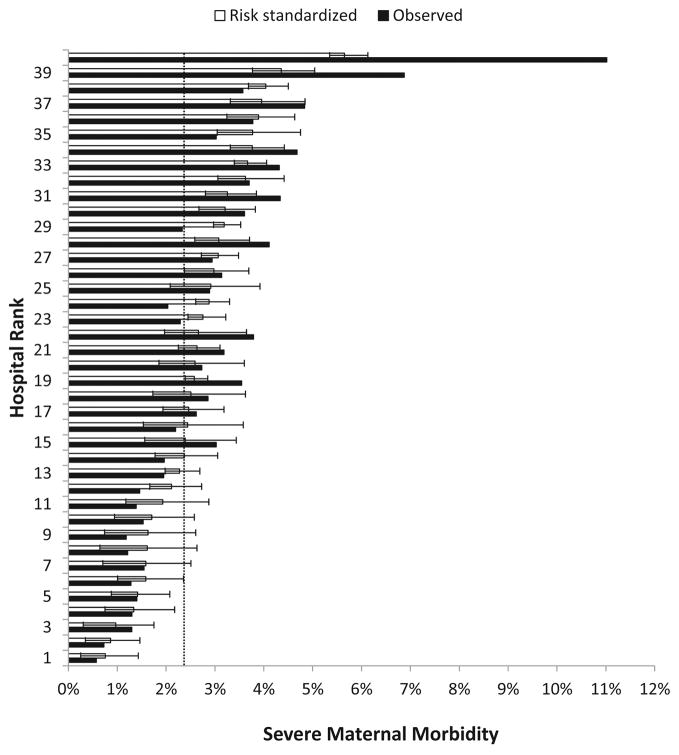
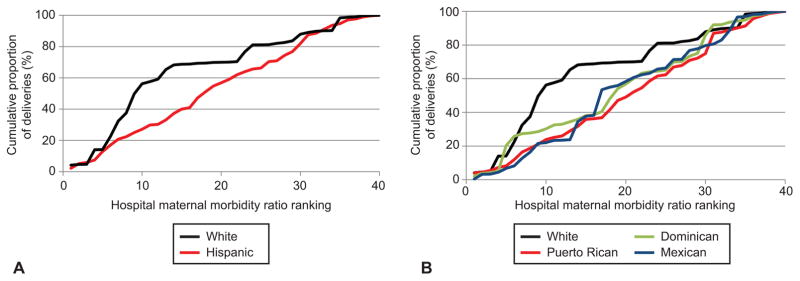
Results: Severe maternal morbidity occurred in 4,541 deliveries and was higher among Hispanic than non-Hispanic white women (2.7% compared with 1.5%, P<.001); this rate was 2.9% among those who were Puerto Rican, 2.7% among those who were foreign-born Dominican, and 3.3% among those who were foreign-born Mexican. After adjustment for patient characteristics, the risk remained elevated for Hispanic women (odds ratio [OR] 1.42, 95% confidence interval [CI] 1.22-1.66) and for all three subgroups compared with non-Hispanic white women (P<.001). Risk for Hispanic women was attenuated in sensitivity analyses (OR 1.17, 95% CI 1.02-1.33). Risk-standardized morbidity across hospitals varied sixfold. We estimate that Hispanic-non-Hispanic white differences in delivery location may contribute up to 37% of the ethnic disparity in severe maternal morbidity rates in New York City hospitals.
Conclusion: Hispanic compared with non-Hispanic white mothers are more likely to deliver at hospitals with higher risk-adjusted severe maternal morbidity rates and these differences in site of delivery may contribute to excess morbidity among Hispanic mothers. Our results suggest improving quality at the lowest performing hospitals could benefit both non-Hispanic white and Hispanic women and reduce ethnic disparities in severe maternal morbidity rates.
Figures
References
-
- New York City Department of Health and Mental Hygiene Bureau of Maternal IaRH. Pregnancy-Associated Mortality New York City, 2006–2010. New York: 2015.
-
- Kuklina EV, Whiteman MK, Hillis SD, et al. An enhanced method for identifying obstetric deliveries: implications for estimating maternal morbidity. Matern Child Health J. 2008 Jul;12(4):469–477. - PubMed
MeSH terms
Grants and funding
LinkOut - more resources
Full Text Sources
Other Literature Sources
Medical
