


Performance of Hispanics and Non-Hispanic Whites on the NIH Toolbox Cognition Battery: the roles of ethnicity and language backgrounds
- PMID: 28080261
- PMCID: PMC5497573
- DOI: 10.1080/13854046.2016.1276216
Performance of Hispanics and Non-Hispanic Whites on the NIH Toolbox Cognition Battery: the roles of ethnicity and language backgrounds
Abstract
Objective: This study examined the influence of Hispanic ethnicity and language/cultural background on performance on the NIH Toolbox Cognition Battery (NIHTB-CB).
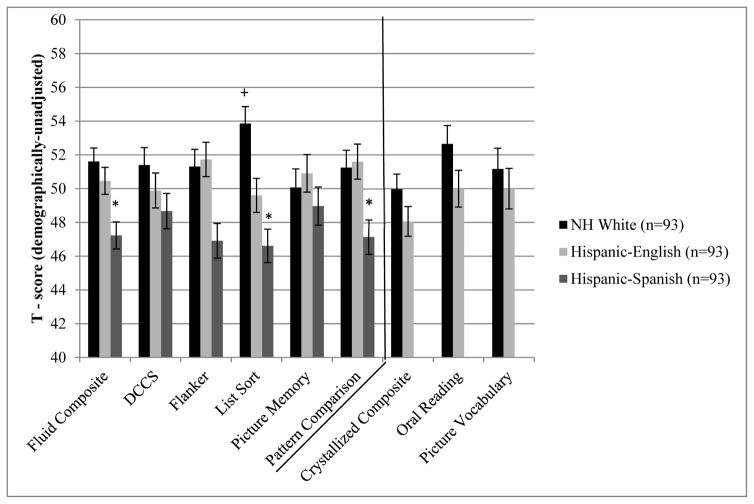
Method: Participants included healthy, primarily English-speaking Hispanic (n = 93; Hispanic-English), primarily Spanish-speaking Hispanic (n = 93; Hispanic-Spanish), and English speaking Non-Hispanic white (n = 93; NH white) adults matched on age, sex, and education levels. All participants were in the NIH Toolbox national norming project and completed the Fluid and Crystallized components of the NIHTB-CB. T-scores (demographically-unadjusted) were developed based on the current sample and were used in analyses.
Results: Spanish-speaking Hispanics performed worse than English-speaking Hispanics and NH whites on demographically unadjusted NIHTB-CB Fluid Composite scores (ps < .01). Results on individual measures comprising the Fluid Composite showed significant group differences on tests of executive inhibitory control (p = .001), processing speed (p = .003), and working memory (p < .001), but not on tests of cognitive flexibility or episodic memory. Test performances were associated with language/cultural backgrounds in the Hispanic-Spanish group: better vocabularies and reading were predicted by being born outside the U.S., having Spanish as a first language, attending school outside the U.S., and speaking more Spanish at home. However, many of these same background factors were associated with worse Fluid Composites within the Hispanic-Spanish group.
Conclusions: On tests of Fluid cognition, the Hispanic-Spanish group performed the poorest of all groups. Socio-demographic and linguistic factors were associated with those differences. These findings highlight the importance of considering language/cultural backgrounds when interpreting neuropsychological test performances. Importantly, after applying previously published NIHTB-CB norms with demographic corrections, these language/ethnic group differences are eliminated.
Keywords: Acculturation; cognition; cultural aspects; language; toolbox.
Figures
References
-
- Altarriba J, Heredia RR, editors. An introduction to bilingualism: Principles and processes. Taylor & Francis; 2008.
-
- Armengol CG. Executive functions in Hispanics: Towards an ecological neuro-psychology. International handbook of cross-cultural neuropsychology. 2007:163–180.
-
- Ardila A. Cultural values underlying psychometric cognitive testing. Neuropsychology review. 2005;15(4):185–195. - PubMed
-
- Arnold BR, Montgomery GT, Castañeda I, Longoria R. Acculturation and performance of Hispanics on selected Halstead-Reitan neuropsychological tests. Assessment. 1994;1(3):239–248.
-
- Artiola I Fortuny L, Heaton RK, Hermosillo D. Neuropsychological comparisons of Spanish-speaking participants from the U.S.-Mexico border region versus Spain. Journal of the International Neuropsychological Society. 1998;4:363–379. - PubMed
Publication types
MeSH terms
Grants and funding
LinkOut - more resources
Full Text Sources
Other Literature Sources