Review
. 2016 Dec 5;371(1709):20150462.
doi: 10.1098/rstb.2015.0462.

Medical mycology and fungal immunology: new research perspectives addressing a major world health challenge

Affiliations
Review

Medical mycology and fungal immunology: new research perspectives addressing a major world health challenge

Neil A R Gow et al. Philos Trans R Soc Lond B Biol Sci. .

Abstract

Fungi cause more than a billion skin infections, more than 100 million mucosal infections, 10 million serious allergies and more than a million deaths each year. Global mortality owing to fungal infections is greater than for malaria and breast cancer and is equivalent to that owing to tuberculosis (TB) and HIV. These statistics evidence fungal infections as a major threat to human health and a major burden to healthcare budgets worldwide. Those patients who are at greatest risk of life-threatening fungal infections include those who have weakened immunity or have suffered trauma or other predisposing infections such as HIV. To address these global threats to human health, more research is urgently needed to understand the immunopathology of fungal disease and human disease susceptibility in order to augment the advances being made in fungal diagnostics and drug development. Here, we highlight some recent advances in basic research in medical mycology and fungal immunology that are beginning to inform clinical decisions and options for personalized medicine, vaccine development and adjunct immunotherapies.This article is part of the themed issue 'Tackling emerging fungal threats to animal health, food security and ecosystem resilience'.

Keywords: fungal cell wall; fungal infection; genetic susceptibility; immune recognition; microbiome.


Figures

Figure 1.
Figure 1.
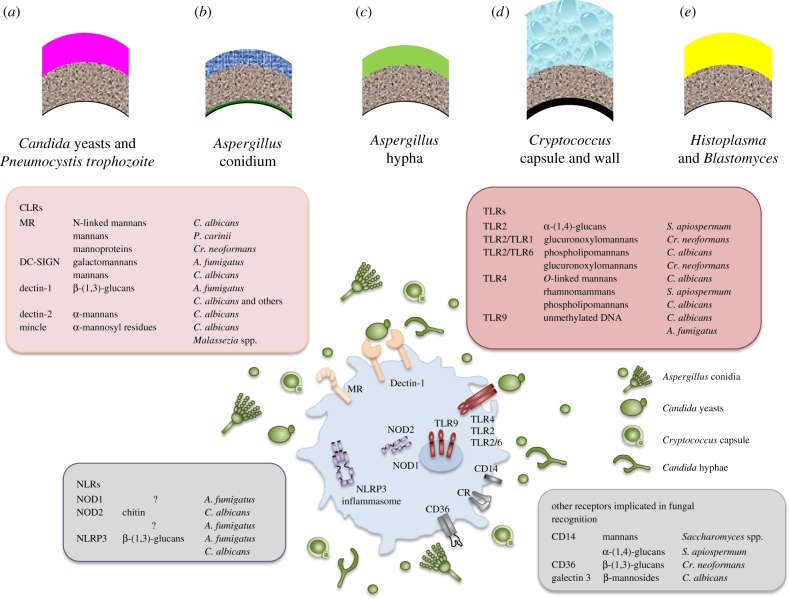
Immune recognition of fungi and their cell walls. (a–e) The cell wall structure of a range of fungal pathogens. The conserved inner wall (grey) is composed mainly of β-1,3-glucan and chitin (lacking in the Pneumocystis wall). The outer wall is predominantly of mannan (Candida, pink); hydrophobins, melanin and α-glucan (Aspergillus conidium, dark blue) and galactomannan and galactosaminoglycan (Aspergillus hypha, green); capsular glucuronoxylomannan, galactoxylomannan (Cryptococcus, light blue) or α-glucan (Histoplasma and Blastomyces, yellow). PAMP–PRR interactions for fungal cell recognition are shown above. Organism names are as in the text, S. apiospermum = Scedosporium apiospermum. The figure was provided by Dr Jeanette Wagener.
Figure 2.
Figure 2.
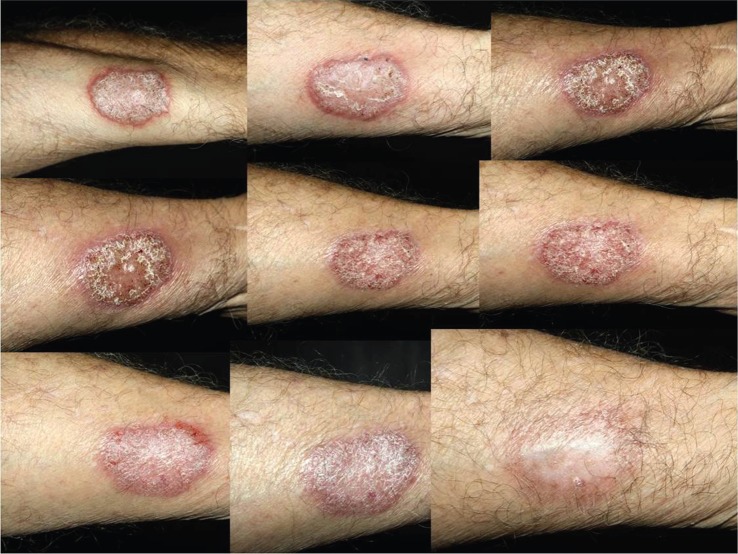
Treatment of chromoblastomycosis from time 0 to 20 months' application of topical imiquimod 5% plus itraconazole 200 mg day−1 [9]. With thanks to Paulo R. Criado and Walter B. Júnior and G. de Sousa.
Figure 3.
Figure 3.
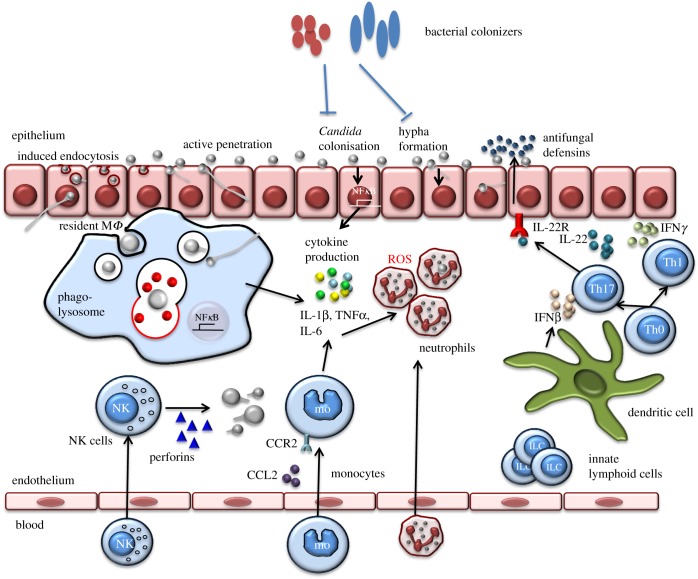
Microbiomes and immunology. Direct and indirect influences of the microbiome on the physiology of fungal pathogen growth and the innate immune response as described in the text. In short, colonization with Candida does not induce the production of cytokines. Upon invasion, Candida activates tissue macrophages to induce production of chemokines and cytokines. This, in turn, will recruit and activate other immune cells from the bloodstream, such as monocytes or neutrophils that will ingest and kill the pathogens. Activations of dendritic cells will also lead to antigen presentation and activation of T-helper responses that, in turn, will aid pathogen elimination. CCR2, chemokine receptor type 2; CCL2, chemokine (C–C motif) ligand 2; NK = natural killer cell; ROS, reactive oxygen species.

References

    1. Casadevall A, Pirofski LA. 2003. The damage-response framework of microbial pathogenesis. Nat. Rev. Microbiol. 1, 17–24. (10.1038/nrmicro732) - DOI - PMC - PubMed
    1. Brown GD, Denning DW, Gow NAR, Levitz SM, Netea MG, White TC. 2012. Hidden killers: human fungal infections. Sci. Transl. Med. 19, 165rv13. (10.1126/scitranslmed.3004404) - DOI - PubMed
    1. Netea MG, Brown GD, Kullberg BJ, Gow NAR. 2008. An integrated model of the recognition of Candida albicans by the innate immune system. Nat. Rev. Microbiol. 6, 67–78. (10.1038/nrmicro1815) - DOI - PubMed
    1. Gow NAR, van de Veerdonk FL, Brown AJ, Netea MG. 2011. Candida albicans morphogenesis and host defence: discriminating invasion from colonization. Nat. Rev. Microbiol. 10, 112–122. (10.1038/nrmicro2711) - DOI - PMC - PubMed
    1. Erwig LP, Gow NAR. 2016. Interactions of fungal pathogens with phagocytes. Nat. Rev. Microbiol. 14, 163–176. (10.1038/nrmicro.2015.21) - DOI - PubMed

Publication types