


Preschool Neurodevelopmental Outcomes in Children with Congenital Heart Disease
- PMID: 28081891
- PMCID: PMC5368010
- DOI: 10.1016/j.jpeds.2016.12.044
Preschool Neurodevelopmental Outcomes in Children with Congenital Heart Disease
Abstract
Objective: To describe preschool neurodevelopmental outcomes of children with complex congenital heart disease (CHD), who were evaluated as part of a longitudinal cardiac neurodevelopmental follow-up program, as recommended by the American Heart Association and the American Academy of Pediatrics, and identify predictors of neurodevelopmental outcomes in these children.
Study design: Children with CHD meeting the American Heart Association/American Academy of Pediatrics high-risk criteria for neurodevelopmental delay were evaluated at 4-5 years of age. Testing included standardized neuropsychological measures. Parents completed measures of child functioning. Scores were compared by group (single ventricle [1V]; 2 ventricles [2V]; CHD plus known genetic condition) to test norms and classified as: normal (within 1 SD of mean); at risk (1-2 SD from mean); and impaired (>2 SD from mean).
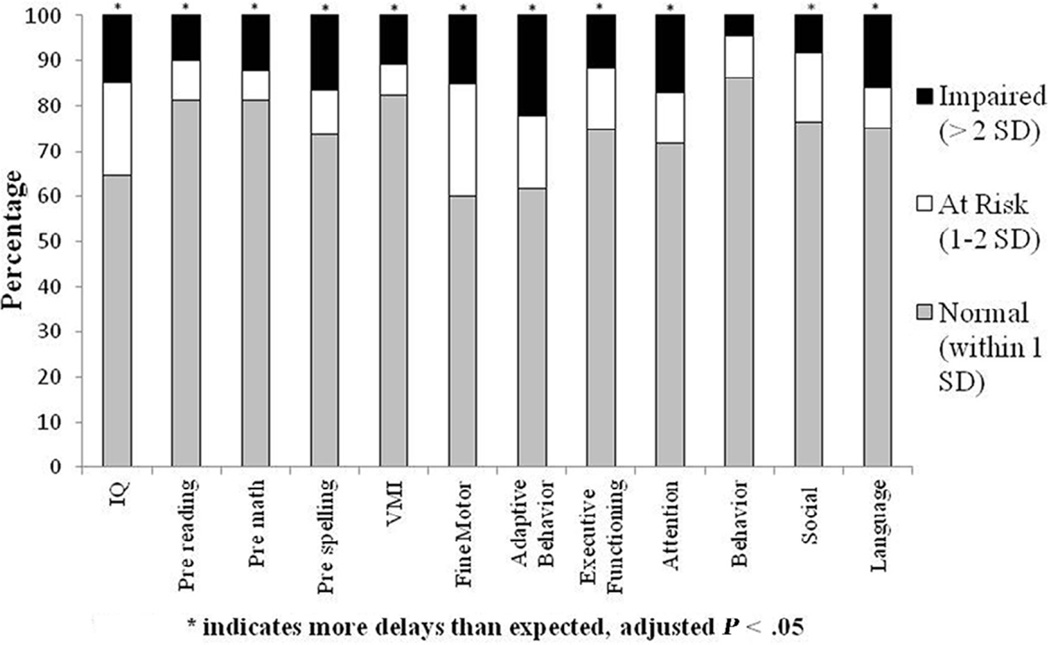
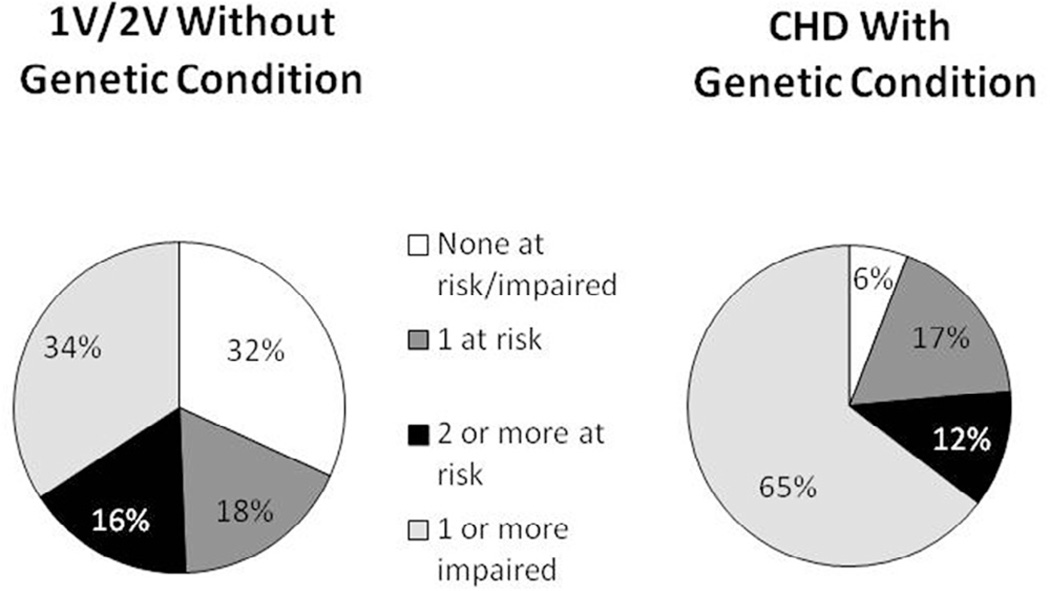
Results: Data on 102 patients were analyzed. Neurodevelopmental scores did not differ based on cardiac anatomy (1V vs 2V); both groups scored lower than norms on fine motor and adaptive behavior skills, but were within 1 SD of norms. Patients with genetic conditions scored significantly worse than 1V and 2V groups and test norms on most measures.
Conclusions: Children with CHD and genetic conditions are at greatest neurodevelopmental risk. Deficits in children with CHD without genetic conditions were mild and may not be detected without formal longitudinal testing. Parents and providers need additional education regarding the importance of developmental follow-up for children with CHD.
Keywords: assessment and surveillance; child development; congenital heart disease/defects; developmental follow-up; developmental outcomes.
Copyright © 2016 Elsevier Inc. All rights reserved.
Conflict of interest statement
The authors declare no conflicts of interest.
Figures
References
-
- Marino BS, Lipkin PH, Newburger JW, Peacock G, Gerdes M, Gaynor JW, et al. Neurodevelopmental outcomes in children with congenital heart disease: evaluation and management: a scientific statement from the American Heart Association. Circulation. 2012;126:1143–1172. - PubMed
-
- Sananes R, Manlhiot C, Kelly E, Hornberger LK, Williams WG, MacGregor D, et al. Neurodevelopmental outcomes after open heart operations before 3 months of age. Ann Thorac Surg. 2012;93:1577–1583. - PubMed
-
- Alton G, Taghados S, Joffe A, Robertson C, Dinu I The Western Canadian Pediatric Therapies Follow-Up Group. Prediction of preschool functional abilities after early complex cardiac surgery. Cardiol Young. 2015;25:655–662. - PubMed
Publication types
MeSH terms
Grants and funding
LinkOut - more resources
Full Text Sources
Other Literature Sources
Medical
