


The Built Environment and Cognitive Disorders: Results From the Cognitive Function and Ageing Study II
- PMID: 28082001
- PMCID: PMC5478362
- DOI: 10.1016/j.amepre.2016.11.020
The Built Environment and Cognitive Disorders: Results From the Cognitive Function and Ageing Study II
Abstract
Introduction: Built environment features have been related to behavior modification and might stimulate cognitive activity with a potential impact on cognitive health in later life. This study investigated cross-sectional associations between features of land use and cognitive impairment and dementia, and also explored urban and rural differences in these associations.
Methods: Postcodes of the 7,505 community-based participants (aged ≥65 years) in the Cognitive Function and Ageing Study II (collected in 2008-2011) were linked to environmental data from government statistics. Multilevel logistic regression investigated associations between cognitive impairment (defined as Mini-Mental State Examination score ≤25) and dementia (Geriatric Mental Status and Automatic Geriatric Examination for Computer-Assisted Taxonomy organicity level ≥3) and land use features, including natural environment availability and land use mix, fitting interaction terms with three rural/urban categories. Data were analyzed in 2015.
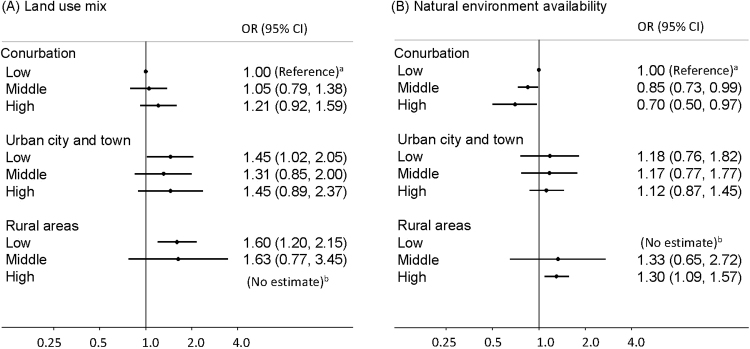
Results: Associations between features of land use and cognitive impairment were not linear. After adjusting for individual-level factors and area deprivation, living in areas with high land use mix was associated with a nearly 30% decreased odds of cognitive impairment (OR=0.72, 95% CI=0.58, 0.89). This was similar, yet non-significant, for dementia (OR=0.70, 95% CI=0.46, 1.06). In conurbations, living in areas with high natural environment availability was associated with 30% reduced odds of cognitive impairment (OR=0.70, 95% CI=0.50, 0.97).
Conclusions: Non-linear associations between features of land use and cognitive impairment were confirmed in this new cohort of older people in England. Both lack of and overload of environmental stimulation may be detrimental to cognition in later life.
Copyright © 2017 American Journal of Preventive Medicine. Published by Elsevier Inc. All rights reserved.
Figures
References
-
- WHO . WHO; Geneva: 2012. Dementia: A Public Health Priority.
-
- Blazer D.G., Yaffe K., Liverman C.T. National Academy of Medicine; Washington, DC: 2015. Cognitive Aging: Progress in Understanding and Opportunities for Action. - PubMed
-
- Wu Y.-T., Fratiglioni L., Matthews F.E. Dementia in Western Europe: epidemiological evidence and implications for policy making. Lancet Neurol. 2016;15(1):116–124. - PubMed
-
- Farrow M. Alzheimer’s Australia; Canberra: 2010. An Australia Government Initiative. Towards a Dementia Prevention Policy for Australia: Implications of the Current Evidence.
-
- Alzheimer’s Disease International . Alzheimer’s Disease International; London: 2012. Policy Brief—Risk Factors for Dementia.
MeSH terms
Grants and funding
LinkOut - more resources
Full Text Sources
Other Literature Sources
Medical
