Hydrogel versus Bare Platinum Coils in Patients with Large or Recurrent Aneurysms Prone to Recurrence after Endovascular Treatment: A Randomized Controlled Trial
- PMID: 28082261
- PMCID: PMC7960015
- DOI: 10.3174/ajnr.A5101
Hydrogel versus Bare Platinum Coils in Patients with Large or Recurrent Aneurysms Prone to Recurrence after Endovascular Treatment: A Randomized Controlled Trial
Abstract
Background and purpose: Some patients are at high risk of aneurysm recurrence after endovascular treatment: patients with large aneurysms (Patients Prone to Recurrence After Endovascular Treatment PRET-1) or with aneurysms that have previously recurred after coiling (PRET-2). We aimed to establish whether the use of hydrogel coils improved efficacy outcomes compared with bare platinum coils.
Materials and methods: PRET was an investigator-led, pragmatic, multicenter, parallel, randomized (1:1) trial. Randomized allocation was performed separately for patients in PRET-1 and PRET-2, by using a Web-based platform ensuring concealed allocation. The primary outcome was a composite of a residual/recurrent aneurysm, adjudicated by a blinded core laboratory, or retreatment, intracranial bleeding, or mass effect during the 18-month follow-up. Secondary outcomes included adverse events, mortality, and morbidity (mRS > 2). The hypothesis was that hydrogel would decrease the primary outcome from 50% to 30% at 18 months, necessitating 125 patients per group (500 for PRET-1 and PRET-2).
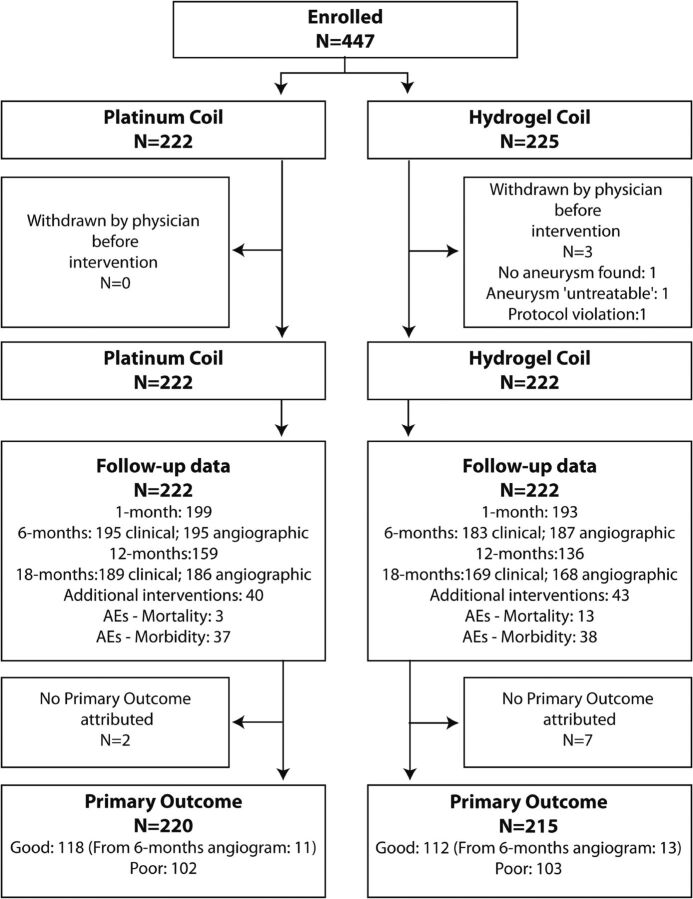
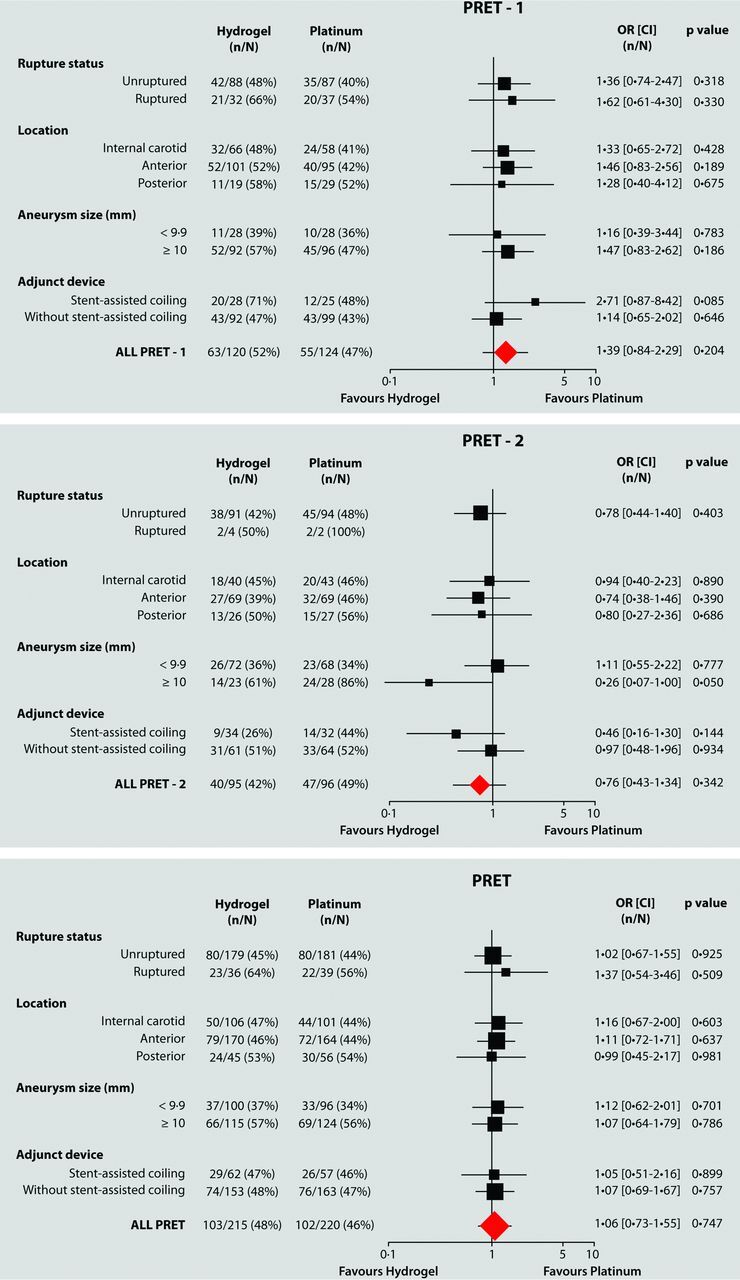
Results: The trial was stopped once 250 patients in PRET-1 and 197 in PRET-2 had been recruited because of slow accrual. A poor primary outcome occurred in 44.4% (95% CI, 35.5%-53.2%) of those in PRET-1 allocated to platinum compared with 52.5% (95% CI, 43.4%-61.6%) of patients allocated to hydrogel (OR, 1.387; 95% CI, 0.838-2.295; P = .20) and in 49.0% (95% CI, 38.8%-59.1%) in PRET-2 allocated to platinum compared with 42.1% (95% CI, 32.0%-52.2%) allocated to hydrogel (OR, 0.959; 95% CI, 0.428-1.342; P = .34). Adverse events and morbidity were similar. There were 3.6% deaths (1.4% platinum, 5.9% hydrogel; P = .011).
Conclusions: Coiling of large and recurrent aneurysms is safe but often poorly effective according to angiographic results. Hydrogel coiling was not shown to be better than platinum.
© 2017 by American Journal of Neuroradiology.
Figures
References
-
- Molyneux A, Kerr R, Stratton I, et al. ; International Subarachnoid Aneurysm Trial (ISAT) Collaborative Group. International Subarachnoid Aneurysm Trial (ISAT) of neurosurgical clipping versus endovascular coiling in 2143 patients with ruptured intracranial aneurysms: a randomised trial. Lancet 2002;360:1267–74 10.1016/S0140-6736(02)11314-6 - DOI - PubMed
-
- Raymond J, Molyneux AJ, Fox AJ, et al. ; TEAM Collaborative Group. The TEAM trial: safety and efficacy of endovascular treatment of unruptured intracranial aneurysms in the prevention of aneurysmal hemorrhages: a randomized comparison with indefinite deferral of treatment in 2002 patients followed for 10 years. Trials 2008;9:43 10.1186/1745-6215-9-43 - DOI - PMC - PubMed
Publication types
MeSH terms
Substances
LinkOut - more resources
Full Text Sources
Other Literature Sources
Medical