. 2017 Feb 1;9(2):323-339.
doi: 10.1093/gbe/evw292.

Molecular Evolution of piggyBac Superfamily: From Selfishness to Domestication

Affiliations

Molecular Evolution of piggyBac Superfamily: From Selfishness to Domestication

Maryem Bouallègue et al. Genome Biol Evol. .

Abstract

The piggyBac transposable element was originally isolated from the cabbage looper moth, Trichoplusia ni, in the 1980s. Despite its early discovery and specificity compared to the other Class II elements, the diversity and evolution of this superfamily have been only partially analyzed. Two main types of elements can be distinguished: the piggyBac-like elements (PBLE) with terminal inverted repeats, untranslated region, and an open reading frame encoding a transposase, and the piggyBac-derived sequences (PGBD), containing a sequence derived from a piggyBac transposase, and which correspond to domesticated elements. To define the distribution, their structural diversity and phylogenetic relationships, analyses were conducted using known PBLE and PGBD sequences to scan databases. From this data mining, numerous new sequences were characterized (50 for PBLE and 396 for PGBD). Structural analyses suggest that four groups of PBLE can be defined according to the presence/absence of sub-terminal repeats. The transposase is characterized by highly variable catalytic domain and C-terminal region. There is no relationship between the structural groups and the phylogeny of these PBLE elements. The PGBD are clearly structured into nine main groups. A new group of domesticated elements is suspected in Neopterygii and the remaining eight previously described elements have been investigated in more detail. In all cases, these sequences are no longer transposable elements, the catalytic domain of the ancestral transposase is not always conserved, but they are under strong purifying selection. The phylogeny of both PBLE and PGBD suggests multiple and independent domestication events of PGBD from different PBLE ancestors.

Keywords: domestication; molecular evolution; piggyBac; transposable element.


Figures

F<sc>ig</sc>. 1.—
Fig. 1.—
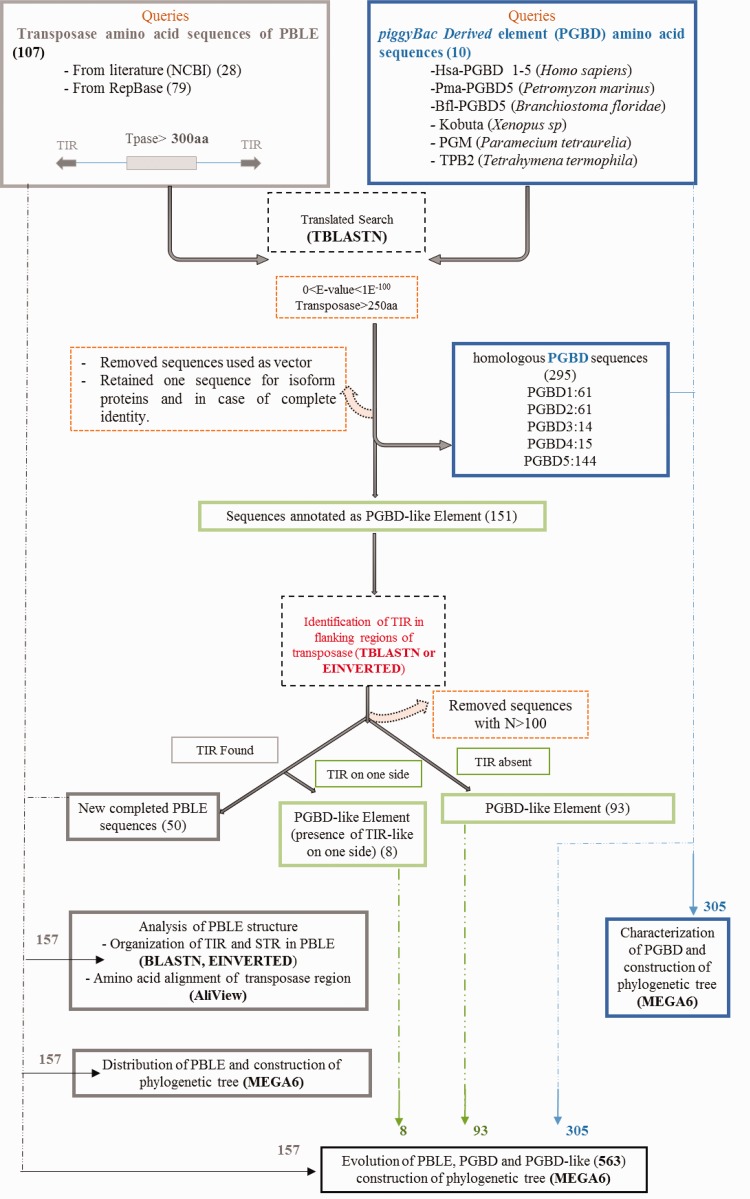
Data mining of piggyBac element. Search of elements belonging to the piggyBac superfamily was done using known copies (literature or database) as BLAST queries. Ten PGBD and 107 PBLE copies were used as queries. After a first run, 295 sequences annotated as PGBD (PGBD1, 2, 3, 4, and 5) and 151 new sequences, annotated as PGBD-like element, belonging to 58 species were retrieved. TIR were looked for in the 5′ and 3′ flanking regions (5 kb in both directions) of these new sequences. Fifty of them were found with two TIR and 101 with one (5′ or 3′) or no TIR. In fine, a total of 563 sequences were available. The sequences with more than 100 N were eliminated.
F<sc>ig</sc>. 2.—
Fig. 2.—
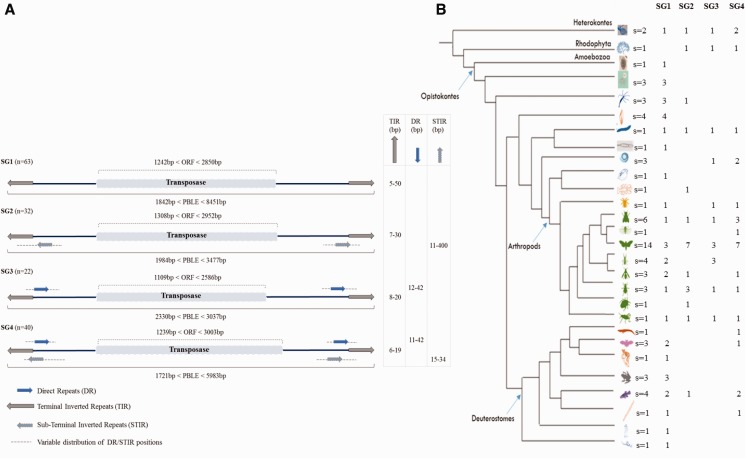
Structure of PBLEs and their distribution among species. (A) According to the presence/absence of DR and STIRs, four groups of PBLE were proposed (from SG1 to SG4). The number of sequences (n) in each group is given in brackets. (B) Specific distribution of the four SGs. The number of species (s) is given for each branch of the phylogenetic tree and according to each structure. Involved species (Heterokontes, Rhodophyta, Amoebozoa, and Opistokontes) are detailed, from the top down, as follows: [Phytophthora infestans, P. ramorum], [Chondrus crispus], [Entamoeba invadens], [Paracoccidioides brasiliensis, Mucor circinelloides, Nosema apis], [Acropora millepora, Hydra magnipapillata, Nematostella vectensis], [Aplysia californica, Biomphalaria glabrata, Crassostrea gigas, Lingula anatina], [Schmidtea mediterranea], [Adineta vaga], [Ancylostoma ceylanicum, Haemonchus contortus, Trichinella spiralis], [Branchipoda crustacean], [Lepeophtheirus salmonis], [Stegodyphus mimosarum], [Aedes aegypti, Anopheles gambiae, Drosophila ananassae, D. biarmipes, D. bipectinata, D. eugracilis], [Mengenilla moldrzyki], [Anticarsia gemmatalis, Agrotis ipsilon, Amyelois transitella, Bombyx mori, Ctenoplusia agnata, Chilo suppressalis, Helicoverpa armigera, Heliconius melpomene, Heliothis virescens, Macdunnoughia crassisigna, Pectinophora gossypiella, Papilio xuthus, Spodoptera frugiperda, Trichoplusia ni], [Cerapachys biroi, Orussus abietinus, Solenopsis invicta, Vollenhovia emeryi], [Athalia rosae, Megachile rotundata, Nasonia vitripennis], [Aphis gossypii, Acyrthosiphon pisum, Diaphorina citri], [Tribolium castaneum], [Locusta migratoria], [Alligator mississippiensis], [Myotis davidii, Myotis lucifugus, Pteropus vampyrus], [Microcebus murinus], [Xenopus borealis, X. laevis, X. tropicalis], [Fundulus heteroclitus, Latimeria chalumnae, Oreochromis niloticus, Salmo salar], [Branchiostoma floridae], [Ciona intestinalis], [Saccoglossus kowalevskii].
F<sc>ig</sc>. 3.—
Fig. 3.—
Phylogenetic tree of PBLE. This phylogeny is based on amino-acid sequences covering about 237 residues (the alignment is given in supplementary material S3, Supplementary Material online). For simplicity, only 29 sequences are represented, but the complete tree is available in supplementary material S7, Supplementary Material online. After a search of the best evolutionary scenario (ProTest 2.4), this unrooted tree was generated in MEGA6 with the maximum likelihood (ML) method, using LG + F + G matrix. Only bootstrapping values (100 replications) higher than 70% are mentioned on the branch. Red dots, green squares, yellow lozenges and blue triangles refer to the different SGs, that is, SG1, SG2, SG3, and SG4, respectively. Sequence names: the term PBLE (piggyBac-Like Element) is used for sequences extracted from literature, or copies newly characterized in this study, while the term piggyBac is restricted to sequences extracted from Repbase (real name of these sequences in this database).
F<sc>ig</sc>. 4.—
Fig. 4.—
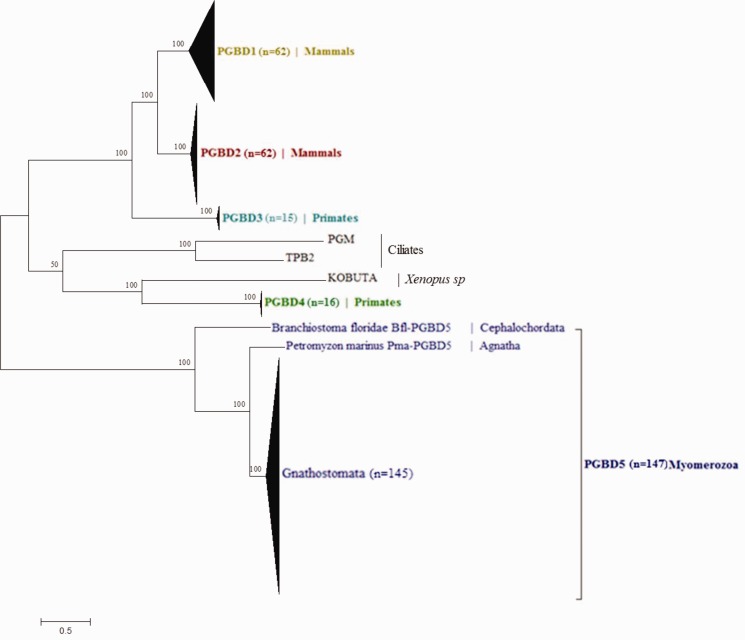
Phylogenetic tree of ‘domesticated’ elements. This phylogenetic tree comprises 10 PGBDs used as queries, including Human PGBD (Hsa-PGBD1, 2, 3, 4, 5), two orthologous to PGBD5 of Humans, namely Pma from the agnathe Petromyzon marinus and Bfl from the cephalochordate Branchiostoma floridae, Tetrahymena thermophila (TPB2) and Paramecium tetraurelia (PGM) piggyMac, KOBUTA from Xenopus sp, and 295 homologous PGBD sequences including 61 PGBD1, 61 PGBD2, 14 PGBD3, 15 PGBD4 and 144 PGBD5 sequences. Conserved transposase regions including 240 residues (see supplementary material S4, Supplementary Material online) were used to generate a maximum likelihood (ML) tree with LG + F + G matrix (best evolutionary scenario proposed by Protest 2.4). The number of sequences in the PGBDs groups is given in brackets.
F<sc>ig</sc>. 5.—
Fig. 5.—
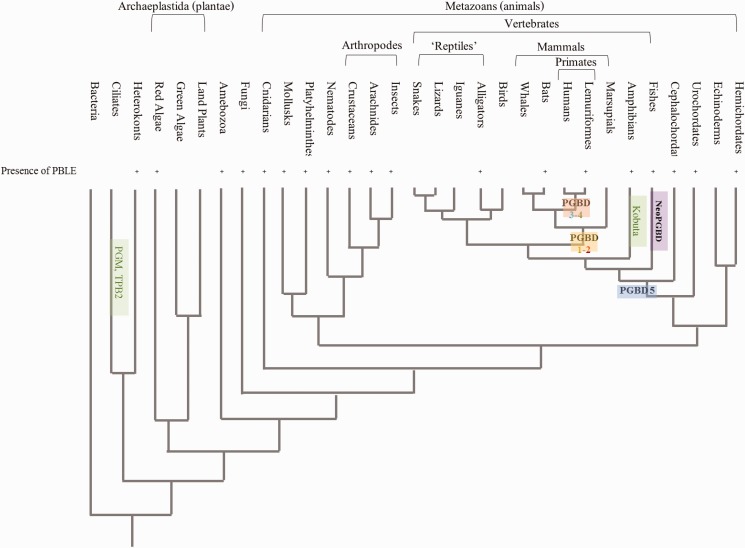
Distribution of PGBD sequences in eukaryotes. Each domesticated group of elements is highlighted by specific colors. PGBD1 and PGBD2 are found in mammals, PGBD3 and PGBD4 in primates, PGBD5 present a large spectrum of species belonging to Myomerozoa (including cephalochordates and all vertebrates). NeoPGBD is only specific to teleost fishes (Actinopterygii). TPB2 and PGM are found in ciliates and KOBUTA in Xenopus sp. The presence of PBLE elements is mentioned by “+”. The general phylogeny used here is redrawn from ref. http://www.talkorigins.org/faqs/comdesc/phylo.html#fig1 and has been modified to add some organisms.
F<sc>ig</sc>. 6.—
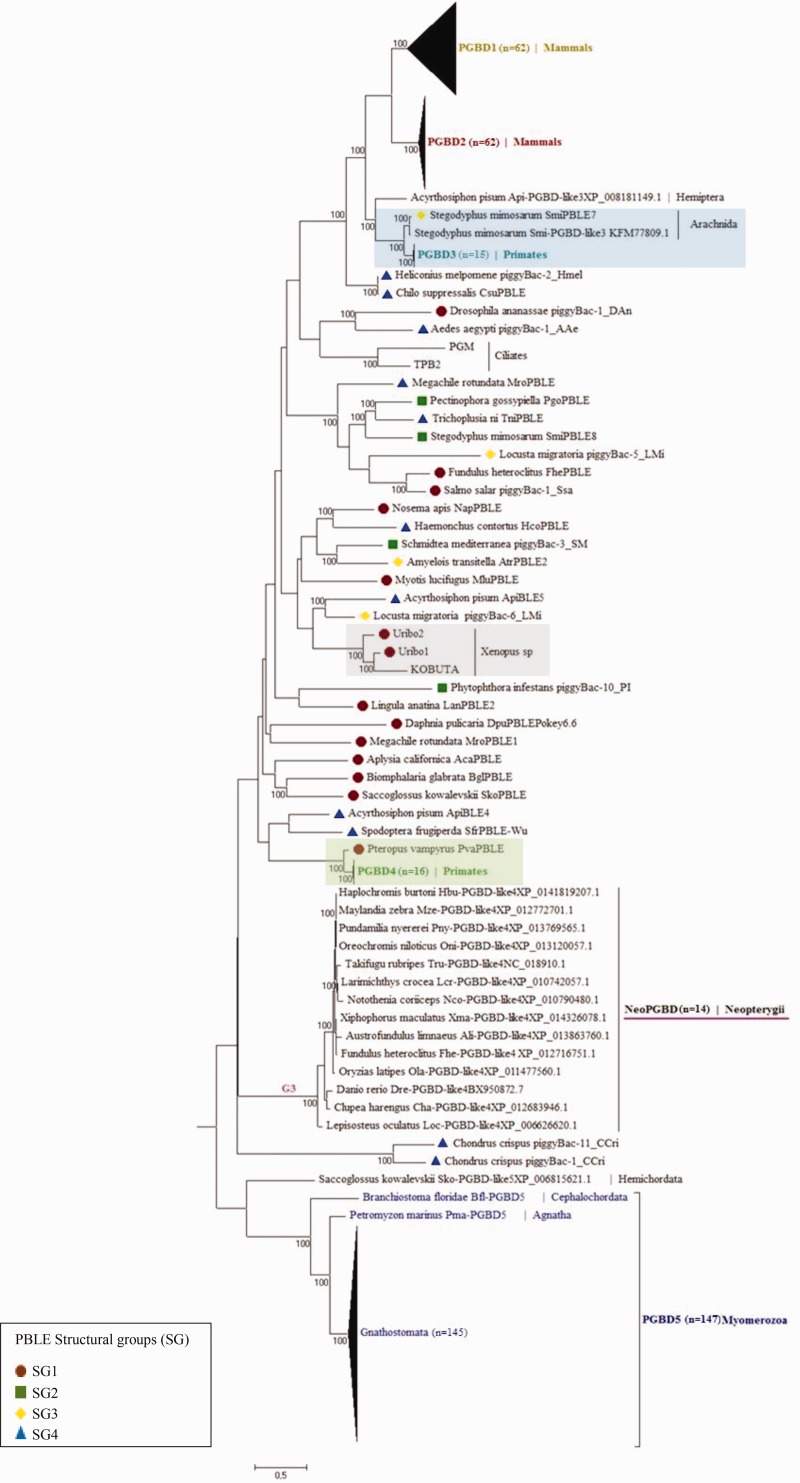
Fig. 6.—
Phylogenetic tree of piggyBac superfamily. This phylogeny is based on amino acid sequences covering about 170 residues (supplementary material S5, Supplementary Material online). For simplicity, only 355 sequences are represented, including 305 PGBD sequences, 17 PGBD-like sequences and 33 PBLE sequences. Maximum likelihood (ML) method, with LG + F + G matrix, is used to construct this tree. Only bootstrap values (100 replications) higher than 70% are labeled. Groups including PGBD elements and PBLE and/or PGBD-like, are framed in colors. Red dots, green squares, yellow lozenges, and blue triangles refer to the different PBLE SGs, that is, SG1, SG2, SG3, and SG4, respectively. The putative domesticated sequences (NeoPGBD), found only in Actinopterygii, are underlined in purple. Sequence names: the term PBLE is used for sequences extracted from literature, or copies newly characterized in this study, while the term piggyBac is restricted to sequences extracted from Repbase (real name of these sequences in this database). TPB2 is from Tetrahymena thermophila, PGM from Paramecium tetraurelia and KOBUTA from Xenopus sp.

References

    1. Arkhipova IR, Meselson M. 2005. Diverse DNA transposons in rotifers of the class Bdelloidea. Proc Natl Acad Sci U S A. 102 (33):11781–11786. - PMC - PubMed
    1. Baudry C, et al. 2009. PiggyMac, a domesticated piggyBac transposase involved in programmed genome rearrangements in the ciliate Paramecium tetraurelia . Genes Dev. 23:2478–2483. - PMC - PubMed
    1. Betancur R.R, et al. 2013. The tree of life and a new classification of bony fishes. PLOS Curr Tree Life. Edition 1.5. doi: 10.1371/currents.tol.53ba26640df0ccaee75bb165c8c26288. - PMC - PubMed
    1. Bigot Y, Brillet B, Augé-Gouillou C. 2005. Conservation of palindromic and mirror motifs within inverted terminal repeats of mariner-like elements. J Mol Biol. 351:108–116. - PubMed
    1. Britten RJ. 1996. DNA sequence insertion and evolutionary variation in gene regulation. Proc Natl Acad Sci U S A. 93:9374–9377. - PMC - PubMed

Publication types