


Measuring the Quality of Care for Psychological Health Conditions in the Military Health System: Candidate Quality Measures for Posttraumatic Stress Disorder and Major Depressive Disorder
- PMID: 28083392
- PMCID: PMC5158296
Measuring the Quality of Care for Psychological Health Conditions in the Military Health System: Candidate Quality Measures for Posttraumatic Stress Disorder and Major Depressive Disorder
Abstract
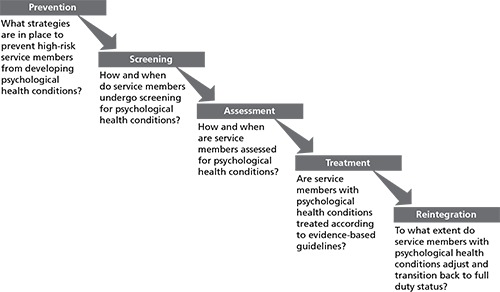
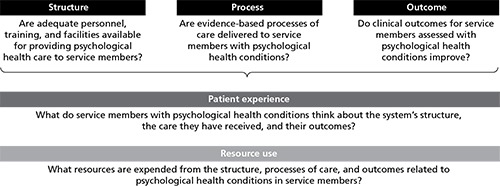
In recent years, the number of U.S. service members treated for psychological health conditions has increased substantially. In particular, at least two psychological health conditions-posttraumatic stress disorder (PTSD) and major depressive disorder (MDD)-have become more common, with prevalence estimates up to 20 percent for PTSD and 37 percent for MDD. Delivering quality care to service members with these conditions is a high-priority goal for the military health system (MHS). Meeting this goal requires understanding the extent to which the care the MHS provides is consistent with evidence-based clinical practice guidelines and its own standards for quality. To better understand these issues, RAND Corporation researchers developed a framework to identify and classify a set of measures for monitoring the quality of care provided by the MHS for PTSD and MDD. The goal of this project was to identify, develop, and describe a set of candidate quality measures to assess care for PTSD and MDD. To accomplish this goal, the authors performed two tasks: (1) developed a conceptual framework for assessing the quality of care for psychological health conditions and (2) identified a candidate set of measures for monitoring, assessing, and improving the quality of care for PTSD and MDD. This article describes their research approach and the candidate measure sets for PTSD and MDD that they identified. The current task did not include implementation planning but provides the foundation for future RAND work to pilot a subset of these measures.
Figures
References
-
- Agency for Healthcare Research and Quality, “Uses of Quality Measures,” undated; referenced 2013. As of August 23, 2013: http://www.qualitymeasures.ahrq.gov/selecting-and-using/using.aspx
-
- AHRQ—See Agency for Healthcare Research and Quality. - PubMed
-
- Damschroder, Laura J., Aron David C., Keith Rosalind E., Kirsh Susan R., Alexander Jeffery A., and Lowery Julie C., “Fostering Implementation of Health Services Research Findings into Practice: A Consolidated Framework for Advancing Implementation Science,” Implementation Science, Vol. 4, No. 1, August 7, 2009. As of January 30, 2014: http://www.implementationscience.com/content/pdf/1748-5908-4-50.pdf - PMC - PubMed
-
- Donabedian, Avedis, An Introduction to Quality Assurance in Health Care, New York: Oxford University Press, 2003.
-
- Institute of Medicine, Returning Home from Iraq and Afghanistan: Assessment of Readjustment Needs of Veterans, Service Members, and Their Families, Washington, D.C.: National Academies Press, 2013. As of May 9, 2014: http://www.nap.edu/catalog.php?record_id=13499 - PubMed
LinkOut - more resources
Full Text Sources