Review
. 2016 Dec 26:6:267.
doi: 10.3389/fonc.2016.00267. eCollection 2016.

Dissecting the Biology of Menstrual Cycle-Associated Breast Cancer Risk

Affiliations
Review

Dissecting the Biology of Menstrual Cycle-Associated Breast Cancer Risk

Vahid Atashgaran et al. Front Oncol. .

Abstract

Fluctuations in circulating estrogen and progesterone across the menstrual cycle lead to increased breast cancer susceptibility in women; however, the biological basis for this increased risk is not well understood. Estrogen and progesterone have important roles in normal mammary gland development, where they direct dynamic interactions among the hormonally regulated mammary epithelial, stromal, and immune cell compartments. The continuous fluctuations of estrogen and progesterone over a woman's reproductive lifetime affect the turnover of mammary epithelium, stem cells, and the extracellular matrix, as well as regulate the phenotype and function of mammary stromal and immune cells, including macrophages and regulatory T cells. Collectively, these events may result in genome instability, increase the chance of random genetic mutations, dampen immune surveillance, and promote tolerance in the mammary gland, and thereby increase the risk of breast cancer initiation. This article reviews the current status of our understanding of the molecular and the cellular changes that occur in the mammary gland across the menstrual cycle and how continuous menstrual cycling may increase breast cancer susceptibility in women.

Keywords: cytokine; estrogen; menstrual cycle; microenvironment; progesterone.


Figures
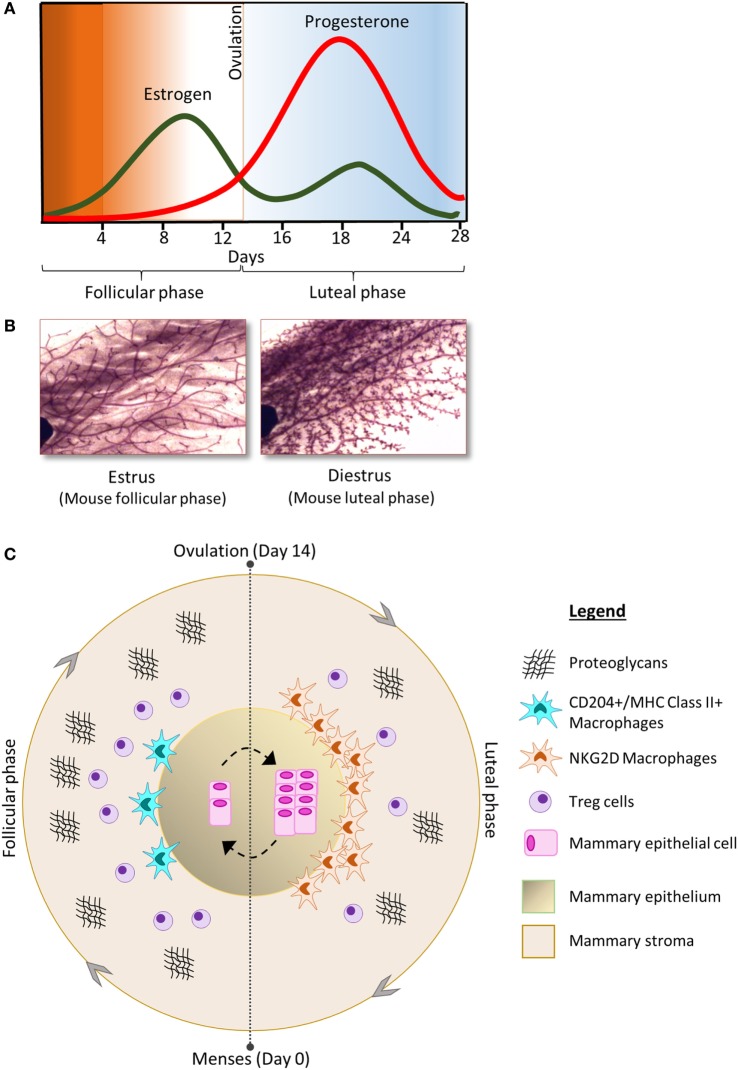
Figure 1
Figure 1
(A) The concentration of estrogen (green) and progesterone (red) fluctuates during the phases of the menstrual cycle and is associated with morphological changes in the cellular components of the mammary gland; shown here in carmine alum-stained mouse mammary gland whole-mount preparations (B) [adapted from Ref. (17) with permission]. (C) The follicular phase of the menstrual cycle is characterized by increase in the number of Tregs and proteoglycans compared to the luteal phase. In contrast, the luteal phase is characterized by increased numbers of mammary epithelial cells as well as increased abundance of macrophages compared to the follicular phase. The phenotype of macrophages in the mammary gland also changes throughout the cycle.

References

    1. Russo J, Russo IH. Development of the human breast. Maturitas (2004) 49:2–15. 10.1016/j.maturitas.2004.04.011 - DOI - PubMed
    1. Hovey RC, Trott JF, Vonderhaar BK. Establishing a framework for the functional mammary gland: from endocrinology to morphology. J Mammary Gland Biol Neoplasia (2002) 7:17–38. 10.1023/A:1015766322258 - DOI - PubMed
    1. Hennighausen L, Robinson GW. Information networks in the mammary gland. Nat Rev Mol Cell Biol (2005) 6:715–25. 10.1038/nrm1714 - DOI - PubMed
    1. McPherson K, Steel CM, Dixon JM. Breast cancer – epidemiology, risk factors, and genetics. BMJ (2000) 321:624–8. 10.1136/bmj.321.7261.624 - DOI - PMC - PubMed
    1. Collaborative Group on Hormonal Factors in Breast Cancer. Menarche, menopause, and breast cancer risk: individual participant meta-analysis, including 118 964 women with breast cancer from 117 epidemiological studies. Lancet Oncol (2012) 13:1141. 10.1016/S1470-2045(12)70425-4 - DOI - PMC - PubMed

LinkOut - more resources
