Review
. 2017 Feb;133(2):197-222.
doi: 10.1007/s00401-017-1670-5. Epub 2017 Jan 13.

Prion disease: experimental models and reality

Affiliations
Review

Prion disease: experimental models and reality

Sebastian Brandner et al. Acta Neuropathol. 2017 Feb.

Abstract

The understanding of the pathogenesis and mechanisms of diseases requires a multidisciplinary approach, involving clinical observation, correlation to pathological processes, and modelling of disease mechanisms. It is an inherent challenge, and arguably impossible to generate model systems that can faithfully recapitulate all aspects of human disease. It is, therefore, important to be aware of the potentials and also the limitations of specific model systems. Model systems are usually designed to recapitulate only specific aspects of the disease, such as a pathological phenotype, a pathomechanism, or to test a hypothesis. Here, we evaluate and discuss model systems that were generated to understand clinical, pathological, genetic, biochemical, and epidemiological aspects of prion diseases. Whilst clinical research and studies on human tissue are an essential component of prion research, much of the understanding of the mechanisms governing transmission, replication, and toxicity comes from in vitro and in vivo studies. As with other neurodegenerative diseases caused by protein misfolding, the pathogenesis of prion disease is complex, full of conundra and contradictions. We will give here a historical overview of the use of models of prion disease, how they have evolved alongside the scientific questions, and how advancements in technologies have pushed the boundaries of our understanding of prion biology.


Figures
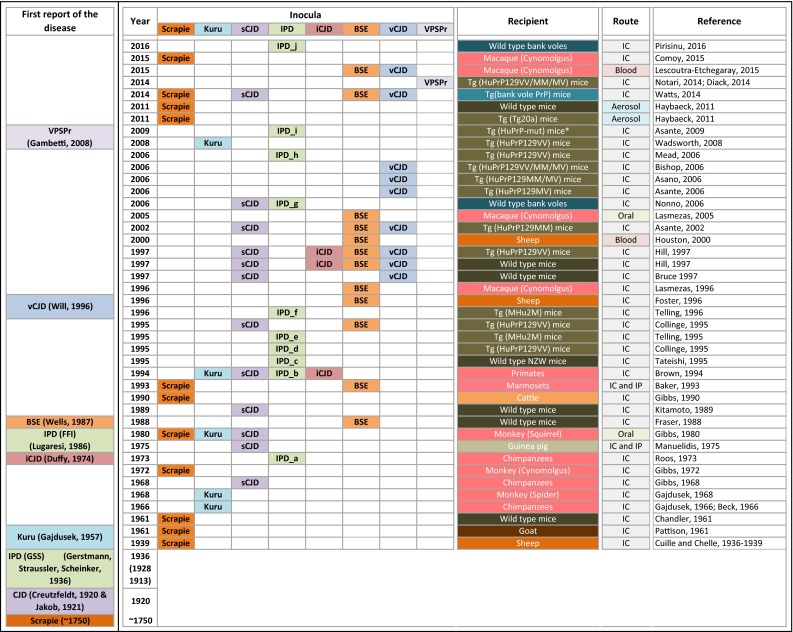
Fig. 1
Fig. 1
History of the use of animal models of prion disease. The left column indicates when the diseases were first reported, starting with scrapie in the 18th century and CJD in 1920. The time line (second column) is not strictly chronological, but is aligned with the generation of relevant animal models. The subsequent columns, titled “inocula”, indicate the different forms of prions that were transmitted. The column “recipient” indicates the species and, where appropriate, their genotypes. To the right, the transmission route and the reference. The inocula in the column IPD are complex and are according to the following key: a CJD in patients with family history (specific mutation not known); b E200K, D178N 129V, P102L, 5-OPRI, 7-OPRI, and 8-OPRI; c D178N 129M and 24 basepair deletion mutation on the same PRNP allele; d D178N 129M; e E200K; f D178N 129M; g E200K, V210I; h 6-OPRI; i P102L, A117V, and E200K; j P102L, A117V, and F198S; Tg (HuPrP-mut) mice recipients: *HuPrP-P102L, HuPrP-A117V, and HuPrP-E200K; abbreviations for routes of transmission: IC intracerebral, IP intraperitoneal
Fig. 2
Fig. 2
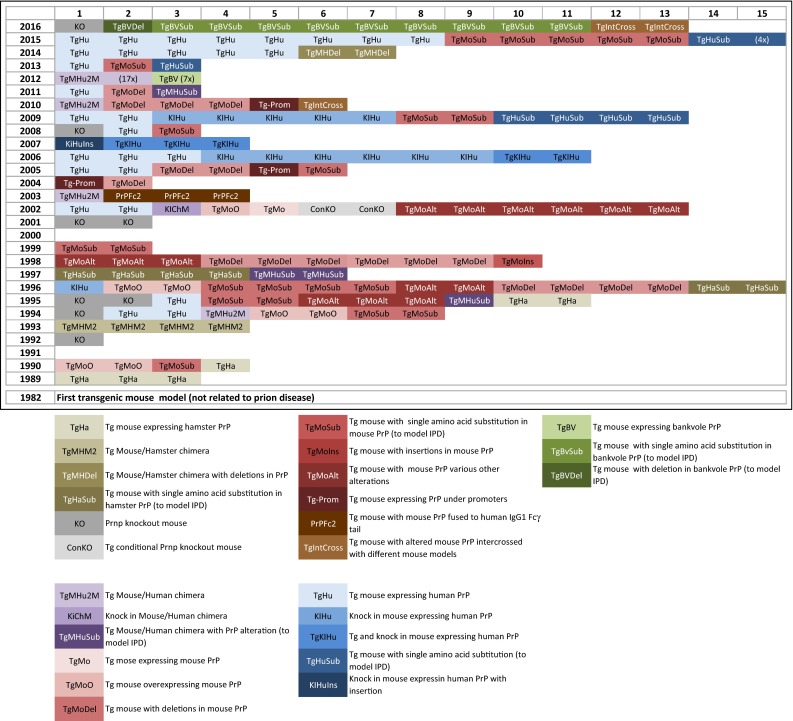
Detailed overview of genetically modified models in prion research. 1982 denotes the year of the first report of the generation of a transgenic mouse. The first use of transgenic mice in prion research was in 1989. The legend explains the abbreviation used in the main graph. Multiple fields indicate the generation of multiple mouse lines, sometimes published in a single article (see also supplementary table for further details)
Fig. 3
Fig. 3
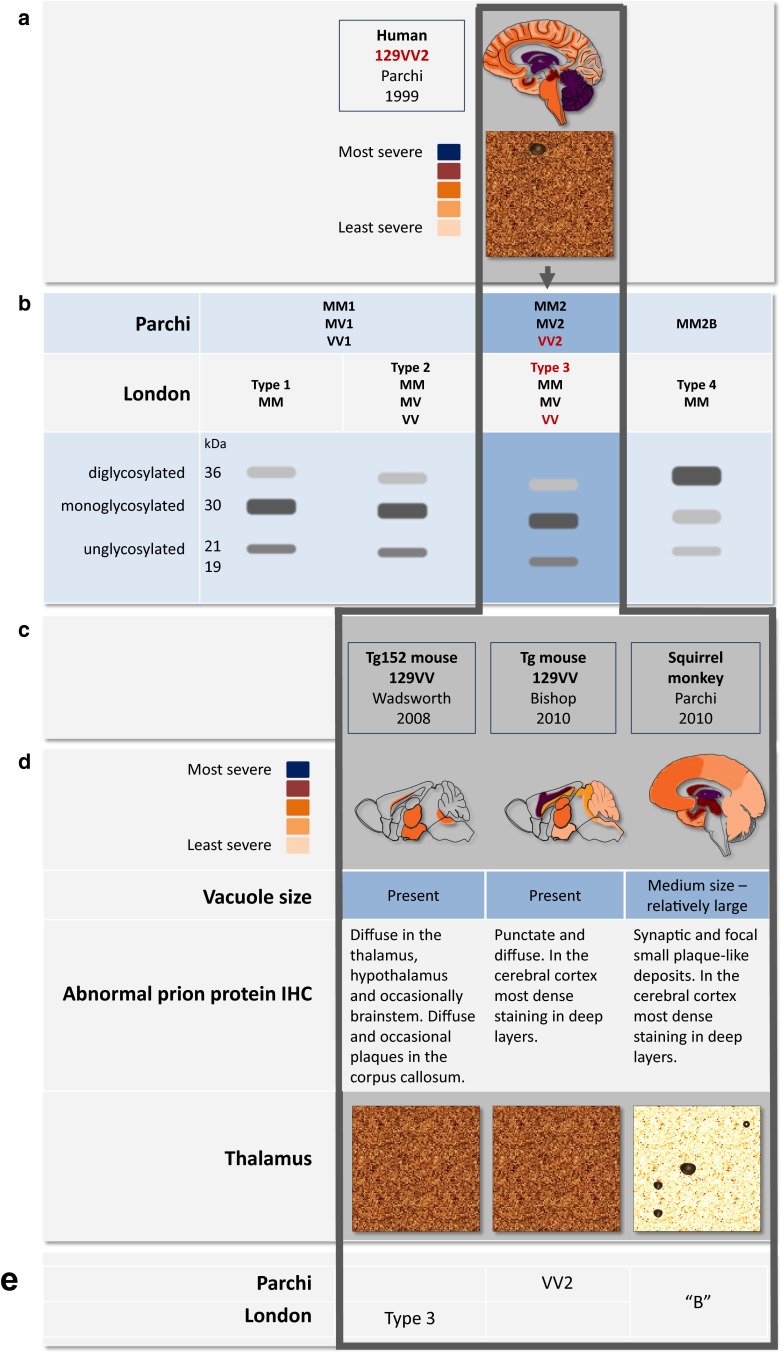
Comparison of neuropathology and molecular strain types between an sCJD patient with PRNP codon 129 VV genotype and animal models. a Schematic representation of the severity of prion pathology and characteristic immunohistological pattern of synaptic and plaque-like abnormal prion protein deposits in the brain from sCJD patient with PRNP codon 129VV genotype. b Corresponding molecular strain is VV2 (Parchi classification) or type 3 (London classification). c Three animal models, two humanised mouse lines with 129V genotype, and a squirrel monkey. d Schematic representation of the anatomical distribution of prion disease pathology, vacuolar size in the neuropil, and immunohistochemical pattern of abnormal prion protein deposits following disease development after intracerebral inoculation with the brain homogenate from the sCJD patient with 129VV genotype. e Corresponding molecular strain types in the animal models
Fig. 4
Fig. 4
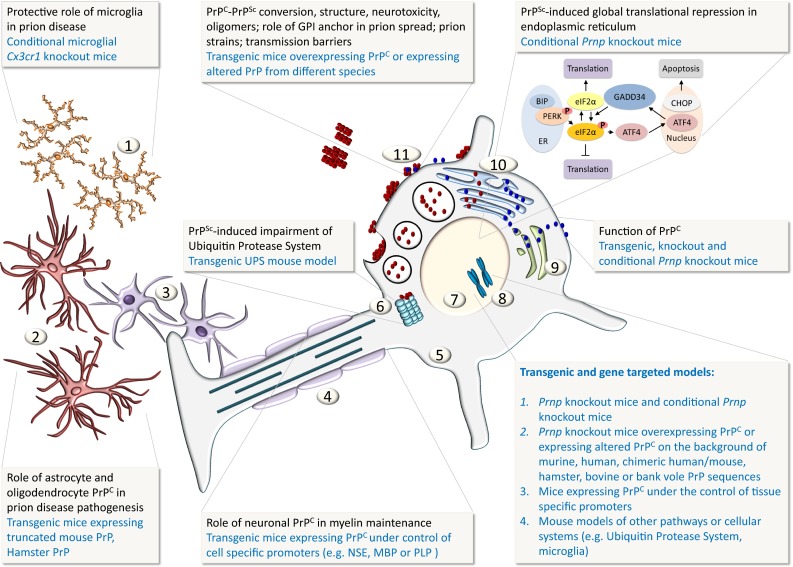
Schematic representation of the cellular and sub-cellular compartments and how PrP function and disease mechanisms are investigated with animal models. Key: 1 microglia, 2 astrocytes, 3 oligodendrocytes, 4 myelinated axon, 5 neuronal cytoplasm, 6 ubiquitin protease system (UPS), 7 neuronal nucleus, 8 chromosomes, 9 Golgi complex, 10 Endoplasmic reticulum (ER), 11 blue globules represent native cellular prion protein PrPC, red globules represent misfolded prion protein PrPSc
Fig. 5
Fig. 5
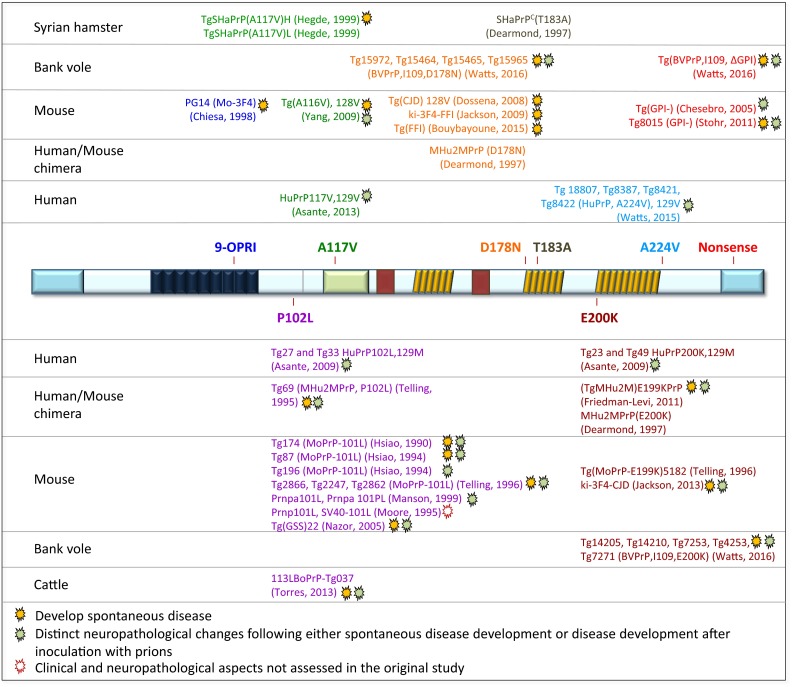
Transgenic mouse models of inherited prion disease. The open reading frame of the PRNP gene is represented in the centre, and the mutations that have been modelled in transgenic animals are shown above and below. On the left, the species PrP sequence of the transgene is shown, i.e., hamster, bank vole, mouse, and bovine sequences as well as chimeric constructs, such as human/mouse. The amber symbols next to the mutant indicate that the model developed a spontaneous disease and the green symbol indicates that there was a distinct neuropathological phenotype either spontaneously or following inoculation with prions. In one study, the clinical and neuropathological aspects were not assessed (open symbol). The mouse lines with no symbol did not develop spontaneous disease and did not show distinct neuropathology Blue or red letters are simply for orientation, to align with the point mutation shown in the centre
Fig. 6
Fig. 6
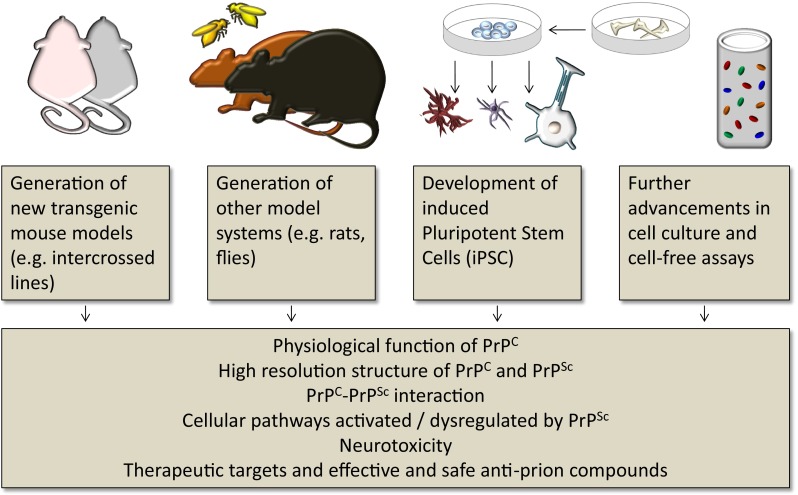
Future perspective in prion disease research: left increasing sophistication of transgenic models, and increasing access to gene editing methodologies is likely to have a significant role also in prion research. Left centre other species, in particular those which are easy to maintain and to manipulate, such as flies may play a role in models, in particular aiming at functional roles of PrP; increasing use of rat models due to the larger brain size. Centre-right a significant potential of induced pluripotent stem cells can be expected, and right in vitro cell-based and cell-free assays will play an important role in diagnostics, epidemiology, and safety of blood products and drug screening

References

    1. Aguzzi A, Heppner FL, Heikenwalder M, Prinz M, Mertz K, Seeger H, Glatzel M. Immune system and peripheral nerves in propagation of prions to CNS. Br Med Bull. 2003;66:141–159. doi: 10.1093/bmb/66.1.141. - DOI - PubMed
    1. Aguzzi A, Weissmann C. Prion research: the next frontiers. Nature. 1997;389:795–798. doi: 10.1038/39758. - DOI - PubMed
    1. Asano M, Mohri S, Ironside JW, Ito M, Tamaoki N, Kitamoto T. vCJD prion acquires altered virulence through trans-species infection. Biochem Biophys Res Commun. 2006;342:293–299. doi: 10.1016/j.bbrc.2006.01.149. - DOI - PubMed
    1. Asante EA, Gowland I, Grimshaw A, Linehan JM, Smidak M, Houghton R, Osiguwa O, Tomlinson A, Joiner S, Brandner S, et al. Absence of spontaneous disease and comparative prion susceptibility of transgenic mice expressing mutant human prion proteins. J Gen Virol. 2009;90:546–558. doi: 10.1099/vir.0.007930-0. - DOI - PMC - PubMed
    1. Asante EA, Grimshaw A, Smidak M, Jakubcova T, Tomlinson A, Jeelani A, Hamdan S, Powell C, Joiner S, Linehan JM, et al. Transmission properties of human PrP 102L prions challenge the relevance of mouse models of GSS. PLoS Pathog. 2015;11:e1004953. doi: 10.1371/journal.ppat.1004953. - DOI - PMC - PubMed

Publication types

LinkOut - more resources