


Optimizing patient-reported outcome and risk factor reporting from cancer survivors: a randomized trial of four different survey methods among colorectal cancer survivors
- PMID: 28084606
- PMCID: PMC5419855
- DOI: 10.1007/s11764-017-0596-1
Optimizing patient-reported outcome and risk factor reporting from cancer survivors: a randomized trial of four different survey methods among colorectal cancer survivors
Abstract
Purpose: The goal of this study was to determine response rates and associated costs of different survey methods among colorectal cancer (CRC) survivors.
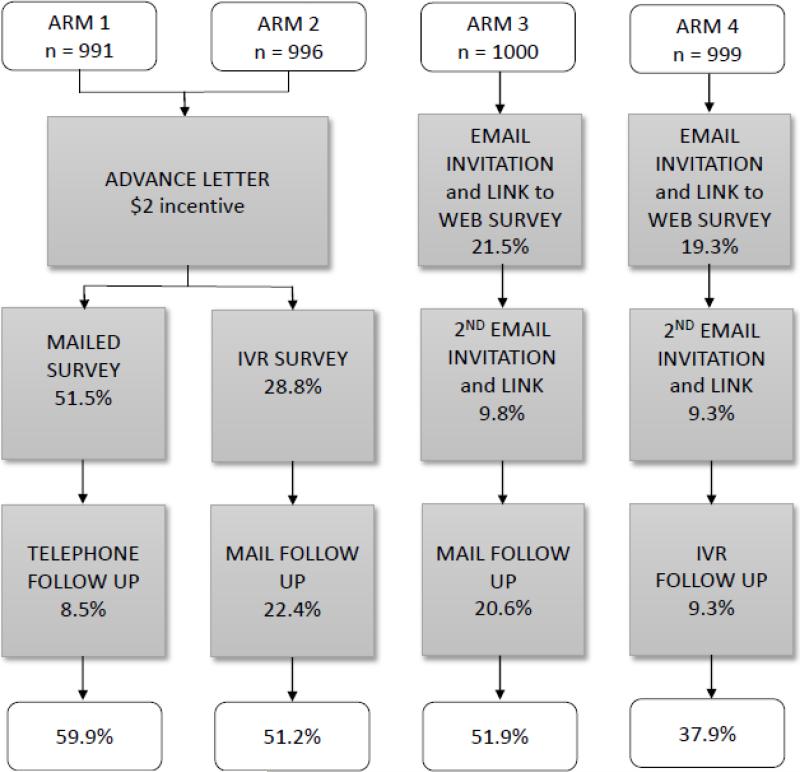
Methods: We assembled a cohort of 16,212 individuals diagnosed with CRC (2010-2014) from six health plans, and randomly selected 4000 survivors to test survey response rates across four mixed-mode survey administration protocols (in English and Spanish): arm 1, mailed survey with phone follow-up; arm 2, interactive voice response (IVR) followed by mail; arm 3; email linked to web-based survey with mail follow-up; and arm 4, email linked to web-based survey followed by IVR.
Results: Our overall response rate was 50.2%. Arm 1 had the highest response rate (59.9%), followed by arm 3 (51.9%), arm 2 (51.2%), and arm 4 (37.9%). Response rates were higher among non-Hispanic whites in all arms than other racial/ethnic groups (p < 0.001), among English (51.5%) than Spanish speakers (36.4%) (p < 0.001), and among higher (53.7%) than lower (41.4%) socioeconomic status (p < 0.001). Survey arms were roughly comparable in cost, with a difference of only 8% of total costs between the most (arm 2) and least (arm 3) expensive arms.
Conclusions: Mailed surveys followed by phone calls achieved the highest response rate; email invitations and online surveys cost less per response. Electronic methods, even among those with email availability, may miss important populations including Hispanics, non-English speakers, and those of lower socioeconomic status.
Implications for cancer survivors: Our results demonstrate effective methods for capturing patient-reported outcomes, inform the relative benefits/disadvantages of the different methods, and identify future research directions.
Keywords: Colorectal cancer; Mixed-mode survey; Patient-reported outcomes; Survivors.
Figures
References
-
- Atrostic BK, Bates N, Burt G, Silberstein A. Nonresponse in U.S. Government Household Surveys: Consistent Measures, Recent Trends, and New Insights. Journal of Official Statistics. 2001;17:209–26.
-
- Sackett DL. Bias in analytic research. Journal of Chronic Diseases. 1979;32:51–63. - PubMed
-
- Groves RM. Nonresponse Rates and Nonresponse Bias in Household Surveys. Public Opinion Quarterly. 2006;70:646–75.
-
- Armes J, Crowe M, Colbourne L, et al. Patients' Supportive Care Needs Beyond the End of Cancer Treatment: A Prospective, Longitudinal Survey. Journal of Clinical Oncology. 2009;27:6172–9. - PubMed
MeSH terms
Grants and funding
LinkOut - more resources
Full Text Sources
Other Literature Sources
Medical
