


Modes of invasion during tumour dissemination
- PMID: 28085224
- PMCID: PMC5423224
- DOI: 10.1002/1878-0261.12019
Modes of invasion during tumour dissemination
Abstract
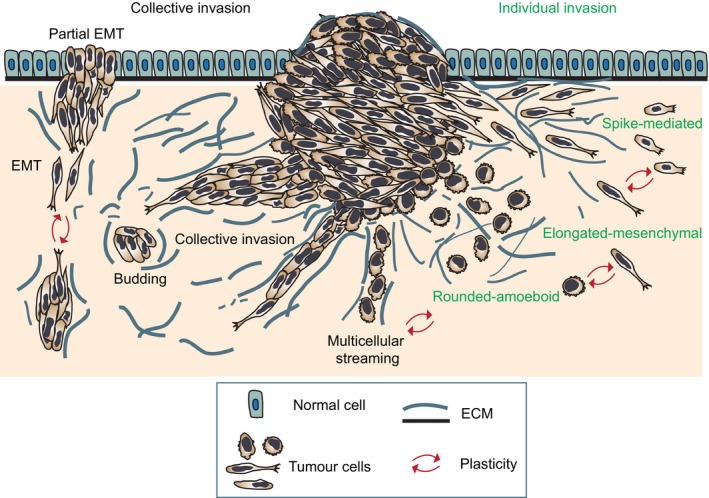
Cancer cell migration and invasion underlie metastatic dissemination, one of the major problems in cancer. Tumour cells exhibit a striking variety of invasion strategies. Importantly, cancer cells can switch between invasion modes in order to cope with challenging environments. This ability to switch migratory modes or plasticity highlights the challenges behind antimetastasis therapy design. In this Review, we present current knowledge on different tumour invasion strategies, the determinants controlling plasticity and arising therapeutic opportunities. We propose that targeting master regulators controlling plasticity is needed to hinder tumour dissemination and metastasis.
Keywords: Rho GTPases; actomyosin contractility; cancer metastasis; invasion; plasticity.
© 2016 The Authors. Published by FEBS Press and John Wiley & Sons Ltd.
Figures
References
-
- Ackerman AB and Ragaz A (1984) The Lives of Lesions. Masson Publishers, New York, NY.
-
- Ahn J, Sanz‐Moreno V and Marshall CJ (2012) The metastasis gene NEDD9 product acts through integrin beta3 and Src to promote mesenchymal motility and inhibit amoeboid motility. J Cell Sci 125, 1814–1826. - PubMed
-
- Alexander S, Koehl GE, Hirschberg M, Geissler EK and Friedl P (2008) Dynamic imaging of cancer growth and invasion: a modified skin‐fold chamber model. Histochem Cell Biol 130, 1147–1154. - PubMed
-
- Amann KJ and Pollard TD (2001) The Arp2/3 complex nucleates actin filament branches from the sides of pre‐existing filaments. Nat Cell Biol 3, 306–310. - PubMed
Publication types
MeSH terms
Substances
Grants and funding
LinkOut - more resources
Full Text Sources
Other Literature Sources
