


Mechanosensitive ion channel Piezo2 is inhibited by D-GsMTx4
- PMID: 28085630
- PMCID: PMC5463886
- DOI: 10.1080/19336950.2017.1279370
Mechanosensitive ion channel Piezo2 is inhibited by D-GsMTx4
Abstract
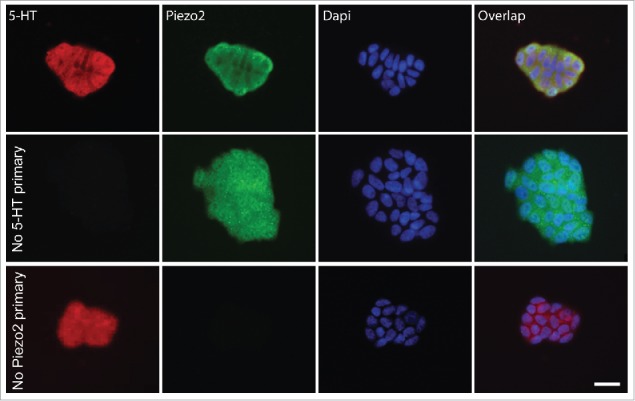
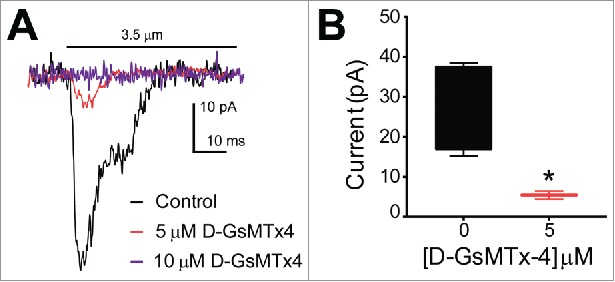
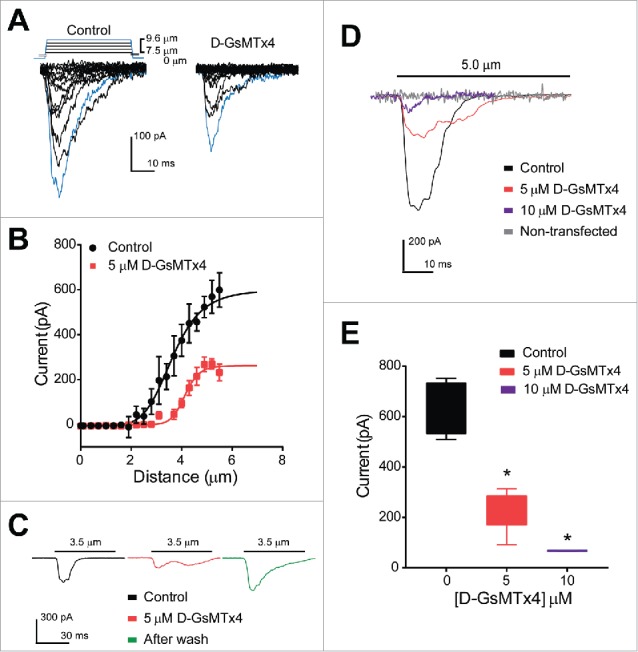
Enterochromaffin (EC) cells are the primary mechanosensors of the gastrointestinal (GI) epithelium. In response to mechanical stimuliEC cells release serotonin (5-hydroxytryptamine; 5-HT). The molecular details ofEC cell mechanosensitivity are poorly understood. Recently, our group found that human and mouseEC cells express the mechanosensitive ion channel Piezo2. The mechanosensitive currents in a humanEC cell model QGP-1 were blocked by the mechanosensitive channel blocker D-GsMTx4. In the present study we aimed to characterize the effects of the mechanosensitive ion channel inhibitor spider peptide D-GsMTx4 on the mechanically stimulated currents from both QGP-1 and human Piezo2 transfected HEK-293 cells. We found co-localization of 5-HT and Piezo2 in QGP-1 cells by immunohistochemistry. QGP-1 mechanosensitive currents had biophysical properties similar to dose-dependently Piezo2 and were inhibited by D-GsMTx4. In response to direct displacement of cell membranes, human Piezo2 transiently expressed in HEK-293 cells produced robust rapidly activating and inactivating inward currents. D-GsMTx4 reversibly and dose-dependently inhibited both the potency and efficacy of Piezo2 currents in response to mechanical force. Our data demonstrate an effective inhibition of Piezo2 mechanosensitive currents by the spider peptide D-GsMTx4.
Keywords: D-GsMTx4; Piezo2; enterochromaffin cell; mechanosensitive ion channel; mechanotransduction.
Figures
Erratum for
- Addendum to: F Wang, K Knutson, C Alcaino, DR Linden, SJ Gibbons, PK Kashyap, M Grover, R Oeckler, PA Gottlieb, HJ Li, et al. Mechanosensitive ion channel Piezo2 is important for enterochromaffin cell response to mechanical forces. J Physiol. 2017; 595(1):79-91; https://doi.org/10.1113/JP272718. doi: 10.1113/JP272718
References
-
- Bulbring E, Crema A. The release of 5-hydroxytryptamine in relation to pressure exerted on the intestinal mucosa. J Physiol. 1959; 146(1):18-28; PMID: 13655213; https://doi.org/ 10.1113/jphysiol.1959.sp006175 - DOI - PMC - PubMed
-
- Cote F, Thevenot E, Fligny C, Fromes Y, Darmon M, Ripoche MA, Bayard E, Hanoun N, Saurini F, Lechat P, et al.. Disruption of the nonneuronal tph1 gene demonstrates the importance of peripheral serotonin in cardiac function. Proc Natl Acad Sci U S A. 2003; 100(23):13525-30; PMID: 14597720; https://doi.org/ 10.1073/pnas.2233056100 - DOI - PMC - PubMed
-
- Kim M, Javed NH, Yu JG, Christofi F, Cooke HJ. Mechanical stimulation activates Galphaq signaling pathways and 5-hydroxytryptamine release from human carcinoid BON cells. J Clin Invest. 2001; 108(7):1051-9; PMID: 11581306; https://doi.org/ 10.1172/JCI12467 - DOI - PMC - PubMed
MeSH terms
Substances
Grants and funding
LinkOut - more resources
Full Text Sources
Other Literature Sources
Molecular Biology Databases
Miscellaneous
