


Incidence of Occult Intrahepatic Metastasis in Hepatocellular Carcinoma Treated With Transplantation Corresponds to Early Recurrence Rates After Partial Hepatectomy
- PMID: 28085695
- PMCID: PMC5507755
- DOI: 10.1097/SLA.0000000000002135
Incidence of Occult Intrahepatic Metastasis in Hepatocellular Carcinoma Treated With Transplantation Corresponds to Early Recurrence Rates After Partial Hepatectomy
Abstract
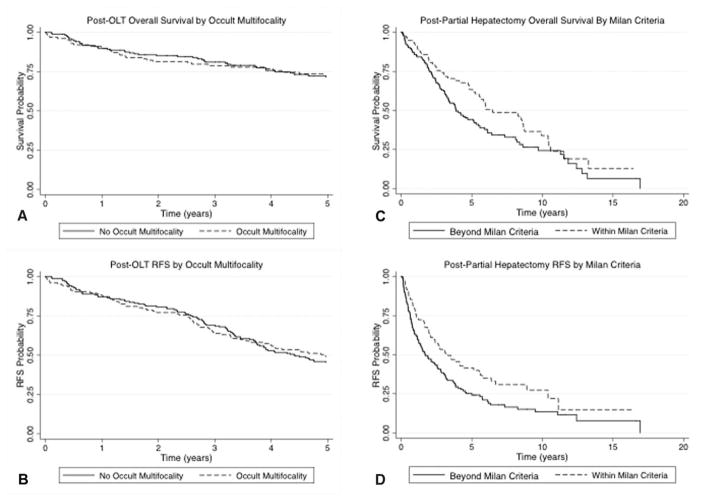
Objective: This study aimed to compare the incidence of radiologically unrecognized (occult) hepatocellular carcinoma (HCC) lesions in explant hepatectomy specimens from orthotopic liver transplants (OLTs) performed for HCC with rates of HCC intrahepatic recurrence after resection.
Summary of background data: Resection of HCC is associated with high rates of intrahepatic HCC recurrence. However, it is unclear whether these recurrences represent incomplete resection of unrecognized metastatic lesions from the primary tumor or subsequent de novo tumor formation due to inherent biological proclivity for HCC formation.
Methods: We collected patient, tumor, and pathology data on HCC patients treated surgically from 3696 OLTs in the Organ Procurement and Transplantation (OPTN) national database, 299 OLTs at a single transplant center, and 232 partial hepatectomies from a hepatobiliary cancer center.
Results: In the OPTN and high-volume transplant center cohorts, 37% and 42% of patients had occult HCC lesions on explant pathology, respectively. Among cancer center patients, the 2-year recurrence rate was 46%, and 74% of patients who recurred presented with liver only recurrence.
Conclusion: Although the transplant and resection populations differ, occult multifocality is common in transplant explants and similar to the 46% early recurrence rate following partial hepatectomy. These data suggest that noncurative resection often results from occult intrahepatic multifocality present at the time of resection rather than a malignant predisposition of the remnant liver with de novo tumorigenesis.
Conflict of interest statement
There are no conflicts of interest to report.
Figures
References
-
- Esquivel CO. Is liver transplantation justified for the treatment of HCC in Child’s A patients? Not always. Liver Transpl. 2003;9:521–522. - PubMed
-
- Pawlik TM. Debate: resection for early hepatocellular carcinoma. J Gastrointest Surg. 2009;13:1026–1028. - PubMed
-
- Bruix J, Sherman M. Management of hepatocellular carcinoma. Hepatology. 2005;42:1208–1236. - PubMed
-
- Hanazaki K, Kajikawa S, Shimozawa N, et al. Survival and recurrence after hepatic resection of 386 consecutive patients with hepatocellular carcinoma. J Am Coll Surg. 2000;191:381–388. - PubMed
-
- Ramacciato G, Mercantini P, Corigliano N, et al. Hepatic resections for hepatocellular carcinoma (HCC): short and long-term results on 106 cirrhotic patients. J Exp Clin Cancer Res. 2003;22(4 suppl):233–241. - PubMed
Publication types
MeSH terms
Grants and funding
LinkOut - more resources
Full Text Sources
Other Literature Sources
Medical
Research Materials
