. 2017 Jan 13;12(1):e0170095.
doi: 10.1371/journal.pone.0170095. eCollection 2017.

Distinctions in Breast Tumor Recurrence Patterns Post-Therapy among Racially Distinct Populations

Affiliations

Distinctions in Breast Tumor Recurrence Patterns Post-Therapy among Racially Distinct Populations

Nikita Wright et al. PLoS One. .

Abstract

Background: Clinical studies have revealed a higher risk of breast tumor recurrence in African-American (AA) patients compared to European-American (EA) patients, contributing to the alarming inequality in clinical outcomes among the ethnic groups. However, distinctions in recurrence patterns upon receiving hormone, radiation, and/or chemotherapy between the races remain poorly characterized.

Methods: We compared patterns and rates (per 1000 cancer patients per 1 year) of recurrence following each form of treatment between AA (n = 1850) and EA breast cancer patients (n = 7931) from a cohort of patients (n = 10504) treated between 2005-2015 at Northside Hospital in Atlanta, GA.

Results: Among patients who received any combination of adjuvant therapy, AA displayed higher overall rates of recurrence than EA (p = 0.015; HR: 1.699; CI: 1.108-2.606). Furthermore, recurrence rates were higher in AA than EA among stage I (p = 0.031; HR: 1.736; CI: 1.052-2.864) and T1 classified patients (p = 0.003; HR: 2.009; CI: 1.263-3.197). Interestingly, among patients who received neoadjuvant chemotherapy, AA displayed higher rates of local recurrence than EA (p = 0.024; HR: 7.134; CI: 1.295-39.313).

Conclusion: Our analysis revealed higher incidence rates of recurrence in AA compared to EA among patients that received any combination of adjuvant therapy. Moreover, our data demonstrates an increased risk of tumor recurrence in AA than EA among patients diagnosed with minimally invasive disease. This is the first clinical study to suggest that neoadjuvant chemotherapy improves breast cancer recurrence rates and patterns in AA.


Conflict of interest statement

One of the authors [PCG Rida] is supported in the form of salary by Novazoi Theranostics. This commercial affiliation does not alter our adherence to PLOS ONE policies on sharing data and materials.

Figures
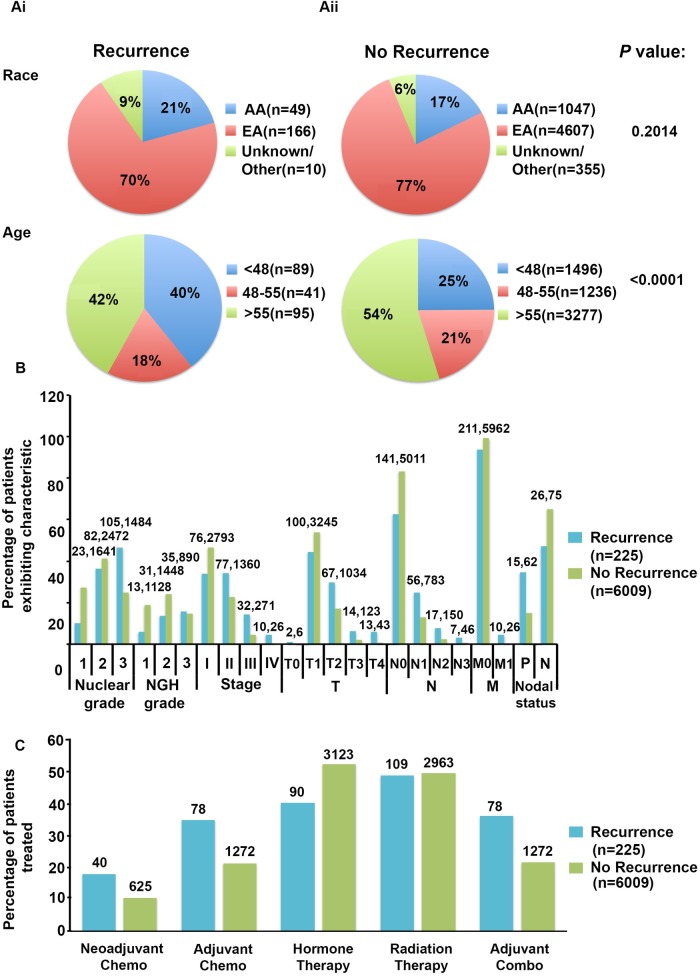
Fig 1
Fig 1. NH demographics, breast clinico-pathological characteristics, and treatment compared between patients with or without tumor recurrence.
(A) The numbers and percentages of patients displaying demographic and (B) breast clinico-pathological characteristics were compared for patients with (n = 225) and without recurrence (n = 6009). (C) The numbers and percentages of tumor recurrences for patients whose disease either recurred or did not recur, were compared in patients who underwent each form of conventional breast cancer treatment. Significant differences in all clinico-pathologic characteristics were observed between patients with or without tumor recurrence (p<0.0001), with the exception of nodal status (p = 0.121). Significant differences in clinico-pathological features were also observed between recurrence and non-recurrence patients receiving each form of treatment (p<0.0001), except for radiation therapy (p = 0.065). A chi-square statistical analysis was used to generate p-values in order to determine significant differences in the proportion of patients exhibiting or not exhibiting recurrence in each category. For example, regarding grade, a p value of 0.02 represents a significant difference for the distribution of recurrence and non-recurrence patients across all grades. Please refer to Supplementary Table 1 for details.
Fig 2
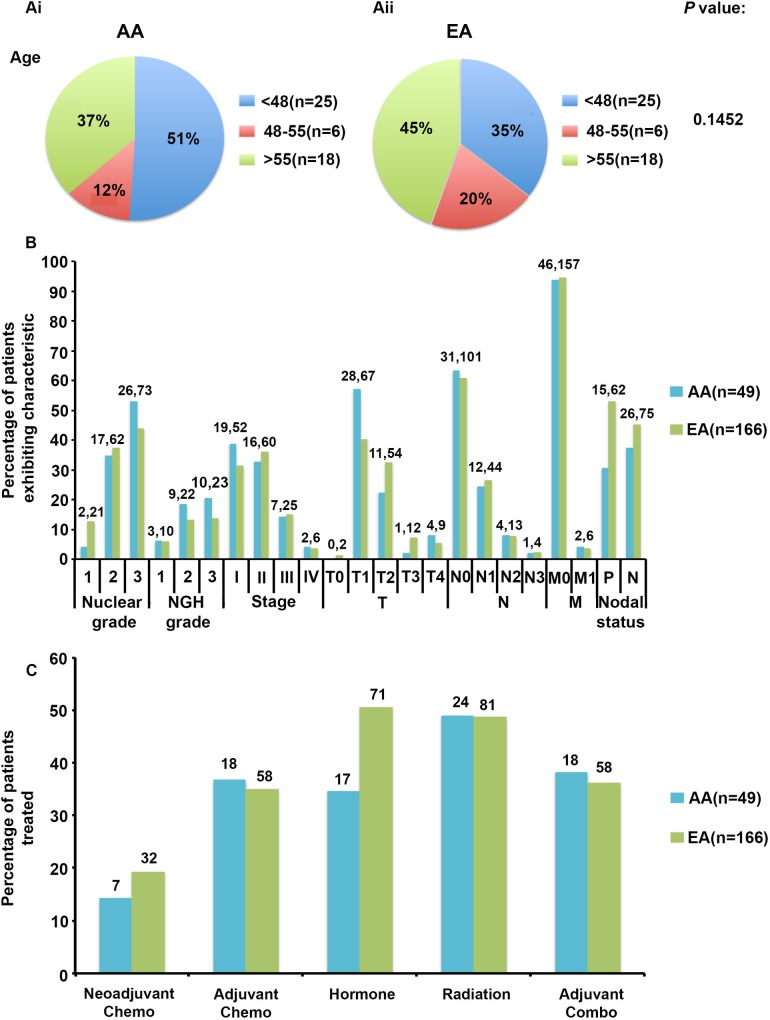
Fig 2. NH demographics, breast, clinico-pathological and treatment compared between AA and EA with tumor recurrence.
(A) The demographic and (B) clinico-pathological characteristics of AA (n = 49) and EA (n = 166) patients with recurrence in the NH cohort were compared. (C) Treatment administration was also compared between AA and EA recurrent breast cancer patients. A chi-square analysis was used to determine statistically significant differences in the proportion of AA and EA patients exhibiting each characteristic and undergoing each form of treatment. No statistically significant differences were observed. Please refer to Supplementary Table 2 for details.
Fig 3
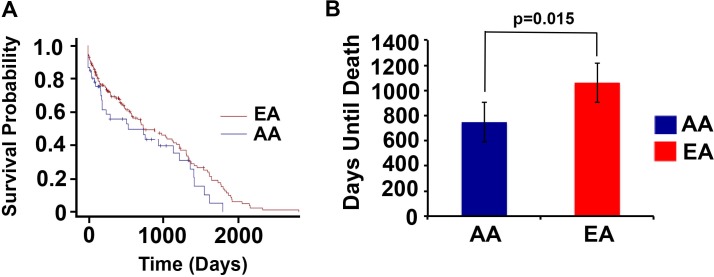
Fig 3. AA exhibit lower survival duration than EA among recurrent breast cancer patients.
(A) Survival time from first recurrence episode until death was compared between AA and EA breast cancer patients. Log-rank analysis was conducted to determine statistical differences between the racial groups. AA exhibited a non-significant lower survival time than EA (p = 0.231). (B) The mean time (days) until death was compared between AA and EA breast cancer patients displaying distant recurrence. AA died notably sooner than EA patients (p = 0.015). A t-test was performed to determine significant differences between the racial groups.

References

    1. Keenan T, Moy B, Mroz EA, Ross K, Niemierko A, Rocco JW, et al. Comparison of the Genomic Landscape Between Primary Breast Cancer in African American Versus White Women and the Association of Racial Differences With Tumor Recurrence. J Clin Oncol. 2015;33(31):3621–7. 10.1200/JCO.2015.62.2126 - DOI - PMC - PubMed
    1. Jatoi I, Anderson WF, Rao SR, Devesa SS. Breast cancer trends among black and white women in the United States. J Clin Oncol. 2005;23(31):7836–41. 10.1200/JCO.2004.01.0421 - DOI - PubMed
    1. Demicheli R, Retsky MW, Hrushesky WJ, Baum M, Gukas ID, Jatoi I. Racial disparities in breast cancer outcome: insights into host-tumor interactions. Cancer. 2007;110(9):1880–8. 10.1002/cncr.22998 - DOI - PubMed
    1. Ahmad A. Pathways to breast cancer recurrence. ISRN Oncol. 2013;2013:290568 10.1155/2013/290568 - DOI - PMC - PubMed
    1. Gerber B, Freund M, Reimer T. Recurrent breast cancer: treatment strategies for maintaining and prolonging good quality of life. Dtsch Arztebl Int. 2010;107(6):85–91. 10.3238/arztebl.2010.0085 - DOI - PMC - PubMed

MeSH terms