


Review
doi: 10.1016/j.cell.2016.12.012.
Epub 2017 Jan 12.
30 Years of NF-κB: A Blossoming of Relevance to Human Pathobiology
Affiliations
- PMID: 28086098
- PMCID: PMC5268070
- DOI: 10.1016/j.cell.2016.12.012
Item in Clipboard
Review
30 Years of NF-κB: A Blossoming of Relevance to Human Pathobiology
Cell.
.
Abstract
NF-κB was discovered 30 years ago as a rapidly inducible transcription factor. Since that time, it has been found to have a broad role in gene induction in diverse cellular responses, particularly throughout the immune system. Here, we summarize elaborate regulatory pathways involving this transcription factor and use recent discoveries in human genetic diseases to place specific proteins within their relevant medical and biological contexts.
Keywords: I-κB; NF-κB; Rel; gene regulation; genetic disease; genomics; human gene; immunity; lymphocyte; transactivator.
Published by Elsevier Inc.
Figures
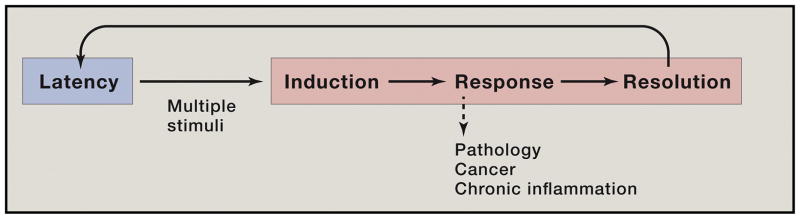
The NF-κB paradigm of timely and flexible biochemical control of cell behavior.
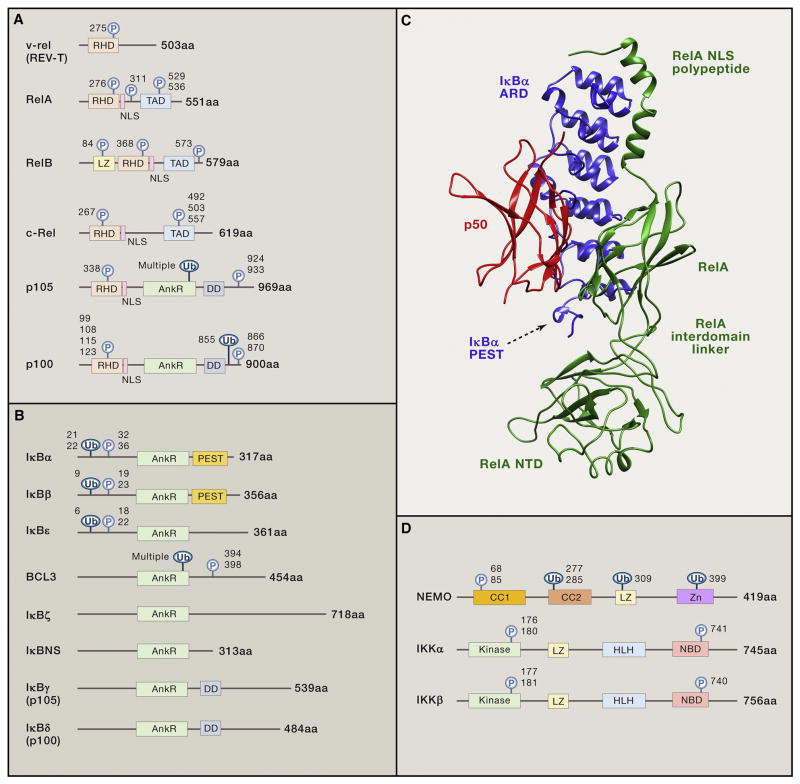
A. Rel homology domain proteins in the NF-κB protein family and the v-Rel oncoprotein. The N-terminal regions of REL family proteins share the Rel homology domain (RHD), which has amino acid similarity to the product of the v-rel oncogene from the Reticuloendotheliosis virus REV-T and a nuclear localization sequence (NLS). RelB has a leucine zipper (LZ) and RelA, RelB, and c-Rel, harbor a transactivation domain (TAD). p105 and p100 have 5–7 tandem ankyrin repeats (AnkR) and a death domain (DD). Regulatory phosphorylation sites (P) and ubiquitination sites (Ub) are shown. B. Inhibitors of NF-κB (IκB) family of proteins. The eight described IκBs are characterized by their 5–7 tandem ankyrin repeats (AnkR) which mediate binding to NF-κB dimers. The N-terminal regions of the classical IκBs (IκBα, IκBβ, IκBε) contain two serine residues (P), which permit the accelerated ubiquitination (Ub) and degradation of the protein when phosphorylated. BCL3 has similar modification residues but IκBζ and IκBNS do not. The C-terminal regions of p105 and p100 function as IκBs for their linked RHD even before processing by forming large complexes with Rel proteins, including p50 and p52. PEST: Region rich in the amino acids proline, glutamic acid, serine, and threonine. DD: death domain. C. Structure of the IκB:NF-κB latent complex (PBD 1NFI). Ribbon diagram of the crystal structure of the isolated complex including IκBα (blue), showing its anchor and repeat domain (ARD) and PEST sequence rich in the amino acids proline, glutamic acid, serine, and threonine that acts as a signal for protein degradation, p50 (red), and the RelA (green), inter-domain linker, and N-terminal domain (NTD). D. IKK complex. Shown are the components of the IKK complex including two kinases: IKKα, IKKβ, and the non-enzymatic subunit NEMO. CC1: Coiled-coil domain 1; CC2: Coiled-coil domain 2; LZ: Leucine zipper; Zn: Zinc-finger; Kinase: Kinase domain; HLH: Helix-loop-helix region; NBD: NEMO-binding domain. Regulatory phosphorylation sites (P) and ubiquitination sites (Ub) are shown. The number of amino acids (aa) of each protein is shown at right. Adapted from (Hayden and Ghosh, 2008, 2012).
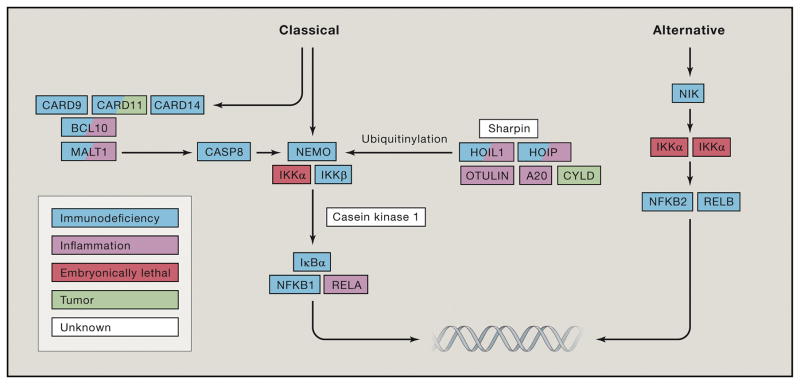
Color coded boxes indicate the main feature of diseases.
References
-
- Baltimore D. NF-kappaB is 25. Nat Immunol. 2011;12:683–685. - PubMed
-
- Basart H, van de Kar A, Ades L, Cho TJ, Carter E, Maas SM, Wilson LC, van der Horst CM, Wade EM, Robertson SP, et al. Frontometaphyseal dysplasia and keloid formation without FLNA mutations. Am J Med Genet A. 2015;167:1215–1222. - PubMed
Publication types
MeSH terms
Substances
Grants and funding
LinkOut - more resources
Full Text Sources
Other Literature Sources
