


Comment
doi: 10.1016/j.cell.2016.12.007.
Epub 2017 Jan 12.
The Interfaces of Genetic Conflict Are Hot Spots for Innovation
Affiliations
- PMID: 28086100
- PMCID: PMC5480287
- DOI: 10.1016/j.cell.2016.12.007
Item in Clipboard
Comment
The Interfaces of Genetic Conflict Are Hot Spots for Innovation
Cell.
.
Abstract
RNA-guided Cas9 endonucleases protect bacteria from viral infection and have been creatively repurposed as programmable molecular scalpels for surgical manipulation of DNA. Now, two papers in Cell (Pawluk et al. and Rauch et al.) identify viral proteins that suppress Cas9 and may function like molecular sheaths for the Cas9 scalpel.
Copyright © 2017. Published by Elsevier Inc.
Figures
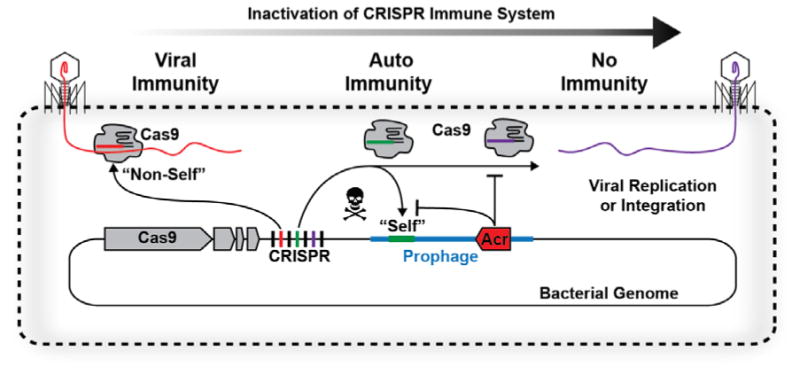
Schematic representation of a virus infecting a bacterial cell. The cell contains an active type II CRISPR system—typified by Cas9—and a CRISPR locus with a spacer (red) complementary to a target in the viral genome (red). However, in some cases a phage (a virus that infect bacteria) is able to integrate the bacterial genome. The integrated phage is now called a prophage (blue) and the cell is referred to as a lysogen. If the host CRISPR locus contains a spacer (green) that targets the prophage, then this may elicit an autoimmune reaction that results in the degradation of the host genome. Some (pro)phages encode anti-CRISPR (Acr, red arrow) proteins that blocks Cas9 cleavage, preventing CRISPR-induced autoimmunity. In this case, the host and the prophage have a shared interest in preventing Cas9 degradation, but the trade-off is that Acr-mediated blocking of the immune systems also make the cell more susceptible infection by subsequent viruses.
Comment in
-
Naturally Occurring Off-Switches for CRISPR-Cas9.Cell. 2016 Dec 15;167(7):1829-1838.e9. doi: 10.1016/j.cell.2016.11.017. Epub 2016 Dec 8. Cell. 2016. PMID: 27984730 Free PMC article.
Comment on
-
Naturally Occurring Off-Switches for CRISPR-Cas9.Cell. 2016 Dec 15;167(7):1829-1838.e9. doi: 10.1016/j.cell.2016.11.017. Epub 2016 Dec 8. Cell. 2016. PMID: 27984730 Free PMC article.
-
Inhibition of CRISPR-Cas9 with Bacteriophage Proteins.Cell. 2017 Jan 12;168(1-2):150-158.e10. doi: 10.1016/j.cell.2016.12.009. Epub 2016 Dec 29. Cell. 2017. PMID: 28041849 Free PMC article.
References
-
- Barrangou R, Doudna JA. Applications of CRISPR technologies in research and beyond. Nature Biotechnology. 2016;34:933–941. - PubMed
-
- Barrangou R, Fremaux C, Deveau H, Richards M, Boyaval P, Moineau S, Romero DA, Horvath P. CRISPR provides acquired resistance against viruses in prokaryotes. Science. 2007;315:1709–1712. - PubMed
Publication types
MeSH terms
Substances
Grants and funding
LinkOut - more resources
Full Text Sources
Other Literature Sources
