


A realist review of the partograph: when and how does it work for labour monitoring?
- PMID: 28086823
- PMCID: PMC5237234
- DOI: 10.1186/s12884-016-1213-4
A realist review of the partograph: when and how does it work for labour monitoring?
Abstract
Background: The partograph (or partogram) is recommended by the World Health Organisation (WHO), for monitoring labour wellbeing and progress. Concerns about limitations in the way the partograph is used in the clinical context and the potential impact on its effectiveness have led to this realist systematic review of partograph use.
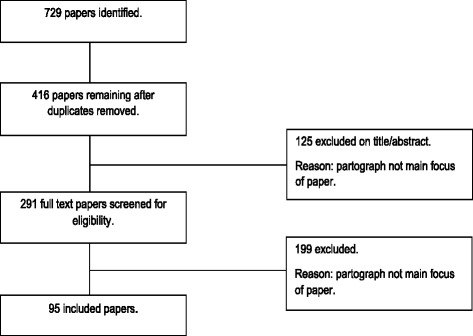
Methods: This review aimed to answer two key questions, 1) What is it about the partograph that works (or does not work); for whom does it work; and in what circumstances? 2) What are the essential inputs required for the partograph to work? A comprehensive search strategy encompassed key databases; including papers of varying methodologies. Papers were selected for inclusion if the focus of the paper was the partograph and related to context, mechanism or outcome. Ninety five papers were included for data synthesis. Two authors completed data extraction and synthesis.
Results: The evidence synthesis relates the evidence to identified theories of health worker acceptability, health system support, effective referral systems, human resources and health worker competence, highlighting barriers and facilitators.
Conclusions: This first comprehensive realist synthesis of the partograph, provides the international community of maternity clinicians with a picture of potential issues and solutions related to successful labour recording and management, which is also translatable to other monitoring approaches.
Keywords: Context; Labour; Outcomes; Partogram; Partograph; Use.
Figures

References
-
- World Health Organisation . WHO recommendations for augmentation of labour. Geneva: WHO; 2014. - PubMed
-
- Lavender T, Hart A, Smyth RMD. Effect of partogram use on outcomes for women in spontaneous labour at term. Cochrane Database of Systematic Reviews, 2013; Issue 7. Art. No.: CD005461. DOI: 10.1002/14651858.CD005461.pub4. - PubMed
Publication types
MeSH terms
LinkOut - more resources
Full Text Sources
Other Literature Sources
Medical
