. 2017 Jan 13;16(1):9.
doi: 10.1186/s12943-017-0583-1.

The lncRNA CRNDE promotes colorectal cancer cell proliferation and chemoresistance via miR-181a-5p-mediated regulation of Wnt/β-catenin signaling

Affiliations

The lncRNA CRNDE promotes colorectal cancer cell proliferation and chemoresistance via miR-181a-5p-mediated regulation of Wnt/β-catenin signaling

Peng Han et al. Mol Cancer. .

Abstract

Background: With more than 600,000 mortalities each year, colorectal cancer (CRC) is the third most commonly diagnosed type of cancer worldwide. Recently, mechanisms involving noncoding RNAs have been implicated in the development of CRC.

Methods: We examined expression levels of lncRNA CRNDE and miR-181a-5p in 64 cases of CRC tissues and cell lines by qRT-PCR. Gain-of-function and loss-of-function assays were performed to examine the effect of CRNDE and miR-181a-5p on proliferation and chemoresistance of CRC cells. Using fluorescence reporter and western blot assays, we also explored the possible mechanisms of CRNDE in CRC cells.

Results: In this study, we found that the expression levels of the CRNDE were upregulated in CRC clinical tissue samples. We identified microRNA miR-181a-5p as an inhibitory target of CRNDE. Both CRNDE knockdown and miR-181a-5p overexpression in CRC cell lines led to inhibited cell proliferation and reduced chemoresistance. We also determined that β-catenin and TCF4 were inhibitory targets of miR-181a-5p, and that Wnt/β-catenin signaling was inhibited by both CRNDE knockdown and miR-181a-5p overexpression. Significantly, we found that the repression of cell proliferation, the reduction of chemoresistance, and the inhibition of Wnt/β-catenin signaling induced by CRNDE knockdown would require the increased expression of miR-181a-5p.

Conclusions: Our study demonstrated that the lncRNA CRNDE could regulate the progression and chemoresistance of CRC via modulating the expression levels of miR-181a-5p and the activity of Wnt/β-catenin signaling.

Keywords: CRNDE; Chemoresistance; Colorectal cancer; Proliferation; Wnt/β-catenin signaling; miR-181a-5p.


Figures

Fig. 1
Fig. 1
CRNDE expression is elevated in CRC tissue. a Expression levels of CRNDE analyzed from data retrieved from the TCGA database in CRC patients (P <0.001). b Expression levels of CRNDE analyzed from GSO/GDS4385 (P < 0.01). c Expression levels of CRNDE as determined by qRT-PCR in 64 clinical CRC samples compared to those in adjacent normal tissue samples (P < 0.001). d CRNDE expression in six CRC cell lines compared with normal colorectal tissue pool. *P < 0.05, ***P < 0.01 and ***P < 0.001. e Kaplan-Meier analysis of the association between GRIM-19 expression and the survival in 64 clinical CRC patients. P < 0.001
Fig. 2
Fig. 2
CRNDE binds to miR-181a-5p and represses its expression. a Schematic illustration of the predicted binding sites between CRNDE and miR-181a-5p, and mutation of potential miR-181a-5p binding sequence in CRNDE. b Luciferase assays in 293 T cells transfected CRNDE wild type or mutants with miR-181a-5p (*P < 0.05). c Expression levels of miR-181a-5p as determined by qRT-PCR in 64 CRC samples compared to those in adjacent normal tissue samples (P < 0.001). d Expression levels of CRNDE and e miR-181a-5p as determined by qRT-PCR in HCT116 and SW480 cells transfected with siRNA targeting CRNDE (siR-CRNDE) or a control siRNA (siR-control) (*P < 0.05, ***P < 0.001). f Expression levels of CRNDE and g miR-181a-5p as determined by qRT-PCR in HCT116 and SW480 cells transfected with plasmids overexpressing wild type, mutant CRNDE or an empty vector (*P < 0.05, ***P < 0.001). h HEK293T were transfected with CRNDE, S1-CRNDE or S1-CRNDE mutant with or without miR-181a-5p inhibitor, then pull-down assays were performed (*P < 0.05). i Inverse correlation between the expression levels of CRNDE and those of miR-181a-5p in 64 CRC samples (r = −0.632, P < 0.001)
Fig. 3
Fig. 3
CRNDE knockdown and miR-181a-5p overexpression inhibit CRC cell proliferation. a MTT cell proliferation assays performed in HCT116 and SW480 cells transfected with siR-CRNDE or siR-control, or in HCT116 and SW480 cells transfected with miR-181a-5p or a control microRNA (miR-control). b colony formation assays performed in HCT116 and SW480 cells transfected with siR-CRNDE or siR-control, or in HCT116 and SW480 cells transfected with miR-181a-5p or miR-control. c BrdU assay performed in HCT116 and SW480 cells transfected with siR-CRNDE or siR-control, or in HCT116 and SW480 cells transfected with miR-181a-5p or miR-control. *P < 0.05, **P < 0.01
Fig. 4
Fig. 4
CRNDE knockdown and miR-181a-5p overexpression repress CRC cell chemoresistance. a MTT cell proliferation assay performed in HCT116 and SW480 cells transfected with siRNA targeting CRNDE or a control siRNA and treated with the indicated concentrations of 5-Fu. b MTT cell proliferation assay performed in HCT116 and SW480 cells transfected with miR-181a-5p or a control microRNA and treated with the indicated concentrations of 5-Fu. c MTT cell proliferation assay performed in HCT116 and SW480 cells transfected with siR-CRNDE or a control siRNA and treated with the indicated concentrations of Oxa. d MTT cell proliferation assay performed in HCT116 and SW480 cells transfected with miR-181a-5p or miR-control and treated with the indicated concentrations of Oxa. e Expression levels of CRNDE and f miR-181a-5p as determined by qRT-PCR in 5-Fu resistant HCT116 and SW480 cells. *P < 0.05
Fig. 5
Fig. 5
MiR-181a-5p targets β-catenin/TCF4 and inhibits Wnt/β-catenin signaling. a Expression levels of β-catenin and TCF4 shown as downregulated in HUVEC overexpressing miR-181a-5p from TarBase v7.0 database of DIANA TOOLS. b Schematic illustration of the predicted miR-181a-5p binding sites with the 3′-UTR of β-catenin and TCF4. c Luciferase activity assay performed in HEK293 cells co-transfected with miR-181a-5p and luciferase reporter plasmids driven by either wild type (WT) or mutant (MUT) 3′-UTR of β-catenin and TCF4 that was devoid of miR-181a-5p binding activity. d The protein levels of β-catenin and TCF4 as determined by Western blot analysis in HCT116 and SW480 cells transfected with miR-181a-5p or miR-control. e Inverse correlation between the expression levels of miR-181a-5p and those of β-catenin (r = −0.562, P < 0.001), and between the expression levels of miR-181a-5p and those of TCF4 (r = −0.518, P < 0.001) in 64 CRC samples. f TOP/FOP luciferase activity in HCT116 and SW480 cells transfected with miR-181a-5p or a miR-control. g The protein levels of Cyclin D1 and Axin2 as determined by Western blot analysis in HCT116 and SW480 cells transfected with miR-181a-5p or miR-control. *P < 0.05
Fig. 6
Fig. 6
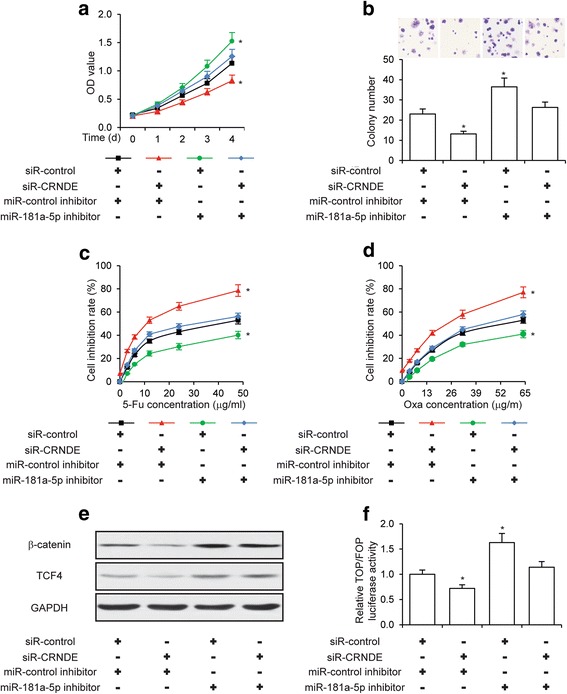
Regulation of CRC cell proliferation, chemoresistance and Wnt/β-catenin signaling by CRNDE requires miR-181a-5p. a MTT cell proliferation assay, b colony formation assay, c MTT cell proliferation assay under the treatment of the indicated concentrations of 5-Fu or d Oxa, e The protein levels of β-catenin and TCF4 as determined by Western blot analysis, and f TOP/FOP luciferase activity assay performed in HCT116 cells transfected with siR-CRNDE or siR-control simultaneously with inhibitors of miR-181a-5p or miR-control. *P < 0.05
Fig. 7
Fig. 7
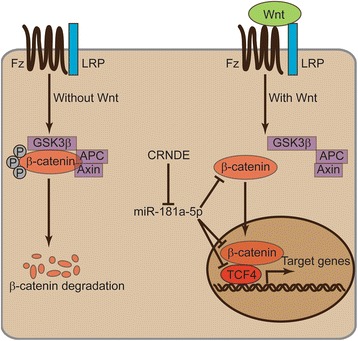
Schematic representation of Wnt/β-catenin signaling involved in regulation of CRNDE and miR-181a-5p

References

    1. Ferlay J, Shin HR, Bray F, Forman D, Mathers C, Parkin DM. Estimates of worldwide burden of cancer in 2008: GLOBOCAN 2008. Int J Cancer. 2010;127:2893–917. - PubMed
    1. Jemal A, Bray F, Center MM, Ferlay J, Ward E, Forman D. Global cancer statistics. CA Cancer J Clin. 2011;61:69–90. doi: 10.3322/caac.20107. - DOI - PubMed
    1. Pritchard CC, Grady WM. Colorectal cancer molecular biology moves into clinical practice. Gut. 2011;60:116–29. doi: 10.1136/gut.2009.206250. - DOI - PMC - PubMed
    1. Walther A, Johnstone E, Swanton C, Midgley R, Tomlinson I, Kerr D. Genetic prognostic and predictive markers in colorectal cancer. Nat Rev Cancer. 2009;9:489–99. doi: 10.1038/nrc2645. - DOI - PubMed
    1. Kazemzadeh M, Safaralizadeh R, Feizi MA, Ravanbakhsh R, Somi MH, Hashemzadeh S. LOC100287225, novel long intergenic non-coding RNA, misregulates in colorectal cancer. Cancer Biomark. 2016;16:499–505. doi: 10.3233/CBM-160589. - DOI - PubMed

Publication types

MeSH terms

LinkOut - more resources