


Multidimensional assessment of impulsivity in relation to obesity and food addiction
- PMID: 28087369
- PMCID: PMC5344714
- DOI: 10.1016/j.appet.2017.01.009
Multidimensional assessment of impulsivity in relation to obesity and food addiction
Abstract
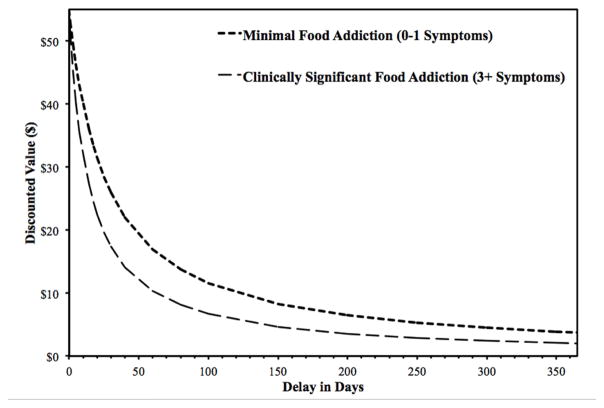
Based on similarities between overconsumption of food and addictive drugs, there is increasing interest in "food addiction," a compulsive eating pattern defined using symptoms parallel to substance use disorders. Impulsivity, a multidimensional construct robustly linked to drug addiction, has been increasingly examined as an obesity determinant, but with mixed findings. This study sought to clarify relations between three major domains of impulsivity (i.e., impulsive personality traits, discounting of delayed rewards, and behavioral inhibition) in both obesity and food addiction. Based on the association between impulsivity and compulsive drug use, the general hypothesis was that the impulsivity-food addiction relation would be stronger than and responsible for the impulsivity-obesity relation. Using a cross-sectional dimensional design, participants (N = 181; 32% obese) completed a biometric assessment, the Yale Food Addiction Scale (YFAS), the UPPS-P Impulsive Behavior Scales, a Go/NoGo task, and measures of monetary delay discounting. Results revealed significantly higher prevalence of food addiction among obese participants and stronger zero-order associations between impulsivity indices and YFAS compared to obesity. Two aspects of impulsivity were independently significantly associated with food addiction: (a) a composite of Positive and Negative Urgency, reflecting proneness to act impulsively during intense mood states, and (b) steep discounting of delayed rewards. Furthermore, the results supported food addiction as a mediator connecting both urgency and delay discounting with obesity. These findings provide further evidence linking impulsivity to food addiction and obesity, and suggest that food addiction may be a candidate etiological pathway to obesity for individuals exhibiting elevations in these domains.
Keywords: Delay discounting; Food addiction; Impulsivity; Obesity; Urgency.
Copyright © 2017 Elsevier Ltd. All rights reserved.
Figures
References
-
- American Psychiatric Association. Diagnostic and Statistical Manual of Mental Disorders. 4. Washington, DC: 2000.
-
- Amlung M, Petker T, Jackson J, Balodis I, MacKillop J. Steep Discounting of Delayed Monetary and Food Rewards in Obesity: A Meta-Analysis. Psychological Medicine 2016 - PubMed
-
- Amlung M, Sweet LH, Acker J, Brown CL, Mackillop J. Dissociable brain signatures of choice conflict and immediate reward preferences in alcohol use disorders. Addiction Biology. 2013 http://doi.org/10.1111/adb.12017. - DOI - PMC - PubMed
-
- Avena NM. The study of food addiction using animal models of binge eating. Appetite. 2010;55(3):734–737. http://doi.org/10.1016/j.appet.2010.09.010. - DOI - PMC - PubMed
MeSH terms
Grants and funding
LinkOut - more resources
Full Text Sources
Other Literature Sources
Medical
