


Elimination of sucrose transport and hydrolysis in Saccharomyces cerevisiae: a platform strain for engineering sucrose metabolism
- PMID: 28087672
- PMCID: PMC5424818
- DOI: 10.1093/femsyr/fox006
Elimination of sucrose transport and hydrolysis in Saccharomyces cerevisiae: a platform strain for engineering sucrose metabolism
Abstract
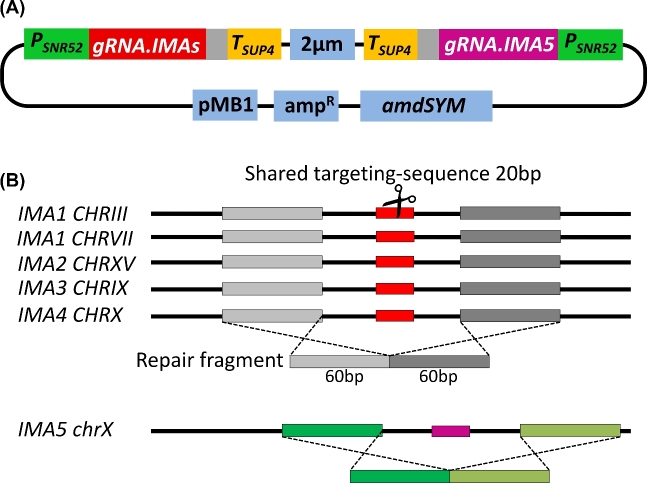
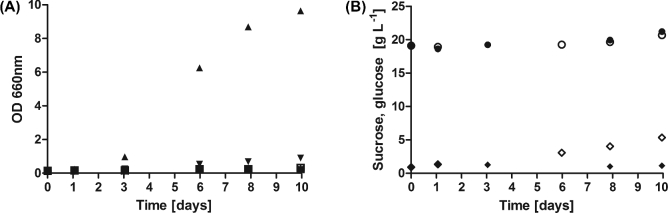
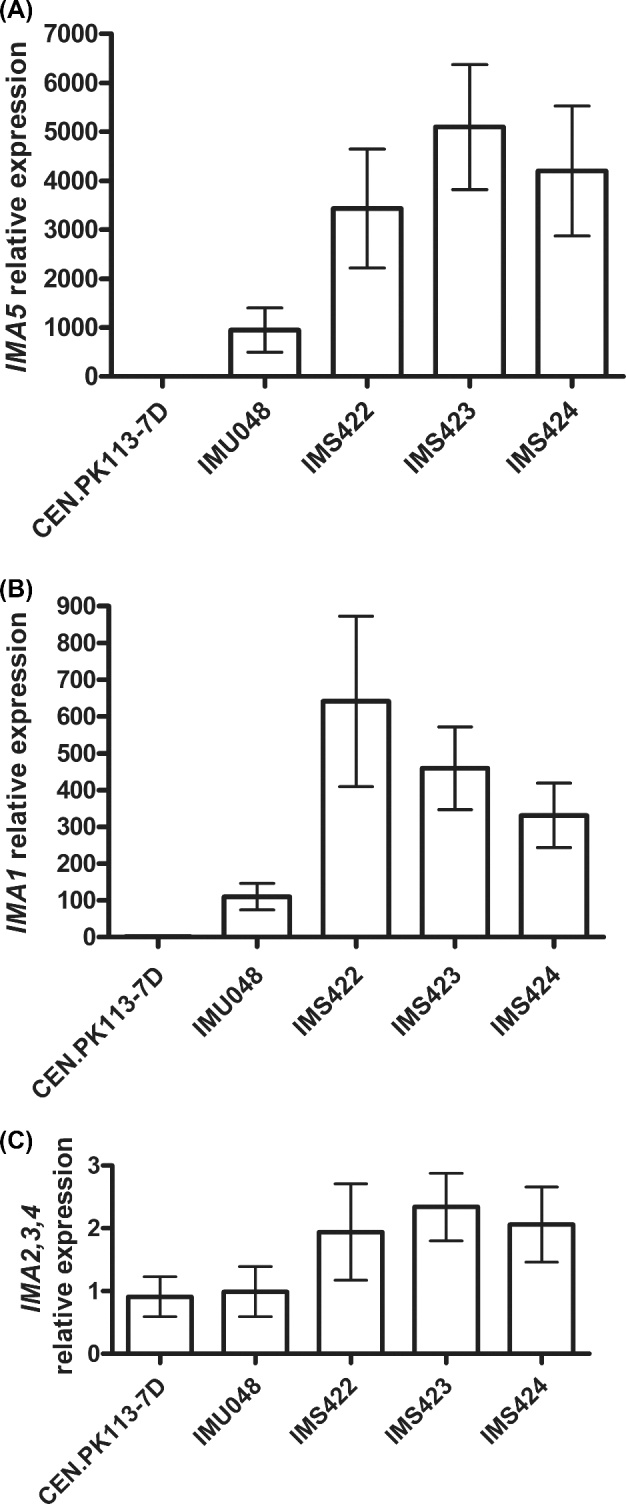
Many relevant options to improve efficacy and kinetics of sucrose metabolism in Saccharomyces cerevisiae and, thereby, the economics of sucrose-based processes remain to be investigated. An essential first step is to identify all native sucrose-hydrolysing enzymes and sucrose transporters in this yeast, including those that can be activated by suppressor mutations in sucrose-negative strains. A strain in which all known sucrose-transporter genes (MAL11, MAL21, MAL31, MPH2, MPH3) were deleted did not grow on sucrose after 2 months of incubation. In contrast, a strain with deletions in genes encoding sucrose-hydrolysing enzymes (SUC2, MAL12, MAL22, MAL32) still grew on sucrose. Its specific growth rate increased from 0.08 to 0.25 h-1 after sequential batch cultivation. This increase was accompanied by a 3-fold increase of in vitro sucrose-hydrolysis and isomaltase activities, as well as by a 3- to 5-fold upregulation of the isomaltase-encoding genes IMA1 and IMA5. One-step Cas9-mediated deletion of all isomaltase-encoding genes (IMA1-5) completely abolished sucrose hydrolysis. Even after 2 months of incubation, the resulting strain did not grow on sucrose. This sucrose-negative strain can be used as a platform to test metabolic engineering strategies and for fundamental studies into sucrose hydrolysis or transport.
Keywords: disaccharide; isomaltase; laboratory evolution; multiple gene deletion; real-time PCR; reverse engineering.
© FEMS 2017.
Figures
References
-
- Alamäe T, Pärn P, Viigand K et al. . Regulation of the Hansenula polymorpha maltase gene promoter in H. polymorpha and Saccharomyces cerevisiae. FEMS Yeast Res 2003;4:165–73 - PubMed
-
- Bali M, Zhang B, Morano KA et al. . The Hsp90 molecular chaperone complex regulates maltose induction and stability of the Saccharomyces MAL gene transcription activator Mal63p. J Biol Chem 2003;278:47441–8 - PubMed
-
- Basso TO, de Kok S, Dario M et al. . Engineering topology and kinetics of sucrose metabolism in Saccharomyces cerevisiae for improved ethanol yield. Metab Eng 2011;13:694–703 - PubMed
MeSH terms
Substances
LinkOut - more resources
Full Text Sources
Other Literature Sources
