. 2017 Mar 3;292(9):3720-3728.
doi: 10.1074/jbc.M116.763813. Epub 2017 Jan 13.

Iso-α-acids, Bitter Components of Beer, Prevent Inflammation and Cognitive Decline Induced in a Mouse Model of Alzheimer's Disease

Affiliations

Iso-α-acids, Bitter Components of Beer, Prevent Inflammation and Cognitive Decline Induced in a Mouse Model of Alzheimer's Disease

Yasuhisa Ano et al. J Biol Chem. .

Abstract

Alongside the rapid growth in aging populations worldwide, prevention and therapy for age-related memory decline and dementia are in great demand to maintain a long, healthy life. Here we found that iso-α-acids, hop-derived bitter compounds in beer, enhance microglial phagocytosis and suppress inflammation via activation of the peroxisome proliferator-activated receptor γ. In normal mice, oral administration of iso-α-acids led to a significant increase both in CD11b and CD206 double-positive anti-inflammatory type microglia (p < 0.05) and in microglial phagocytosis in the brain. In Alzheimer's model 5xFAD mice, oral administration of iso-α-acids resulted in a 21% reduction in amyloid β in the cerebral cortex as observed by immunohistochemical analysis, a significant reduction in inflammatory cytokines such as IL-1β and chemokines including macrophage inflammatory protein-1α in the cerebral cortex (p < 0.05) and a significant improvement in a novel object recognition test (p < 0.05), as compared with control-fed 5xFAD mice. The differences in iso-α-acid-fed mice were due to the induction of microglia to an anti-inflammatory phenotype. The present study is the first to report that amyloid β deposition and inflammation are suppressed in a mouse model of Alzheimer's disease by a single component, iso-α-acids, via the regulation of microglial activation. The suppression of neuroinflammation and improvement in cognitive function suggests that iso-α-acids contained in beer may be useful for the prevention of dementia.

Keywords: Alzheimer disease; inflammation; microglia; neuroinflammation; phagocytosis.


Conflict of interest statement

The authors declare that they have no conflicts of interest with the contents of this article

Figures
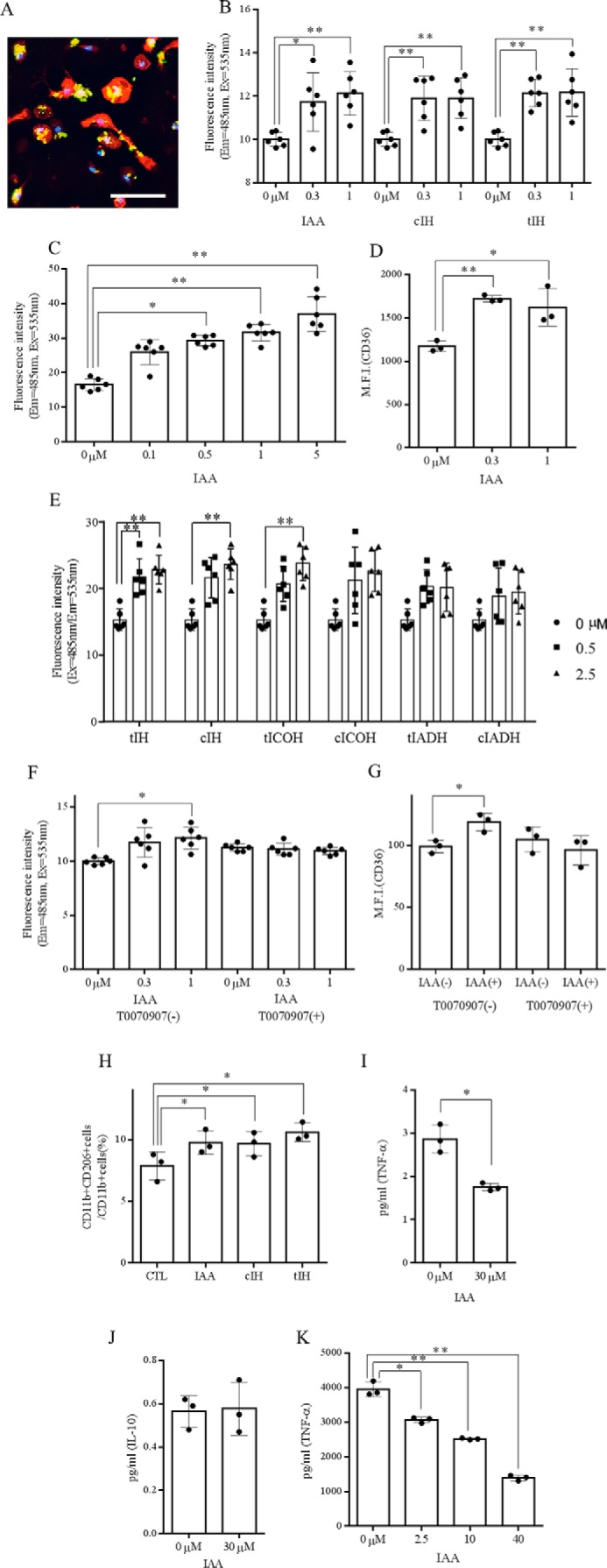
FIGURE 1.
FIGURE 1.
Effect of in vitro treatment with iso-α-acids on microglial phagocytic and anti-inflammatory activity. A, immunofluorescent image of cultured microglia showing CD11b-positive microglia (red) engulfing Aβ-FAM (green). DAPI-stained nuclei are shown in blue. The scale bar indicates 100 μm. B, effects of isomerized hop extract containing 0.3 or 1 μm IAAs, tIH, or cIH on in vitro phagocytosis of Aβ-FAM by CD11b-positive microglia. C, effects of 0.1–5 μm IAAs on in vitro phagocytosis of Aβ-FAM by CD11b-positive microglia. D, expression of CD36 on microglia cells treated with 0, 0.3, or 1.0 μm IAA analyzed by flow cytometry. E, microglial phagocytosis of Aβ-FAM measured after pretreatment with 0, 0.5, and 2.5 μm individual iso-α-acids: tIH, cIH, trans-isocohumulone (tICOH), cis-isocohumulone (cICOH), trans-isoadhumulone (tIADH), and cis-isoadhumulone (cIADH). F and G, phagocytosis of Aβ (F) and CD36 expression (G) in isolated microglia pretreated with 50 nm T0070907, a PPAR-γ antagonist, prior to iso-α-acid treatment. H, ratio of CD11b-positive and CD206-positive cells to CD11b-positive cells in microglia, calculated by flow cytometry after treatment with 3 μm IAA. I and J, ratio of TNF-α-positive (I) and IL-10-positive (J) cells to CD11b-positive microglia. K, concentration of TNF-α in microglial cultural supernatant after pretreatment with 0, 0.5, and 2.5 μm IAA and treatment with 5 ng/ml LPS and 0.5 ng/ml IFN-γ. The data are the means ± S.D. of 3–5 wells/sample. *, p < 0.05; **, p < 0.01.
FIGURE 2.
FIGURE 2.
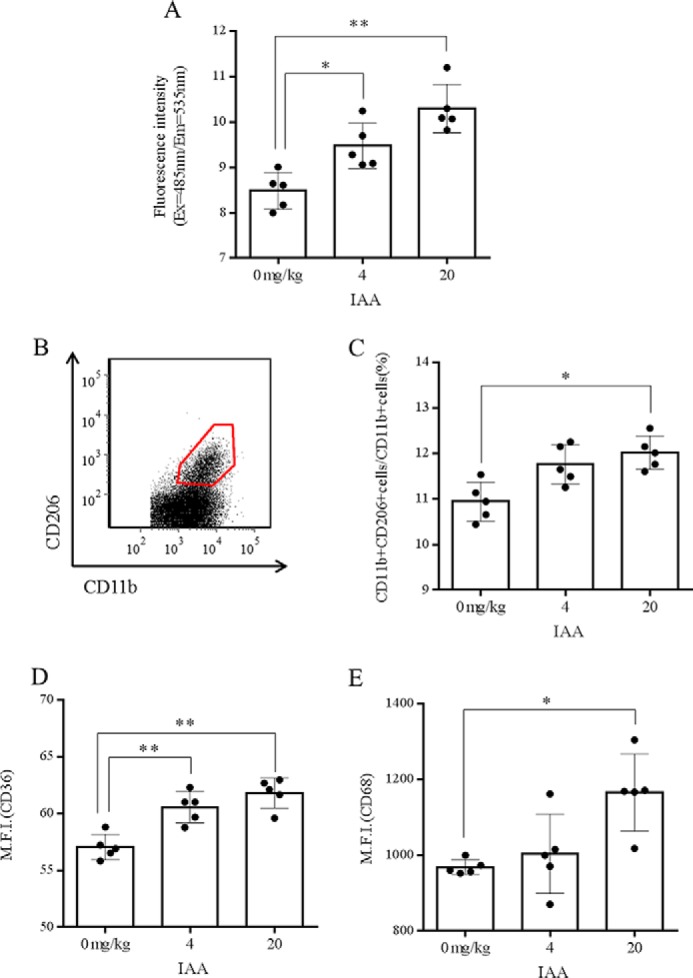
Effect of in vivo treatment with iso-α-acids on microglial phagocytic activity. A, phagocytosis of Aβ by microglia isolated from hippocampi of mice orally administered 0, 4, or 20 mg/kg of IAAs once a day for 3 days. B and C, scatter plots from flow cytometry detection of CD11b-positive cells showing the ratio of CD11b CD206 double-positive to CD11b-positive microglia under the above conditions. CD11b- and CD206-positive cells were gated as shown by the boxed area in B, and the ratio of CD11b-positive cells plus CD206-positive cells to CD11b-positive cells was calculated (C). D and E, expression of CD36 (D), and CD68 (E) in CD11b-positive microglia. The data are the means ± S.D. of 5 mice/group. *, p < 0.05; **, p < 0.01.
FIGURE 3.
FIGURE 3.
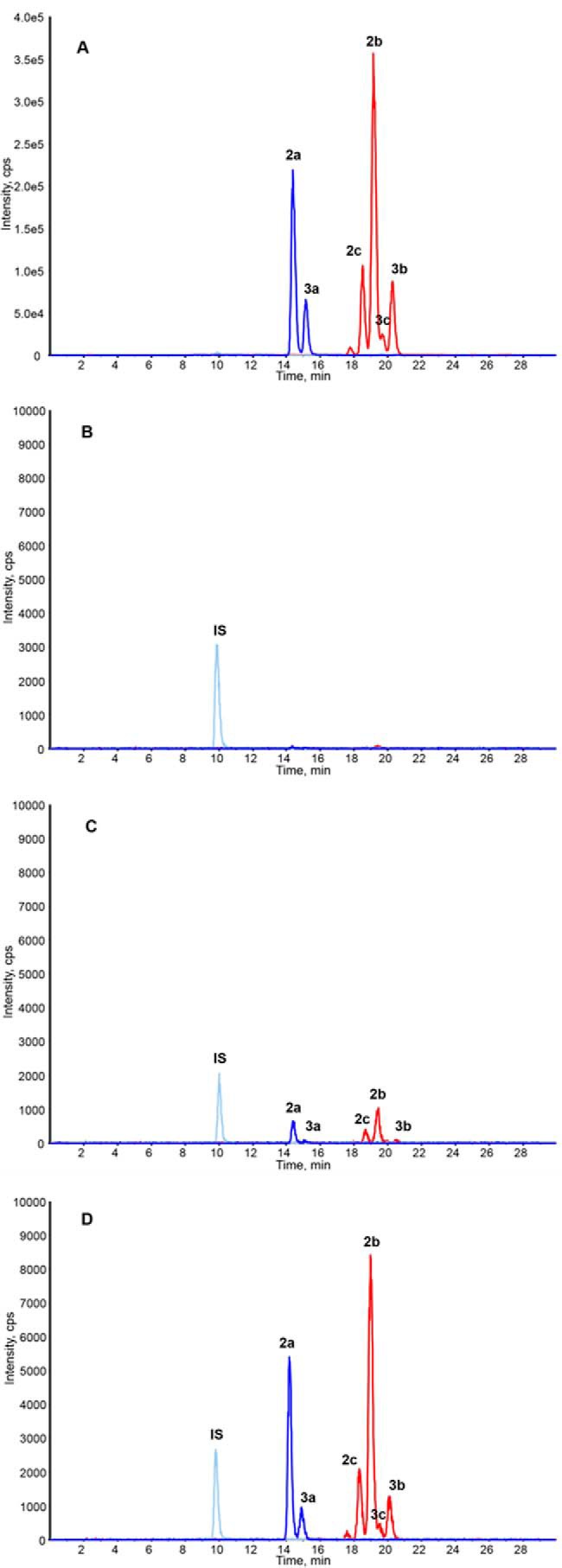
Permeability of iso-α-acids through the blood-brain barrier. A–D, HPLC-MS/MS chromatograms of an IHE (sample for administration) (A), vehicle (B), IHE containing 0.5 g/kg of iso-α-acids (C), and IHE containing 2 g/kg of iso-α-acids (D). The peaks are labeled according to the compounds shown in Fig. 7.
FIGURE 4.
FIGURE 4.
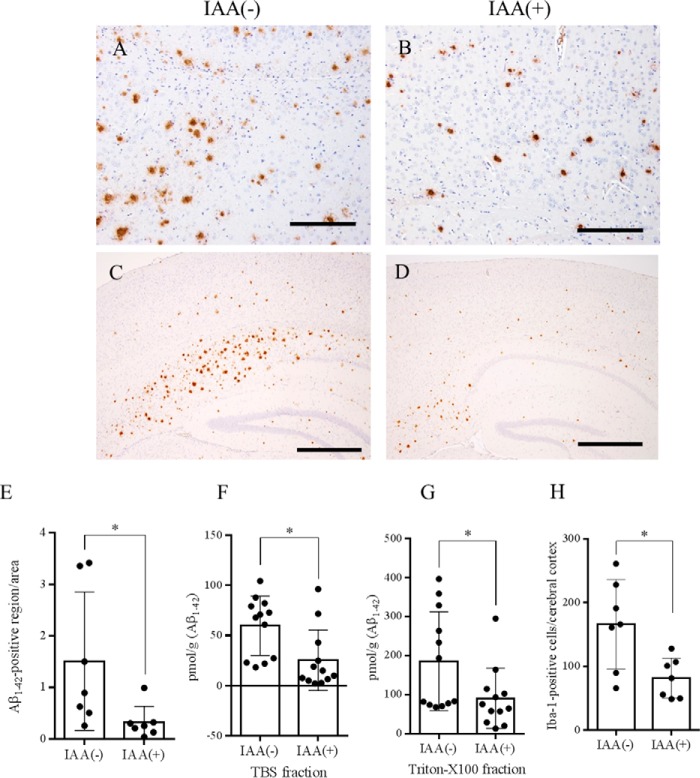
Effect of oral iso-α-acids on Aβ deposition in the brain of Alzheimer's disease model mice. A–D, immunohistochemistry of Aβ1–42 distribution in the cerebral cortex of mice fed with control diet (A and C) and IAA-containing diet (B and D). E, quantification of Aβ1–42-positive areas in cerebral cortex calculated by ImageJ. F–H, soluble (F) and insoluble (G) Aβ1–42, the number of Iba-1 positive cells (H) in the cortex of 5xFAD transgenic mice fed with CTL or IAA diet for 2.5 months quantified by ELISA. The data in the ELISA assay are represented as the means ± S.E. of 13 mice (wild-type group with control diet, 5xFAD group with control diet, 5xFAD group with IAA diet), or 5 mice (wild-type group with IAA diet). The data in the immunohistochemistry represent the means ± S.D. of 6–7 mice/group. *, p < 0.05. The scale bars represent 200 μm in A and B and 500 μm in C and D.
FIGURE 5.
FIGURE 5.
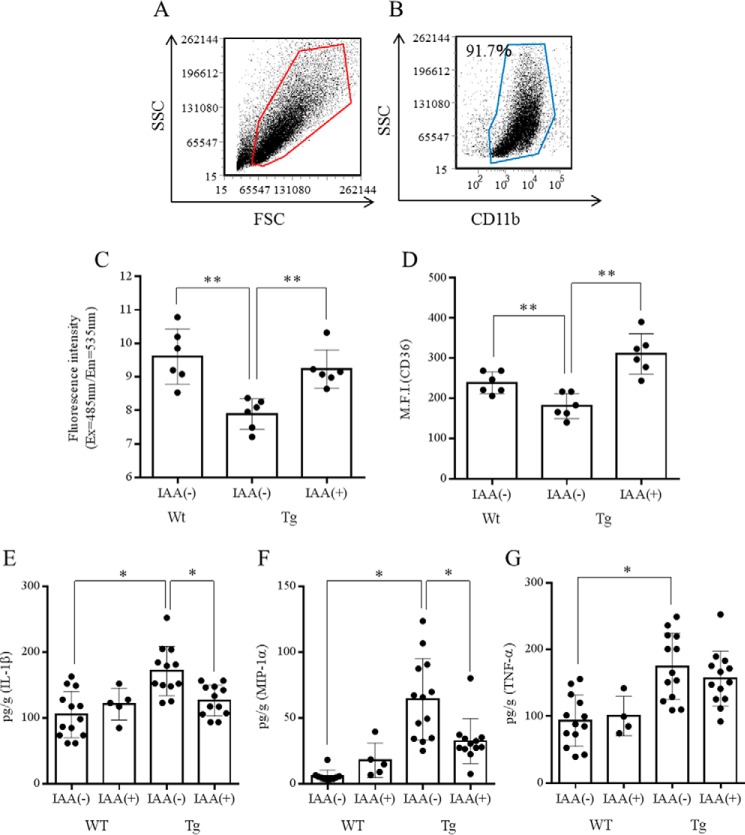
Characterization of microglia in the brains of mice fed a diet with or without iso-α-acids for 2.5 months. A and B, purity of isolated microglia after MACS (>90%) in the scatter plot of forward scatter (FSC) and side scatter (SSC). C, Aβ phagocytosis in microglia isolated from the wild-type, control, and IAA groups. D, expression of CD36 on the surface of microglia. E–G, concentration of IL-1β (E), TNF-α (F), and MIP-1α (G) in the cerebral cortex. The data represent the means ± S.D. of 7 or 13 mice/group. *, p < 0.05; **, p < 0.01.
FIGURE 6.
FIGURE 6.
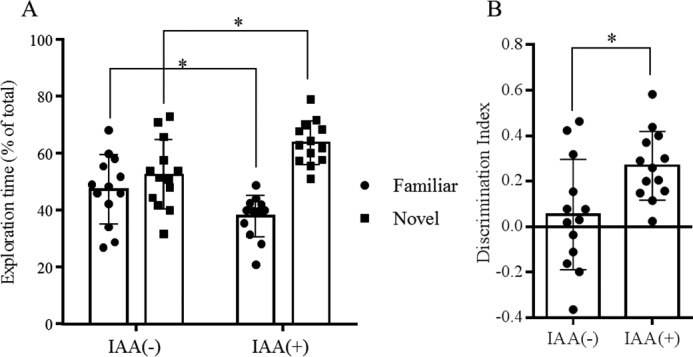
Novel object recognition test of episodic memory. A, time spent by 5xFAD transgenic mice fed a control diet or a diet containing 0.05% (w/w) IAAs for 2.5 months exploring novel and familiar objects during 5 min of re-exploration as a percentage of the total time spent exploring objects. B, discrimination index (time spent with object A − time spent with object B)/(total time exploring both objects). The data represent the means ± S.D. of 13 mice/group. *, p < 0.05.
FIGURE 7.
FIGURE 7.
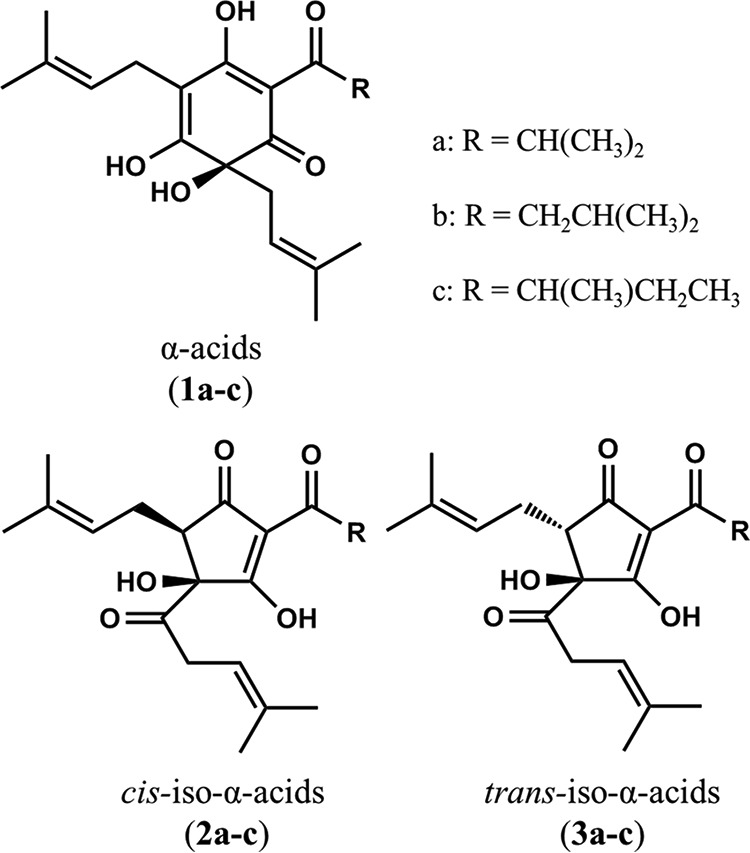
Chemical structures of α-acids and iso-α-acids. Shown are the structures of α-acids cohumulone (1a), humulone (1b), and adhumulone (1c); cis-iso-α-acids cis-isocohumulone (2a), cis-isohumulone (2b), and cis-isoadhumulone (2c); and trans-iso-α-acids trans-isocohumulone (3a), trans-isohumulone (3b), and trans-isoadhumulone (3c).

References

    1. Matsui T., Yoshimura A., Toyama T., Matsushita S., and Higuchi S. (2011) Preventive effect of moderation in drinking on dementia. Nihon Rinsho 69, (Suppl. 10) 217–222 - PubMed
    1. Neafsey E. J., and Collins M. A. (2011) Moderate alcohol consumption and cognitive risk. Neuropsychiatr. Dis. Treat. 7, 465–484 - PMC - PubMed
    1. Horvat P., Richards M., Kubinova R., Pajak A., Malyutina S., Shishkin S., Pikhart H., Peasey A., Marmot M. G., Singh-Manoux A., and Bobak M. (2015) Alcohol consumption, drinking patterns, and cognitive function in older Eastern European adults. Neurology 84, 287–295 - PMC - PubMed
    1. Arntzen K. A., Schirmer H., Wilsgaard T., and Mathiesen E. B. (2010) Moderate wine consumption is associated with better cognitive test results: a 7 year follow up of 5033 subjects in the Tromsø Study. Acta Neurol. Scand. Suppl. 2010, 23–29 - PubMed
    1. Porquet D., Griñán-Ferré C., Ferrer I., Camins A., Sanfeliu C., Del Valle J., and Pallàs M. (2014) Neuroprotective role of trans-resveratrol in a murine model of familial Alzheimer's disease. J. Alzheimers Dis. 42, 1209–1220 - PubMed

MeSH terms