


The Rice Paradox: Multiple Origins but Single Domestication in Asian Rice
- PMID: 28087768
- PMCID: PMC5400379
- DOI: 10.1093/molbev/msx049
The Rice Paradox: Multiple Origins but Single Domestication in Asian Rice
Abstract
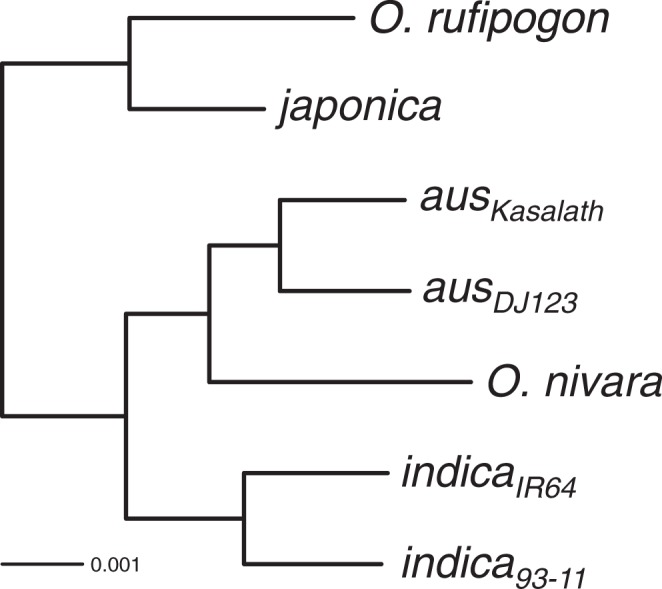
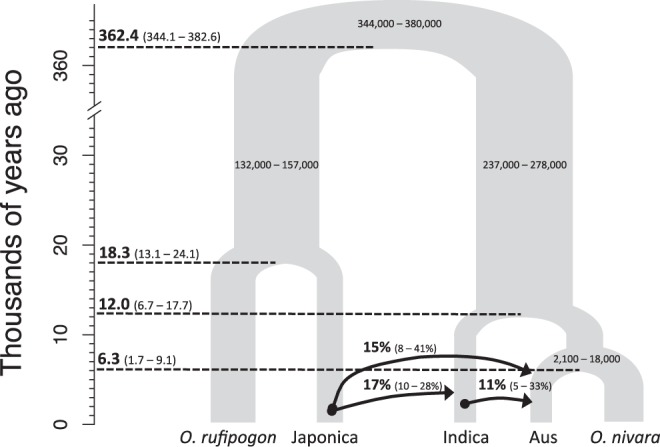
The origin of domesticated Asian rice (Oryza sativa) has been a contentious topic, with conflicting evidence for either single or multiple domestication of this key crop species. We examined the evolutionary history of domesticated rice by analyzing de novo assembled genomes from domesticated rice and its wild progenitors. Our results indicate multiple origins, where each domesticated rice subpopulation (japonica, indica, and aus) arose separately from progenitor O. rufipogon and/or O. nivara. Coalescence-based modeling of demographic parameters estimate that the first domesticated rice population to split off from O. rufipogon was O. sativa ssp. japonica, occurring at ∼13.1-24.1 ka, which is an order of magnitude older then the earliest archeological date of domestication. This date is consistent, however, with the expansion of O. rufipogon populations after the Last Glacial Maximum ∼18 ka and archeological evidence for early wild rice management in China. We also show that there is significant gene flow from japonica to both indica (∼17%) and aus (∼15%), which led to the transfer of domestication alleles from early-domesticated japonica to proto-indica and proto-aus populations. Our results provide support for a model in which different rice subspecies had separate origins, but that de novo domestication occurred only once, in O. sativa ssp. japonica, and introgressive hybridization from early japonica to proto-indica and proto-aus led to domesticated indica and aus rice.
Keywords: crop species; adaptation; gene flow; introgressive hybridization.
© The Author 2017. Published by Oxford University Press on behalf of the Society for Molecular Biology and Evolution.
Figures
References
-
- Bates J, Petrie CA, Singh RN.. 2016. Approaching rice domestication in South Asia: new evidence from Indus settlements in northern India. J Archaeol Sci. Advance Access published November 21, 2016, doi: http://dx.doi.org/10.1016/j.jas.2016.04.018. - DOI - PMC - PubMed
-
- Castillo CC, Tanaka K, Sato Y-I, Ishikawa R, Bellina B, Higham C, Chang N, Mohanty R, Kajale M, Fuller DQ.. 2016. Archaeogenetic study of prehistoric rice remains from Thailand and India: evidence of early japonica in South and Southeast Asia. Archaeol Anthropol Sci. 8:523–543.
Publication types
MeSH terms
LinkOut - more resources
Full Text Sources
Other Literature Sources
