


Accumulation of DNA damage in the aged hematopoietic stem cell compartment
- PMID: 28088982
- PMCID: PMC5242379
- DOI: 10.1053/j.seminhematol.2016.11.001
Accumulation of DNA damage in the aged hematopoietic stem cell compartment
Abstract
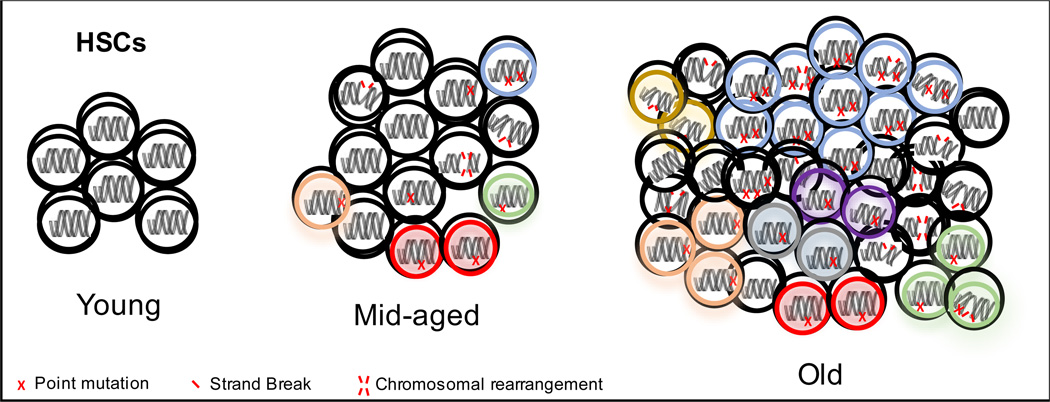
Aging is associated with loss of functional potential of multiple tissue systems, and there has been significant interest in understanding how tissue-specific cells contribute to this decline. DNA damage accumulation has been widely associated with aging in differentiated cell types. However, tissue-specific stem cells were once thought to be a geno-protected population, as damage accrued in a stem cell population has the potential to be inherited by differentiated progeny, as well as propagated within the stem cell compartment through self-renewal divisions. This review will discuss the evidence for DNA damage accumulation in the aged HSC compartment, potential drivers, and finally the consequences of the acquired damage.
Keywords: Aging; DNA damage; HSC; Hematopoietic stem cells.
Published by Elsevier Inc.
Figures
References
-
- Failla G. Considerations bearing on permissible accumulated radiation doses for occupational exposure; the aging process and cancerogenesis. Radiology. 1957;69(1):23–28. discussion, 8–9. - PubMed
-
- Moskalev AA, Shaposhnikov MV, Plyusnina EN, Zhavoronkov A, Budovsky A, Yanai H, et al. The role of DNA damage and repair in aging through the prism of Koch-like criteria. Ageing research reviews. 2013;12(2):661–684. - PubMed
-
- Lindahl T. Instability and decay of the primary structure of DNA. Nature. 1993;362(6422):709–715. - PubMed
Publication types
MeSH terms
Grants and funding
LinkOut - more resources
Full Text Sources
Other Literature Sources
Medical
