


Barriers to providing maternity care to women with physical disabilities: Perspectives from health care practitioners
- PMID: 28089188
- PMCID: PMC5466834
- DOI: 10.1016/j.dhjo.2016.12.021
Barriers to providing maternity care to women with physical disabilities: Perspectives from health care practitioners
Abstract
Background: Women with physical disabilities are known to experience disparities in maternity care access and quality, and communication gaps with maternity care providers, however there is little research exploring the maternity care experiences of women with physical disabilities from the perspective of their health care practitioners.
Objective: This study explored health care practitioners' experiences and needs around providing perinatal care to women with physical disabilities in order to identify potential drivers of these disparities.
Methods: We conducted semi-structured telephone interviews with 14 health care practitioners in the United States who provide maternity care to women with physical disabilities, as identified by affiliation with disability-related organizations, publications and snowball sampling. Descriptive coding and content analysis techniques were used to develop an iterative code book related to barriers to caring for this population. Public health theory regarding levels of barriers was applied to generate broad barrier categories, which were then analyzed using content analysis.
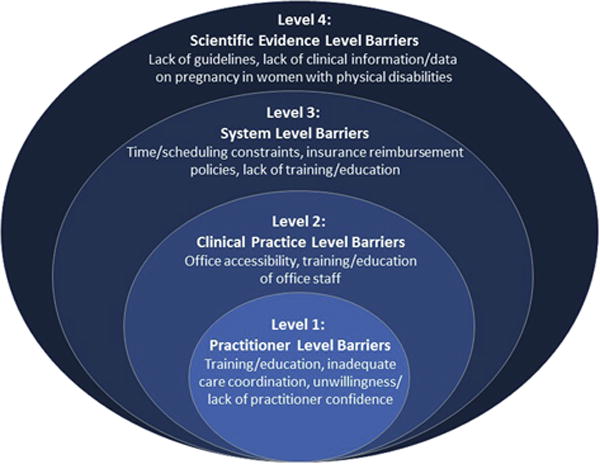
Results: Participant-reported barriers to providing optimal maternity care to women with physical disabilities were grouped into four levels: practitioner level (e.g., unwillingness to provide care), clinical practice level (e.g., accessible office equipment like adjustable exam tables), system level (e.g., time limits, reimbursement policies), and barriers relating to lack of scientific evidence (e.g., lack of disability-specific clinical data).
Conclusion: Participants endorsed barriers to providing optimal maternity care to women with physical disabilities. Our findings highlight the needs for maternity care practice guidelines for women with physical disabilities, and for training and education regarding the maternity care needs of this population.
Keywords: Disability; Perinatal care; Pregnancy; Prenatal care; Women's health.
Copyright © 2016 Elsevier Inc. All rights reserved.
References
MeSH terms
Grants and funding
LinkOut - more resources
Full Text Sources
Other Literature Sources
Medical
