


24-Hour protein, arginine and citrulline metabolism in fed critically ill children - A stable isotope tracer study
- PMID: 28089618
- PMCID: PMC5404980
- DOI: 10.1016/j.clnu.2016.12.023
24-Hour protein, arginine and citrulline metabolism in fed critically ill children - A stable isotope tracer study
Abstract
Background & aims: The reference method to study protein and arginine metabolism in critically ill children is measuring plasma amino acid appearances with stable isotopes during a short (4-8 h) time period and extrapolate results to 24-h. However, 24-h measurements may be variable due to critical illness related factors and a circadian rhythm could be present. Since only short duration stable isotope studies in critically ill children have been conducted before, the aim of this study was to investigate 24-h appearance of specific amino acids representing protein and arginine metabolism, with stable isotope techniques in continuously fed critically ill children.
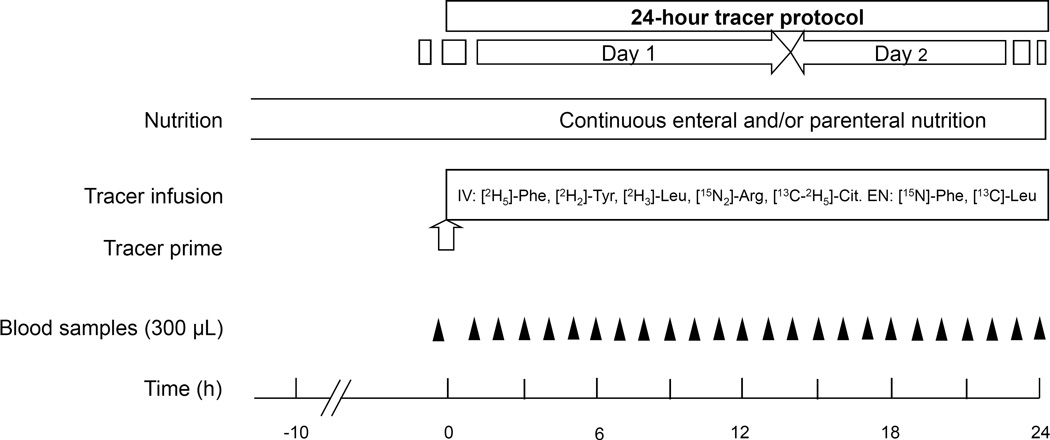
Methods: In eight critically ill children, admitted to the pediatric (n = 4) or cardiovascular (n = 4) intensive care unit, aged 0-10 years, receiving continuous (par)enteral nutrition with protein intake 1.0-3.7 g/kg/day, a 24-h stable isotope tracer protocol was carried out. L-[ring-2H5]-phenylalanine, L-[3,3-2H2]-tyrosine, L-[5,5,5-2H3]-leucine, L-[guanido-15N2]-arginine and L-[5-13C-3,3,4,4-2H4]-citrulline were infused intravenously and L-[15N]-phenylalanine and L-[1-13C]leucine enterally. Arterial blood was sampled every hour.
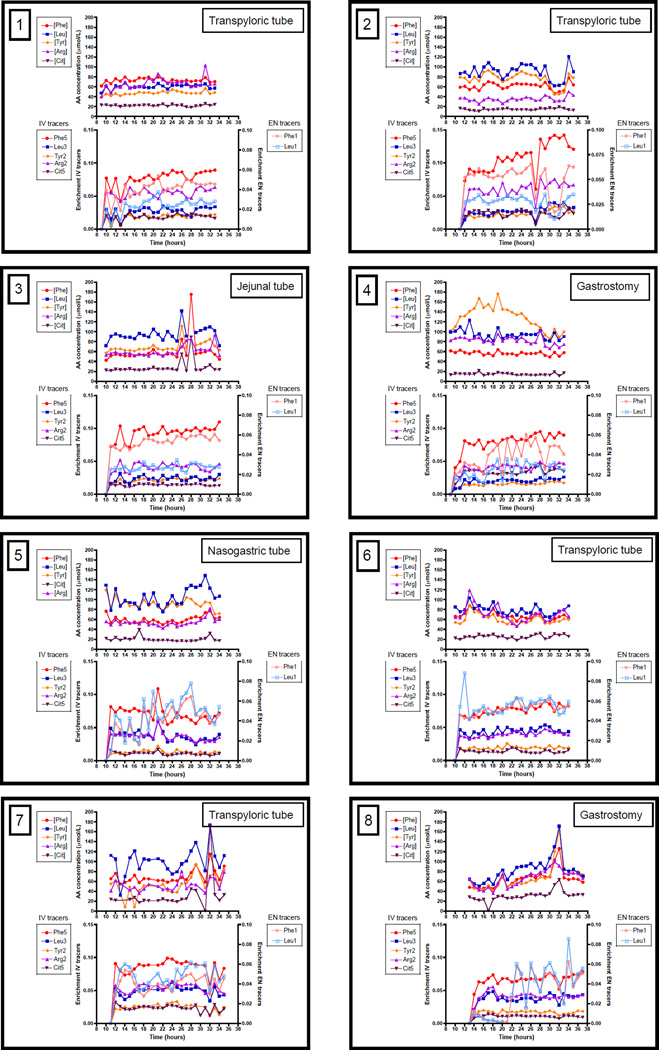
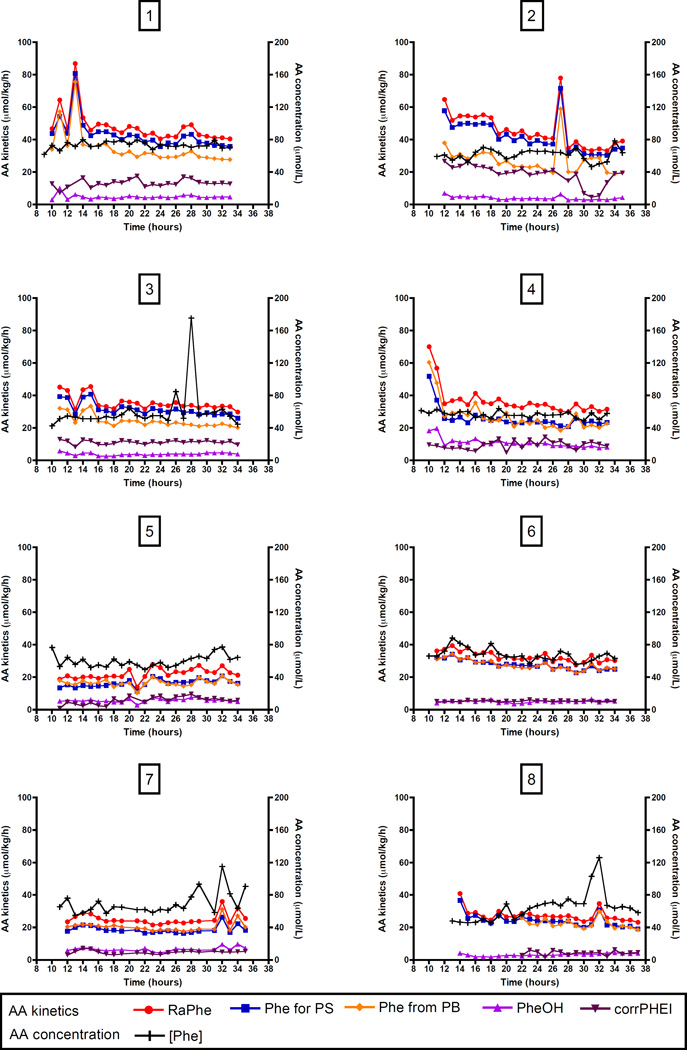
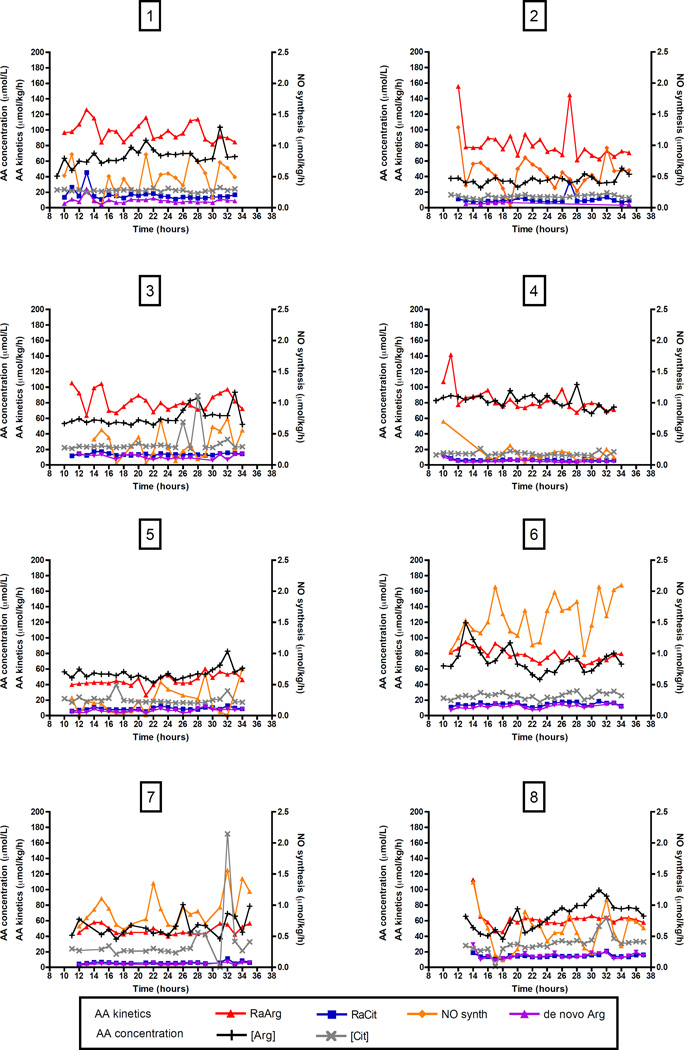
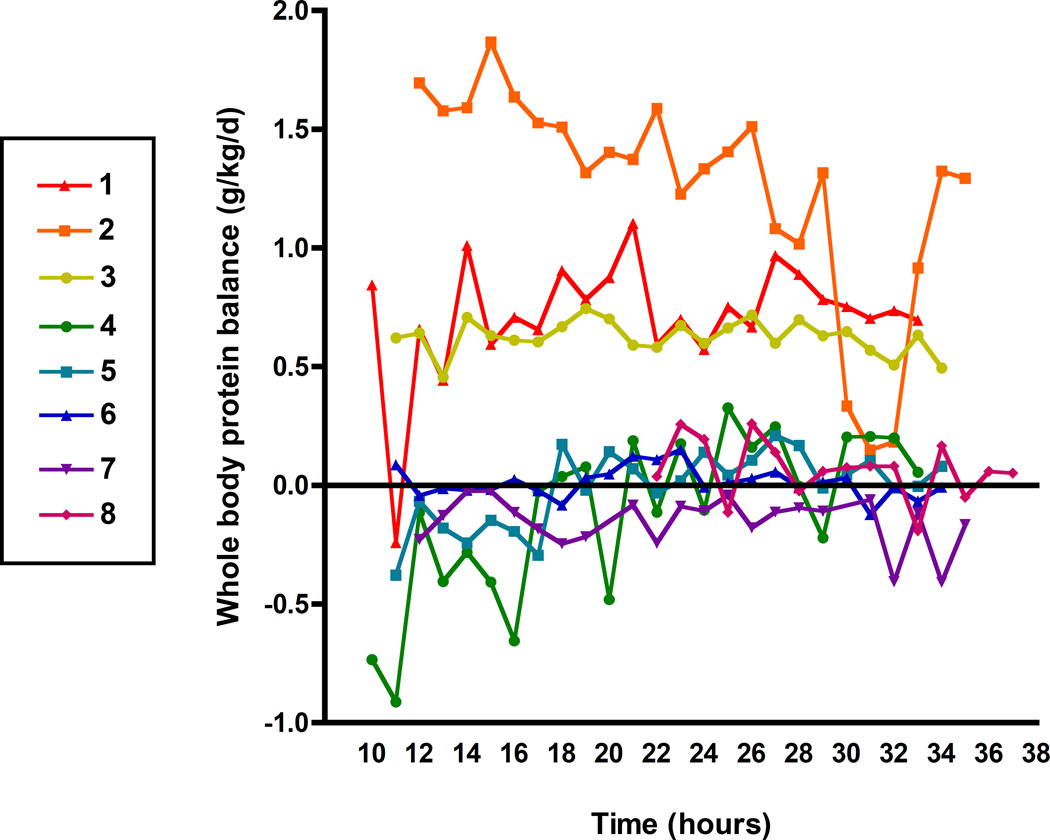
Results: Coefficients of variation, representing intra-individual variability, of the amino acid appearances of phenylalanine, tyrosine, leucine, arginine and citrulline were high, on average 14-19% for intravenous tracers and 23-26% for enteral tracers. No evident circadian rhythm was present. The pattern and overall 24-h level of whole body protein balance differed per individual.
Conclusions: In continuously fed stable critically ill children, the amino acid appearances of phenylalanine, tyrosine, leucine, arginine and citrulline show high variability. This should be kept in mind when performing stable isotope studies in this population. There was no apparent circadian rhythm.
Clinical trial register: NCT01511354 on clinicaltrials.gov.
Keywords: 24-Hour pattern; Amino acid metabolism; Circadian rhythm; Critical illness; Pediatric; Protein metabolism.
Copyright © 2017 Elsevier Ltd and European Society for Clinical Nutrition and Metabolism. All rights reserved.
Conflict of interest statement
All authors declare no conflict of interest.
Figures
References
-
- Pollack MM, Ruttimann UE, Wiley JS. Nutritional depletions in critically ill children: associations with physiologic instability and increased quantity of care. JPEN J Parenter Enteral Nutr. 1985;9:309–313. - PubMed
-
- Mehta NM, Compher C. A.S.P.E.N. Clinical Guidelines: nutrition support of the critically ill child. JPEN J Parenter Enteral Nutr. 2009;33:260–276. - PubMed
-
- Koletzko B, Goulet O, Hunt J, Krohn K, Shamir R. Parenteral Nutrition Guidelines Working G, European Society for Clinical N, Metabolism, European Society of Paediatric Gastroenterology H, Nutrition, et al. 1. Guidelines on Paediatric Parenteral Nutrition of the European Society of Paediatric Gastroenterology, Hepatology and Nutrition (ESPGHAN) and the European Society for Clinical Nutrition and Metabolism (ESPEN), Supported by the European Society of Paediatric Research (ESPR) J Pediatr Gastroenterol Nutr. 2005;41(Suppl 2):S1–S87. - PubMed
-
- de Betue CT, Deutz NE. Changes in arginine metabolism during sepsis and critical illness in children. Nestle Nutr Inst Workshop Ser. 2013;77:17–28. - PubMed
-
- Protein and amino acid requirements in human nutrition: report of a joint FAO/WHO/UNU expert consultation. Geneva, Switzerland: WHO; 2007.
MeSH terms
Substances
Associated data
Grants and funding
LinkOut - more resources
Full Text Sources
Other Literature Sources
Medical
