


The effects of acute psychological stress on circulating and stimulated inflammatory markers: A systematic review and meta-analysis
- PMID: 28089638
- PMCID: PMC5553449
- DOI: 10.1016/j.bbi.2017.01.011
The effects of acute psychological stress on circulating and stimulated inflammatory markers: A systematic review and meta-analysis
Abstract
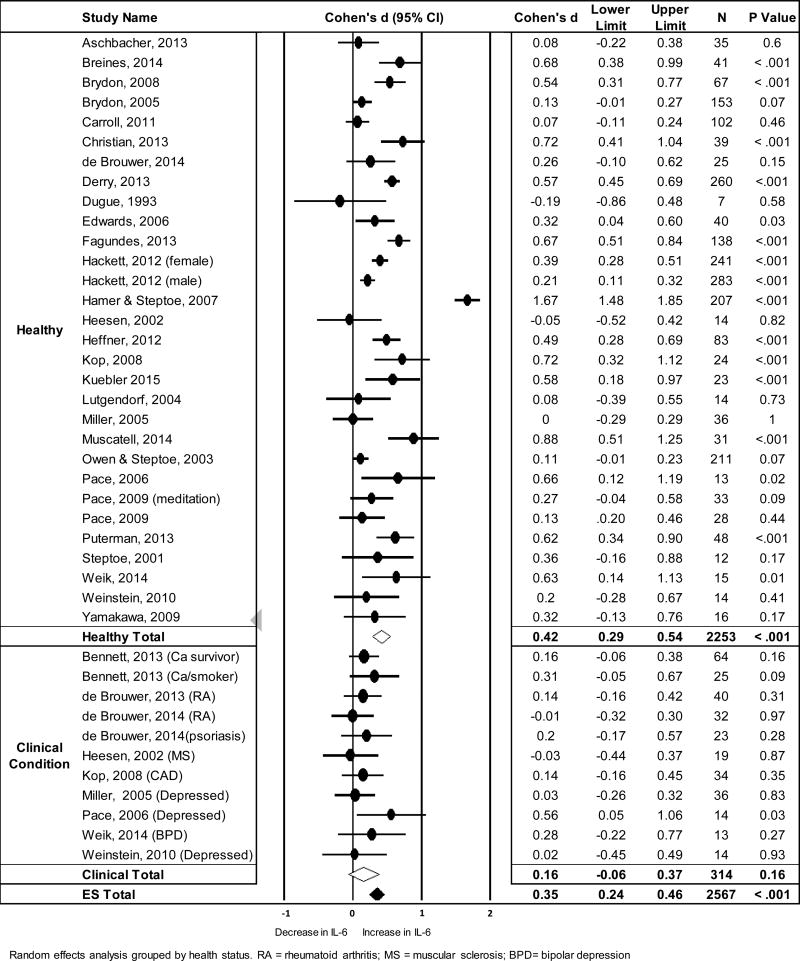
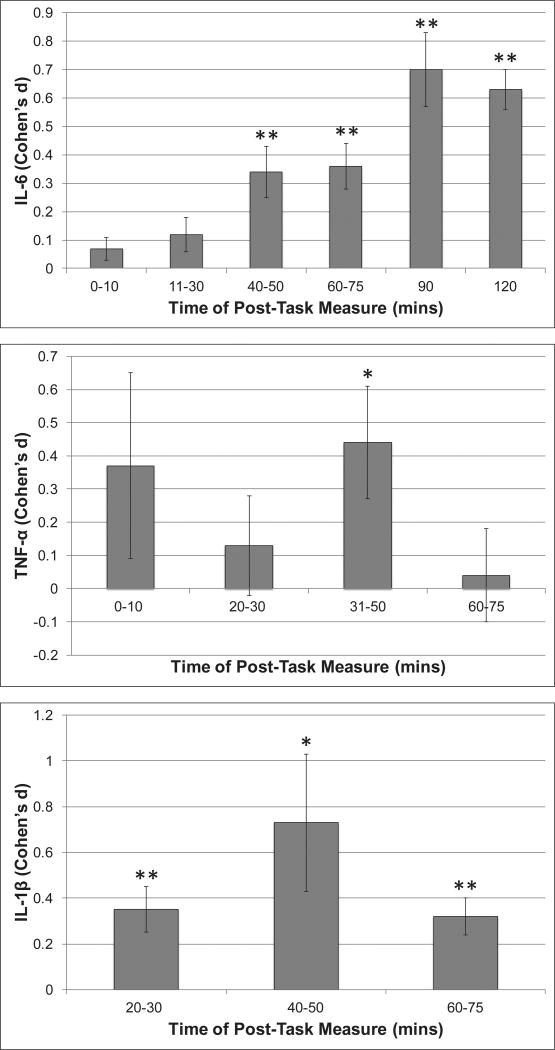
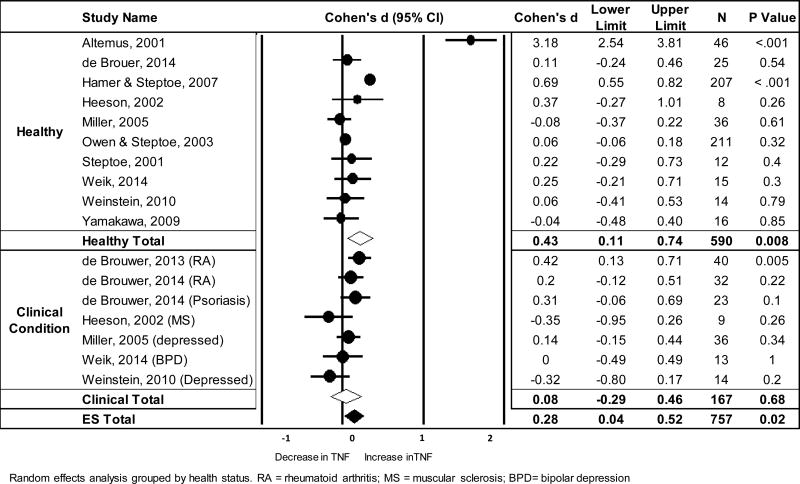
Inflammatory reactivity to acute laboratory stress is thought to reflect individual differences in responsivity to environmental stressors and may confer future health risk. To characterize this response, we conducted a meta-analysis of 34 studies that measured circulating inflammatory markers and 15 studies that measured stimulated production of inflammatory markers before and after exposure to laboratory challenge. Results showed significant stress-related increases in circulating interleukin (IL)-1β (d=0.66, p<0.001), IL-6 (d=0.35, p<0.001), IL-10 (d=0.69, p<0.001), and tumor necrosis factor(TNF)-α (d=0.28, p<0.001), but not IL-1ra, IL-2, interferon-γ, or C-reactive protein. There were sufficient data to assess the time course of IL-6, IL-1β, and TNF-α reactivity. IL-6 increased from baseline to measures taken 40-50, 60-75, 90, and 120min following stress, with the largest effect at 90min post-stress (d=0.70, p<0.001). IL-1β increased from baseline to 20-30, 40-50, and 60-70min following stress, with the largest effect between 40 and 50min post-stress (d=0.73, p=0.02). For TNF-α, there was a significant increase from baseline to 31-50min post stress (d=0.44, p=0.01), but not at later times. There was no difference in magnitude of IL-6 reactivity as a function of type of stress (social-evaluative versus other). For stimulated inflammatory markers, results showed stress-related increases in IL-1β when measured 20-120min post-stress (d=1.09, p<0.001), and in IL-4 and interferon-γ when measured 0-10min post stressor (d=-0.42, p<0.001 and d=0.47, p<0.001). These results extend findings from a prior meta-analysis (Steptoe et al., 2007) to show reliable increases in circulating IL-6, IL-1β, IL-10 and TNF-α and stimulated IL-1β, IL-4 and interferon-γ in response to acute stress. It is possible that these responses contribute to associations between exposure to life challenges and vulnerability to inflammatory disease.
Keywords: Acute psychological stress; Inflammation; Inflammatory cytokines; Systematic review.
Copyright © 2017 Elsevier Inc. All rights reserved.
Figures
References
-
- Ackerman KD, Martino M, Heyman R, Moyna NM, Rabin BS. Stressor-induced alteration of cytokine production in multiple sclerosis patients and controls. Psychosom. Med. 1998;60:484–491. - PubMed
-
- Akira S, Takeda K. Toll-like receptor signalling. Nature reviews: Immunology. 2004;4(7):499–511. - PubMed
-
- Altemus M, Rao B, Dhabar FS, Ding W, Granstein RD. Stress indicued changes in skin barrier function in healthy women. J. Invest. Dermatol. 2001;117:309–317. - PubMed
-
- Bachen EA, Manuck SB, Marsland AL, Cohen S, Malkoff SB, Muldoon MF, Rabin BS. Lymphocyte subset and cellular immune responses to a brief experimental stressor. Psychosom. Med. 1992;54:673–679. - PubMed
Publication types
MeSH terms
Substances
Grants and funding
LinkOut - more resources
Full Text Sources
Other Literature Sources
Medical
Research Materials
