


Estimating glomerular filtration rate for the full age spectrum from serum creatinine and cystatin C
- PMID: 28089986
- PMCID: PMC5837496
- DOI: 10.1093/ndt/gfw425
Estimating glomerular filtration rate for the full age spectrum from serum creatinine and cystatin C
Abstract
Background: We recently published and validated the new serum creatinine (Scr)-based full-age-spectrum equation (FAS crea ) for estimating the glomerular filtration rate (GFR) for healthy and kidney-diseased subjects of all ages. The equation was based on the concept of normalized Scr and shows equivalent to superior prediction performance to the currently recommended equations for children, adolescents, adults and older adults.
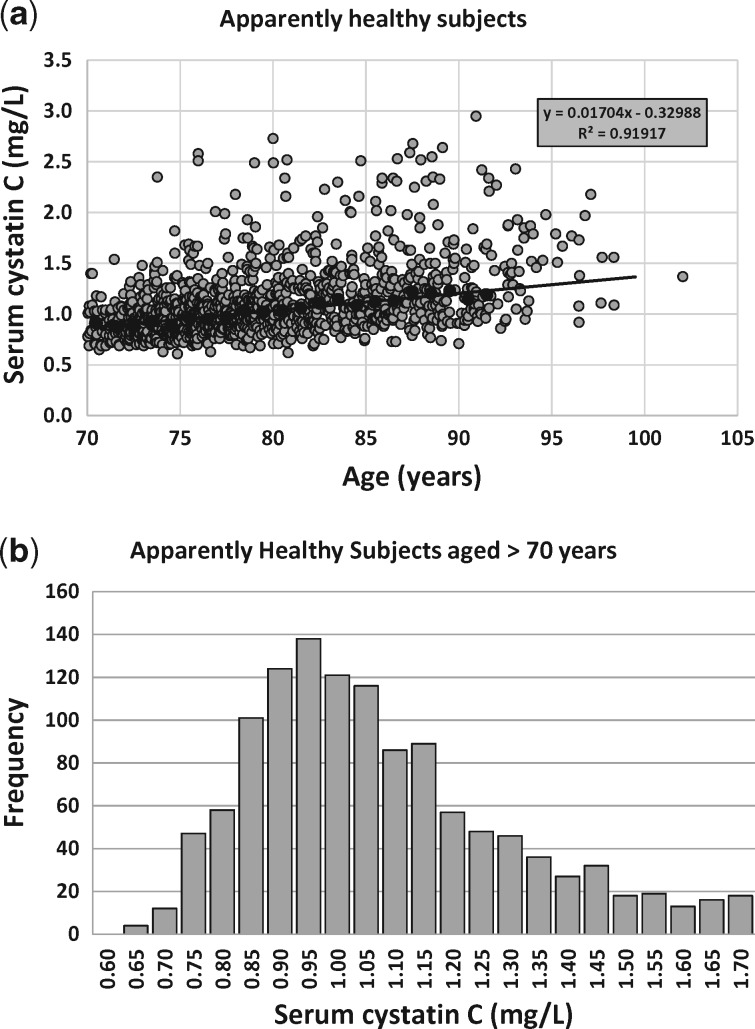
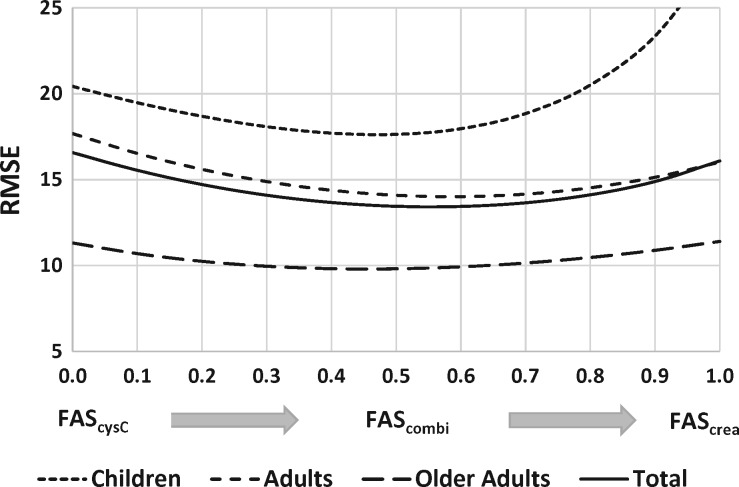
Methods: Based on an evaluation of the serum cystatin C (ScysC) distribution, we defined normalization constants for ScysC ( Q cysC = 0.82 mg/L for ages <70 years and Q cysC = 0.95 mg/L for ages ≥70 years). By replacing Scr/ Q crea in the FAS crea equation with ScysC/ Q cysC , or with the average of both normalized biomarkers, we obtained new ScysC-based (FAS cysC ) and combined Scr-/ScysC-based FAS equations (FAS combi ). To validate the new FAS cysC and FAS combi we collected data on measured GFR, Scr, ScysC, age, gender, height and weight from 11 different cohorts including n = 6132 unique white subjects (368 children, aged ≤18 years, 4295 adults and 1469 older adults, aged ≥70 years).
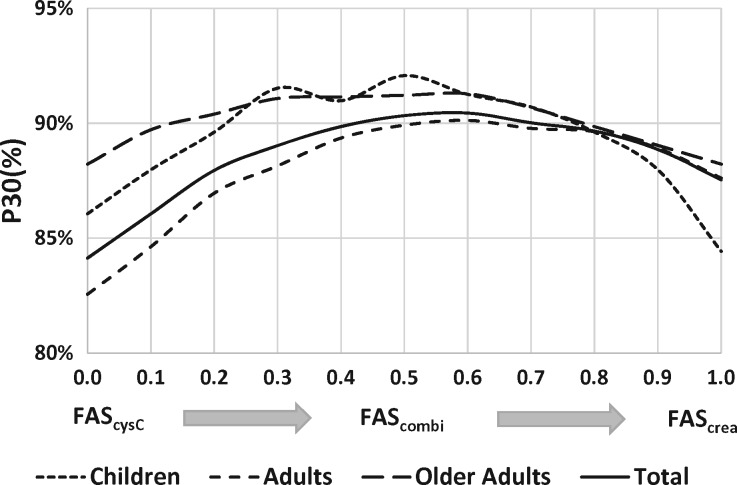
Results: In children and adolescents, the new FAS cysC equation showed significantly better performance [percentage of patients within 30% of mGFR (P30) = 86.1%] than the Caucasian Asian Paediatric Adult Cohort equation (P30 = 76.6%; P < 0.0001), or the ScysC-based Schwartz equation (P30 = 68.8%; P < 0.0001) and the FAS combi equation outperformed all equations with P30 = 92.1% (P < 0.0001). In adults, the FAS cysC equation (P30 = 82.6%) performed equally as well as the Chronic Kidney Disease Epidemiology Collaboration equation (CKD-EPI cysC ) (P30 = 80.4%) and the FAS combi equation (P30 = 89.9%) was also equal to the combined CKD-EPI equation (P30 = 88.2%). In older adults, FAS cysC was superior (P30 = 88.2%) to CKD-EPI cysC (P30 = 84.4%; P < 0.0001) and the FAS combi equation (P30 = 91.2%) showed significantly higher performance than the combined CKD-EPI equation (P30 = 85.6%) (P < 0.0001).
Conclusion: The FAS equation is not only applicable to all ages, but also for all recommended renal biomarkers and their combinations.
Keywords: all ages; all renal biomarkers; combined FAS equation; cystatin C; serum creatinine.
© The Author 2017. Published by Oxford University Press on behalf of ERA-EDTA. All rights reserved.
Figures
Comment in
-
Glomerular filtration rate estimating equations: practical, yes, but can they replace measured glomerular filtration rate?Nephrol Dial Transplant. 2017 Mar 1;32(3):405-407. doi: 10.1093/ndt/gfx006. Nephrol Dial Transplant. 2017. PMID: 28339825 No abstract available.
References
-
- Delanaye P, Pottel H, Botev R.. Con: should we abandon the use of the MDRD equation in favour of the CKD-EPI equation? Nephrol Dial Transplant 2013; 28: 1396–1403 - PubMed
-
- Pottel H, Hoste L, Yayo E. et al. Glomerular filtration rate in healthy living potential kidney donors: a meta-analysis supporting the construction of the full age spectrum (FAS) equation. Nephron Clin Pract 2016; Nephron 2016 Oct 21. [Epub ahead of print] DOI:10.1159/000450893 - PubMed
-
- Grubb A, Blirup-Jensen S, Lindström V. et al. First certified reference material for cystatin C in human serum ERM-DA471/IFCC. Clin Chem Lab Med 2010; 48: 1619–1621 - PubMed
MeSH terms
Substances
Grants and funding
LinkOut - more resources
Full Text Sources
Other Literature Sources
Medical
Research Materials
Miscellaneous
