Review
. 2016 Dec 2;5(12):e114.
doi: 10.1038/cti.2016.71. eCollection 2016 Dec.

Chronic mucocutaneous candidiasis disease associated with inborn errors of IL-17 immunity

Affiliations
Review

Chronic mucocutaneous candidiasis disease associated with inborn errors of IL-17 immunity

Satoshi Okada et al. Clin Transl Immunology. .

Abstract

Chronic mucocutaneous candidiasis (CMC) is characterized by recurrent or persistent infections affecting the nails, skin and oral and genital mucosae caused by Candida spp., mainly Candida albicans. CMC is an infectious phenotype in patients with inherited or acquired T-cell deficiency. Patients with autosomal-dominant (AD) hyper IgE syndrome (HIES), AD signal transducer and activator of transcription 1 (STAT1) gain-of-function, autosomal-recessive (AR) deficiencies in interleukin (IL)-12 receptor β1 (IL-12Rβ1), IL-12p40, caspase recruitment domain-containing protein 9 (CARD9) or retinoic acid-related orphan receptor γT (RORγT) or AR autoimmune polyendocrinopathy-candidiasis-ectodermal dystrophy (APECED) develop CMC as a major infectious phenotype that is categorized as Syndromic CMC. In contrast, CMC disease (CMCD) is typically defined as CMC in patients in the absence of any other prominent clinical signs. This definition is not strict; thus, CMCD is currently used to refer to patients presenting with CMC as the main clinical phenotype. The etiology of CMCD is not related to genes that cause severe combined immunodeficiency or combined immunodeficiency, nor to genes responsible for Syndromic CMC. Four genetic etiologies, AR IL-17 receptor A, IL-17 receptor C and ACT1 deficiencies, and AD IL-17F deficiency, are reported to underlie CMCD. Each of these gene defects directly has an impact on IL-17 signaling, suggesting their nonredundant role in host mucosal immunity to Candida. Here, we review current knowledge focusing on IL-17 signaling and the genetic etiologies responsible for, and associated with, CMC.


Figures
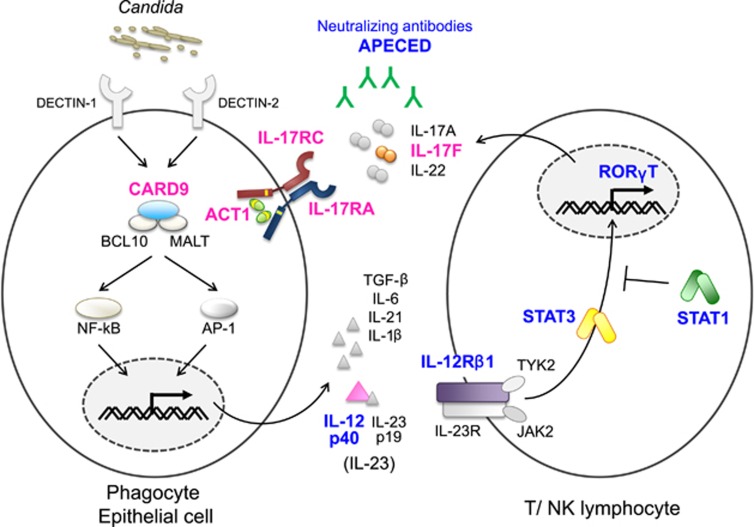
Figure 1
Figure 1
Inborn errors of IL-17 immunity. Phagocytes recognize C. albicans via pattern recognition receptors and produce proinflammatory cytokines, such as IL-6 and IL-23. These proinflammatory cytokines activate T cells via STAT3 and upregulate RORγT expression, leading to production of IL-17A, IL-17F and IL-22. Impairment in IL-23-induced STAT3-mediated signaling in AD HIES and AR IL-12Rβ1 and IL-12p40 deficiencies cause Syndromic CMC. Neutralizing autoantibodies against IL-17A, IL-17F and IL-22 in patients with APECED impair IL-17 signaling, underlying Syndromic CMC. Patients with AR RORγT deficiency show developmental defects of Th17 cells, resulting in Syndromic CMC. They also develop MSMD, probably caused by impairment of IFN-γ production associated with mycobacterial infections. AD STAT1 gain-of-function was originally identified as a genetic etiology of CMCD. However, it can be categorized as Syndromic CMC based on its broad clinical manifestations. The majority of patients with GOF-STAT1 display a decreased frequency of IL-17-producing cells. Defects in four genes (encoding IL-17F, IL-17RA, IL-17RC and ACT1) that are directly involved in IL-17 signaling have been identified in patients with CMCD. Blue: Syndromic CMC-related molecules and neutralizing antibodies (APECED). Magenta: CMCD-related molecules.
Figure 2
Figure 2
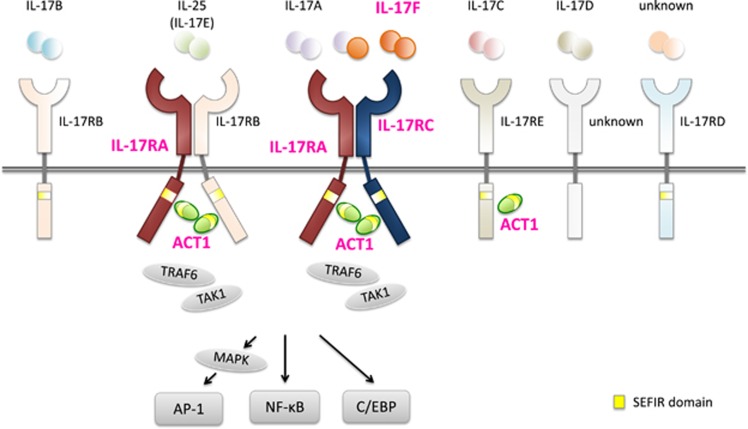
IL-17 and IL-17 receptor family. The IL-17 cytokine family consists of six members (IL-17A, IL-17B, IL-17C, IL-17D, IL-17E and IL-17F), whereas the IL-17R family consists of five members (IL-17RA, IL-17RB, IL-17RC, IL-17RD and IL-17RE). IL-17 cytokines form disulfide-linked homodimers, whereas IL-17A and IL-17F can form heterodimers. Functional receptors for IL-17 family cytokines are thought to consist of homodimers or heterodimers. Upon stimulation, ACT1 is recruited to IL-17RA, IL-17RB and/or IL-17RC (and probably IL-17RE) by homotypic dimerization of two SEFIR domains, and activates the nuclear factor-κB (NFκB), mitogen-activated protein (MAP) kinase and CCAAT enhancer-binding protein (C/EBP) signaling pathways. In this pathway, mutations in four genes (IL17F, IL17RA, IL-17RC and TRAF3IP2/ACT1) have been identified in patients with CMCD. These mutations are directly related to IL-17A/F-induced, IL-17RA/RC-mediated signaling, and mutations in IL17RA and TRAF3IP2 also affect IL-17E-induced, IL-17RA/IL-17RB-mediated signaling. Thus, effective host mucocutaneous immunity against Candida in humans is critically dependent on functional and effective IL-17A/F-induced, IL-17RA/C-mediated signaling. Magenta: CMCD-related molecules.
Figure 3
Figure 3
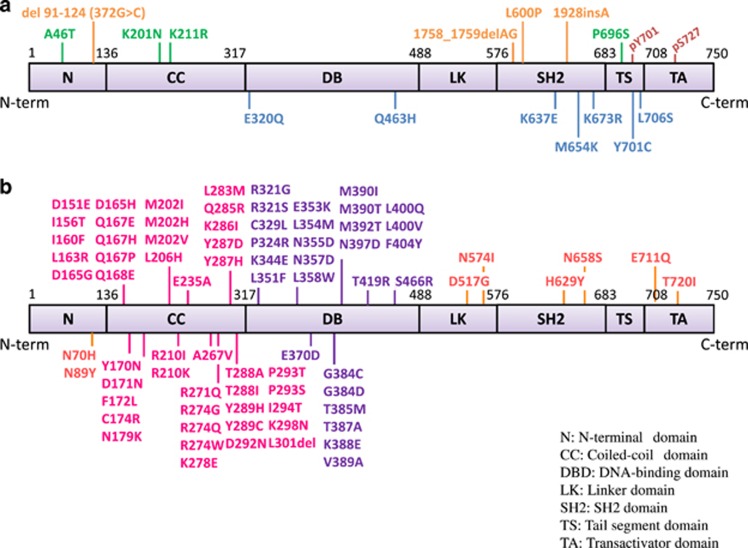
Germline STAT1 mutations identified in patients with primary immune deficiency. (a) Loss-of-function or hypomorphic mutations are shown above human STAT1α isoform. Germline STAT1 mutations identified in patients with an AR form of complete (orange) or partial (green) STAT1 deficiency. Germline STAT1 mutations identified in patients with AD MSMD are shown in blue. (b) Germline GOF-STAT1 mutations are shown above human STAT1α isoform. Gain-of-function mutations are preferentially identified in coiled-coil domain (magenta) and DNA-binding domain (purple) of STAT1. CC, coiled-coil domain; DB, DNA-binding domain; LK, linker domain; N, N-terminal domain; SH2, SH2 domain; TA, transcriptional activation domain; TS, tail segment.

References

    1. Kirkpatrick CH. Chronic mucocutaneous candidiasis. Pediatr Infect Dis J 2001; 20: 197–206. - PubMed
    1. Puel A, Cypowyj S, Marodi L, Abel L, Picard C, Casanova JL. Inborn errors of human IL-17 immunity underlie chronic mucocutaneous candidiasis. Curr Opin Allergy Clin Immunol 2012; 12: 616–622. - PMC - PubMed
    1. Lanternier F, Cypowyj S, Picard C, Bustamante J, Lortholary O, Casanova JL et al. Primary immunodeficiencies underlying fungal infections. Curr Opin Pediatrics 2013; 25: 736–747. - PMC - PubMed
    1. Puel A, Picard C, Cypowyj S, Lilic D, Abel L, Casanova JL. Inborn errors of mucocutaneous immunity to Candida albicans in humans: a role for IL-17 cytokines? Curr Opin Immunol 2010; 22: 467–474. - PMC - PubMed
    1. Conti HR, Shen F, Nayyar N, Stocum E, Sun JN, Lindemann MJ et al. Th17 cells and IL-17 receptor signaling are essential for mucosal host defense against oral candidiasis. J Exp Med 2009; 206: 299–311. - PMC - PubMed

LinkOut - more resources