


Pattern of Local Recurrence and Distant Metastasis in Breast Cancer By Molecular Subtype
- PMID: 28090417
- PMCID: PMC5222631
- DOI: 10.7759/cureus.924
Pattern of Local Recurrence and Distant Metastasis in Breast Cancer By Molecular Subtype
Abstract
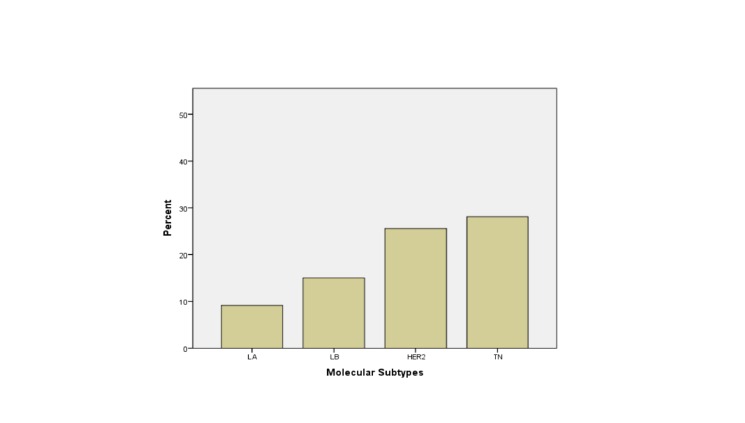
Background and purpose: No longer considered a single disease entity, breast cancer is being classified into several distinct molecular subtypes based on gene expression profiling. These subtypes appear to carry prognostic implications and have the potential to be incorporated into treatment decisions. In this study, we evaluated patterns of local recurrence (LR), distant metastasis (DM), and association of survival with molecular subtype in breast cancer patients in the post-adjuvant radiotherapy setting.
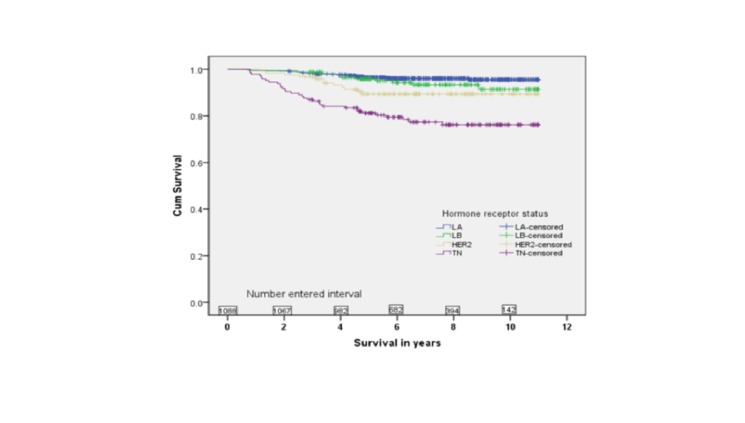
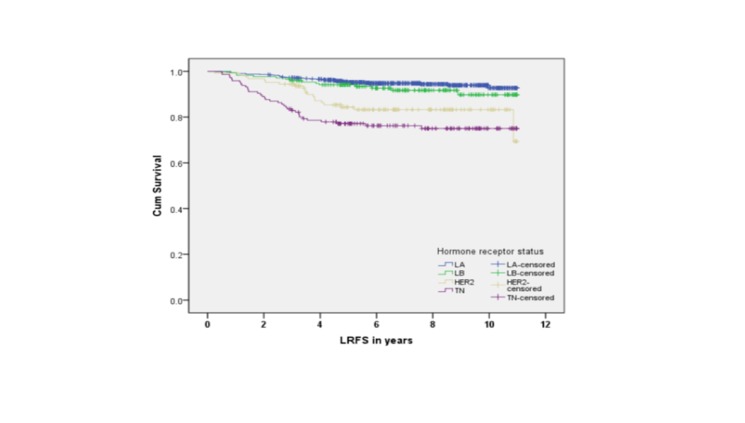
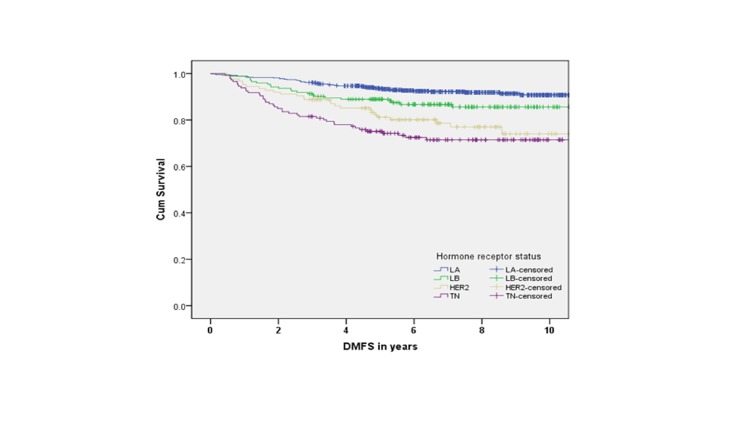
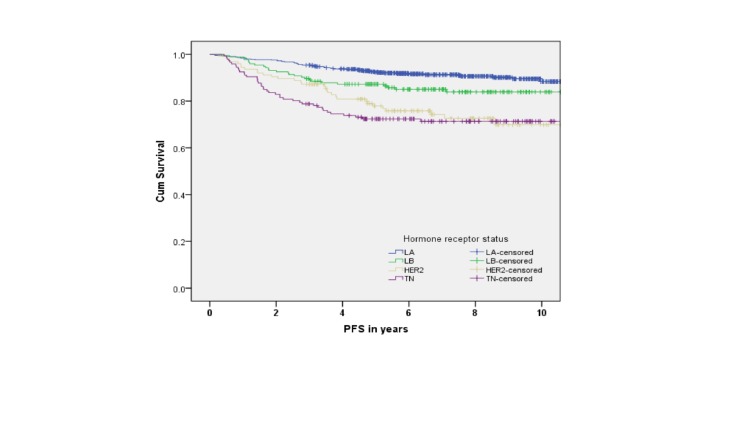
Material and methods: The medical records of 1,088 consecutive, non-metastatic breast cancer patients treated at a single institution between 2004 and 2012 were reviewed. Estrogen/progesterone receptors (ER/PR) and human epidermal growth factor receptor-2 (HER2) enrichment were evaluated by immunohistochemistry. Patients were categorized into one of four subtypes: luminal-A (LA; ER/PR+, HER2-, Grade 1-2), luminal-B (LB; ER/PR+, HER2-, Grade > 2), HER2 over-expression (HER2; ER/PR-, HER2+), and triple negative (TN; ER/PR-, HER2-). Results: The median follow-up time was 6.9 years. During the follow-up, 16% (174/1,088) of patients failed initial treatment and developed either LR (48) or DM (126). The prevalence of LR was the highest in TN (12%) and the lowest in LA (2%). Breast or chest wall relapse was the most frequent site (≈80%) of recurrence in LA, LB, and HER2 subtypes, whereas the regional lymph nodes and chest wall were the common sites of relapse in the TN group (50.0%). DM rates were 6.4% in LA, 12.1% in LB, 19.2% in HER2, and 27.4% in TN subgroups. Five-year survival rates were 84%, 83%, 84%, and 77% in the LA, LB, HER2 and TN subgroups, respectively. There was a statistically significant association between survival and molecular subtypes in an univariate analysis. In the adjusted multivariate analysis, the following variables were independent prognostic factors for survival: T stage, N stage, and molecular subtype.
Conclusions: Of the four subtypes, the LA subtype tends to have the best prognosis, fairly high survival, and low recurrent or metastases rates. The TN and HER2 subtypes of breast cancer were associated with significantly poorer overall survival and prone to earlier recurrence and metastases. Our results demonstrate a significant association between molecular subtype and survival. The risk of death and relapse/metastases increases fewfold in TN compared to LA. Future prospective studies are warranted and could ultimately lead to the tailoring of adjuvant radiotherapy treatment fields based on both molecular subtype and the more conventional clinicopathologic characteristics.
Keywords: breast cancer; molecular subtype; pattern; recurrence.
Conflict of interest statement
The authors have declared that no competing interests exist.
Figures
References
-
- Gene expression patterns of breast carcinomas distinguish tumor subclasses with clinical implications. Sørlie T, Perou CM, Tibshirani R, Aas T, Geisler S, Johnsen H, Hastie T, Eisen MB, van de Rijn M, Jeffrey SS, Thorsen T, Quist H, Matese JC, Brown PO, Botstein D, Lønning PE, Børresen-Dale AL. Proc Natl Acad Sci U S A. 2001;98:10869–10874. - PMC - PubMed
-
- Molecular portraits of human breast tumours. Perou CM, Sørlie T, Eisen MB, van de Rijn M, Jeffrey SS, Rees CA, Pollack JR, Ross DT, Johnsen H, Akslen LA, Fluge O, Pergamenschikov A, Williams C, Zhu SX, Lønning PE, Børresen-Dale AL, Brown PO, Botstein D. Nature. 2000;406:747–752. - PubMed
-
- Nielsen TO, Hsu FD, Jensen K, Cheang M, Karaca G, Hu Z, Hernandez-Boussard T, Livasy C, Cowan D, Dressler L, Akslen LA, Ragaz J, Gown AM, Gilks CB, van de Rijn M, Perou CM. Clin Cancer Res. Vol. 10. Association; 2004. Immunohistochemical and clinical characterization of the basal-like subtype of invasive breast carcinoma; pp. 5367–5374. - PubMed
-
- Common adult stem cells in the human breast give rise to glandular and myoepithelial cell lineages: a new cell biological concept. Böcker W, Moll R, Poremba C, Holland R, Van Diest PJ, Dervan P, Bürger H, Wai D, Ina Diallo R, Brandt B, Herbst H, Schmidt A, Lerch MM, Buchwallow IB. http://www.nature.com/labinvest/journal/v82/n6/full/3780471a.html. Lab Invest. 2002;82:737–746. - PubMed
LinkOut - more resources
Full Text Sources
Other Literature Sources
Research Materials
Miscellaneous