Review
. 2016 Oct 4;4(2):e1244031.
doi: 10.1080/21690731.2016.1244031. eCollection 2016.

RNA G-quadruplexes and their potential regulatory roles in translation

Affiliations
Review

RNA G-quadruplexes and their potential regulatory roles in translation

Jingwen Song et al. Translation (Austin). .

Abstract

DNA guanine (G)-rich 4-stranded helical nucleic acid structures called G-quadruplexes (G4), have been extensively studied during the last decades. However, emerging evidence reveals that 5'- and 3'-untranslated regions (5'- and 3'-UTRs) as well as open reading frames (ORFs) contain putative RNA G-quadruplexes. These stable secondary structures play key roles in telomere homeostasis and RNA metabolism including pre-mRNA splicing, polyadenylation, mRNA targeting and translation. Interestingly, multiple RNA binding proteins such as nucleolin, FMRP, DHX36, and Aven were identified to bind RNA G-quadruplexes. Moreover, accumulating reports suggest that RNA G-quadruplexes regulate translation in cap-dependent and -independent manner. Herein, we discuss potential roles of RNA G-quadruplexes and associated trans-acting factors in the regulation of mRNA translation.

Keywords: Aven; DHX36; FMRP; G-quadruplexes; RNA binding proteins; translation.


Figures
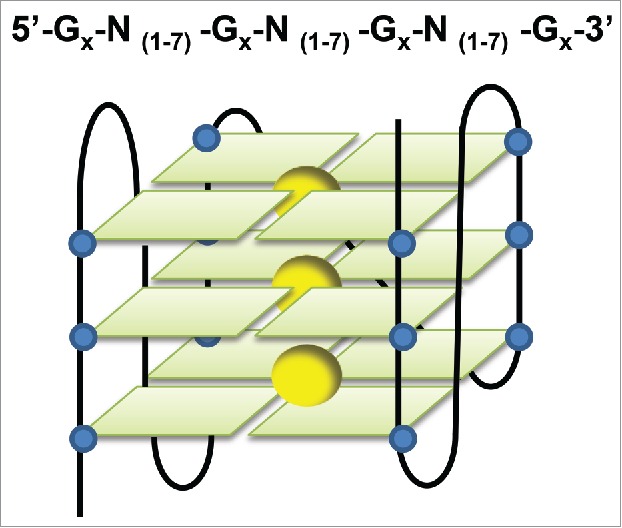
Figure 1.
Figure 1.
Structure of G-quadruplexes. Guanine-rich sequences fold into G-quadruplex structures (G4 structures), composed of planar G-quartets. This representation is a G-quadruplex parallel structure that could be observed in RNA as well as DNA molecules. The guanines are represented as blue, while cations are yellow.
Figure 2.
Figure 2.
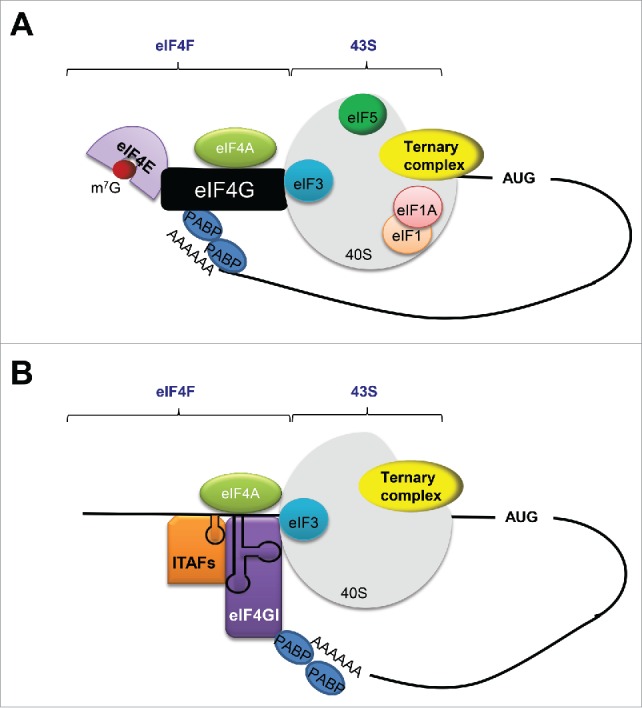
Cap-dependent and Cap–independent translation initiation. (A) In cap-dependent translation, eIF4E binds to the 5′-m7GpppN of the mRNA (m7G). The capped 5′-end is associated with 43S complex by a bridging protein called eIF4G. eIF4G is also bound to eIF4A, the RNA helicase that unwinds 5′ secondary structures. PABP binds the poly (A) tail and brings the 5′-end and 3′-end of the mRNA together through the interaction with eIF4G. eIF3, eIF5, eIF1/eIF1A and ternary complex are shown as represented. (B) ITAFs and eIG4GI (also known as p97/DAP5/NAT1, purple) facilitates IRES cap-independent translation.
Figure 3.
Figure 3.
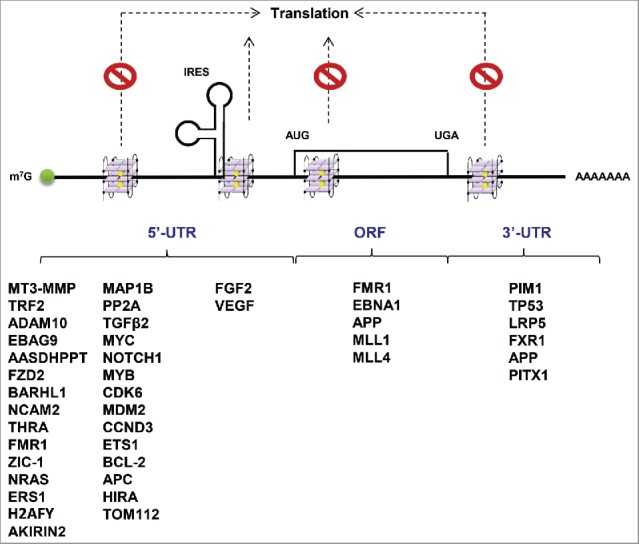
Possible roles of G-quadruplexes in mRNA translation and mRNAs that harbor G4 structures. G-quadruplexes in 5′-UTRs, ORF and 3′-UTRs mainly repress cap-dependent translation, whereas G-quadruplexes in 5′-UTR near IRESs likely enhance the IRES-mediated translation. The genes harboring G4 structures in 5′-UTRs, ORF and 3′-UTRs are listed below.
Figure 4.
Figure 4.
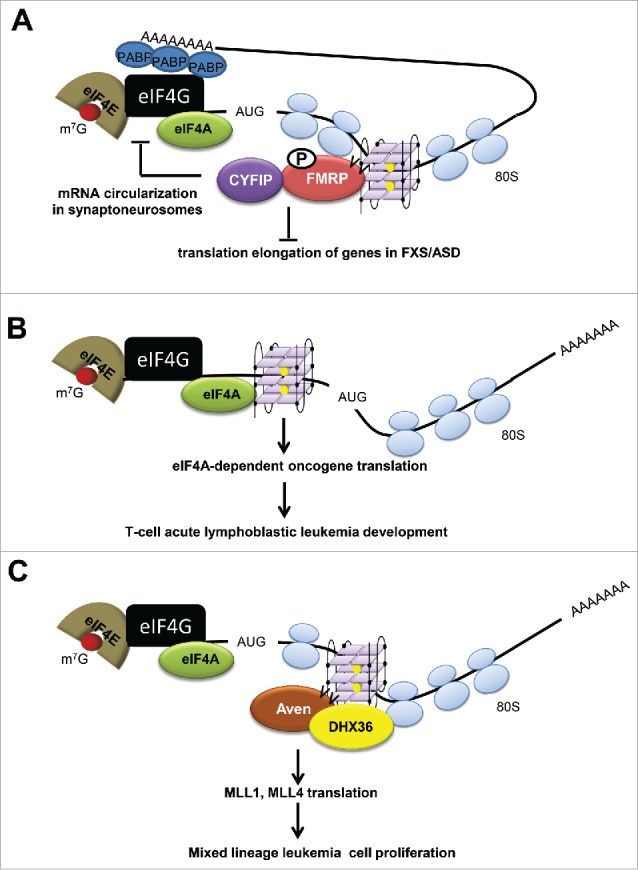
Schematic illustration of the functions of RNA binding proteins that bind RNA G4 structures in mRNAs. (A) Phosphorylated FMRP binds ORFs of mRNAs and inhibits translation. It stalls ribosomes in the elongation stage, resulting in the repressed translation of transcripts related to FXS/ASD. It recruits the co-factor CYFIP in synaptoneurosomes. By interacting with CYFIP, FMRP prevents the complex assembly between eIF4E, eIF4G and PABP, thereby inhibiting translation initiation. RGG/RG motif is denoted as vv. (B) eIF4A unwinds the G4 structures in 5′-UTR of many key transcription factors and oncogenes, thereby contributing to the T cell-acute lymphoblastic leukemia development. (C) Methylated Aven binds G4 structures in the ORFs of MLL1 and MLL4 mRNAs in an RGG/RG motif (denoted as vv) dependent manner. Aven also recruits DHX36 onto the polysomes that may facilitate unwinding of G4 structures. Thus Aven favors the translation of oncogenic proteins to increase leukemic cell proliferation.

References

    1. Bang I. Untersuchungen über die Guanylsäure. Biochemische Zeitschrift. 1910; 26:293-311.
    1. Gellert M, Lipsett MN, Davies DR. Helix formation by guanylic acid. Proc Natl Acad Sci U S A 1962; 48:2013-8; PMID:13947099; http://dx.doi.org/ 10.1073/pnas.48.12.2013 - DOI - PMC - PubMed
    1. Lipps HJ, Gruissem W, Prescott DM. Higher order DNA structure in macronuclear chromatin of the hypotrichous ciliate Oxytricha nova. Proc Natl Acad Sci U S A 1982; 79:2495-9; PMID:6806811; http://dx.doi.org/ 10.1073/pnas.79.8.2495 - DOI - PMC - PubMed
    1. Sundquist WI, Klug A. Telomeric DNA dimerizes by formation of guanine tetrads between hairpin loops. Nature 1989; 342:825-9; PMID:2601741; http://dx.doi.org/ 10.1038/342825a0 - DOI - PubMed
    1. Sundquist WI, Heaphy S. Evidence for interstrand quadruplex formation in the dimerization of human immunodeficiency virus 1 genomic RNA. Proc Natl Acad Sci U S A 1993; 90:3393-7; PMID:8475087; http://dx.doi.org/ 10.1073/pnas.90.8.3393 - DOI - PMC - PubMed

LinkOut - more resources