Therapy-related myeloid neoplasms in children and adolescents
- PMID: 28090486
- PMCID: PMC5234240
- DOI: 10.5045/br.2016.51.4.242
Therapy-related myeloid neoplasms in children and adolescents
Abstract
Background: This retrospective study aimed to characterize and analyze the outcome of therapy-related myeloid neoplasms (t-MNs) in children and adolescents.
Methods: The medical records of 16 patients under 21 years of age at the time of t-MN diagnosis were reviewed.
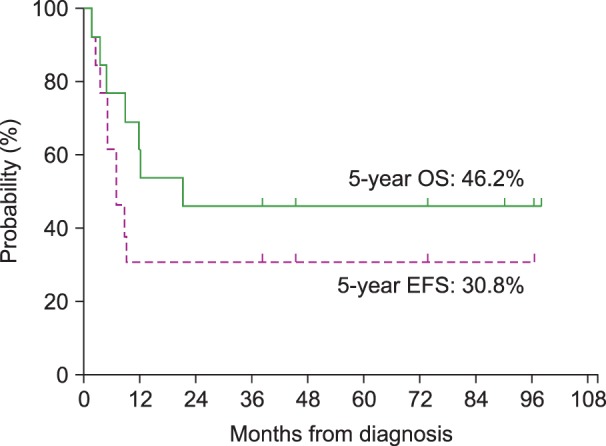
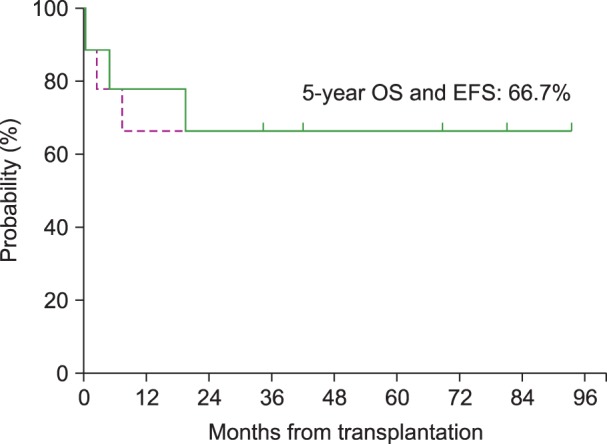
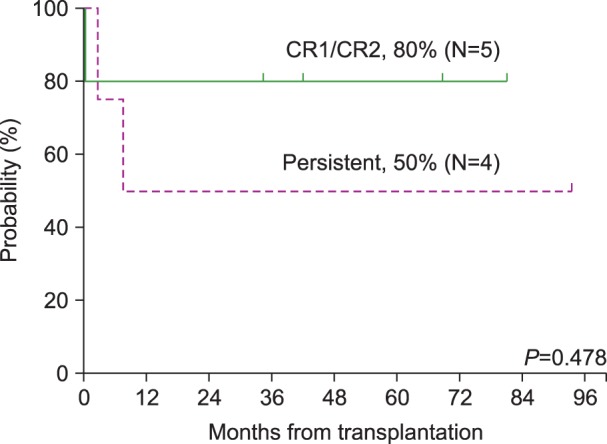
Results: The median patient age was 11.5 years (range, 1.6-20.4 yr). Twelve patients had therapy-related acute myeloid leukemia, 3 patients had myelodysplastic syndrome, and 1 patient had chronic myelomonocytic leukemia. The median latency period was 29 months (range, 11-68 mo). Fourteen patients had cytogenetic aberrations, 8 of whom had an 11q23 abnormality. Of the 13 patients treated with curative intent, 12 patients received myeloid-type induction therapy that led to complete remission (CR) in 8 patients. Nine patients underwent allogeneic transplantation; 4 patients did not undergo transplantation due to chemotherapy-related toxic death (N=3) or parental refusal (N=1). The 5-year overall survival and event-free survival of the 13 patients treated with a curative intent were 46.2% and 30.8%, respectively. For the 9 patients who underwent allogeneic transplantation, the 5-year event-free survival was 66.7%.
Conclusion: A significant proportion of young patients with t-MNs can experience long-term survival, and allogeneic transplantation plays a key role for attaining cure in these patients.
Keywords: Allogeneic hematopoietic stem cell transplantation; Pediatric population; Therapy-related myeloid neoplasms.
Conflict of interest statement
Authors' Disclosures of Potential Conflicts of Interest: No potential conflicts of interest relevant to this article were reported.
Figures
References
-
- Ng AK, Travis LB. Subsequent malignant neoplasms in cancer survivors. Cancer J. 2008;14:429–434. - PubMed
-
- Vardiman JW, Thiele J, Arber DA, et al. The 2008 revision of the World Health Organization (WHO) classification of myeloid neoplasms and acute leukemia: rationale and important changes. Blood. 2009;114:937–951. - PubMed
-
- Smith SM, Le Beau MM, Huo D, et al. Clinical-cytogenetic associations in 306 patients with therapy-related myelodysplasia and myeloid leukemia: the University of Chicago series. Blood. 2003;102:43–52. - PubMed
LinkOut - more resources
Full Text Sources
Other Literature Sources