


Switching from branded to generic glatiramer acetate: 15-month GATE trial extension results
- PMID: 28090798
- PMCID: PMC5700775
- DOI: 10.1177/1352458516688956
Switching from branded to generic glatiramer acetate: 15-month GATE trial extension results
Abstract
Background: Open-label 15-month follow-up of the double-blind, placebo-controlled Glatiramer Acetate clinical Trial to assess Equivalence with Copaxone® (GATE) trial.
Objective: To evaluate efficacy, safety, and tolerability of prolonged generic glatiramer acetate (GTR) treatment and to evaluate efficacy, safety, and tolerability of switching from brand glatiramer acetate (GA) to GTR treatment.
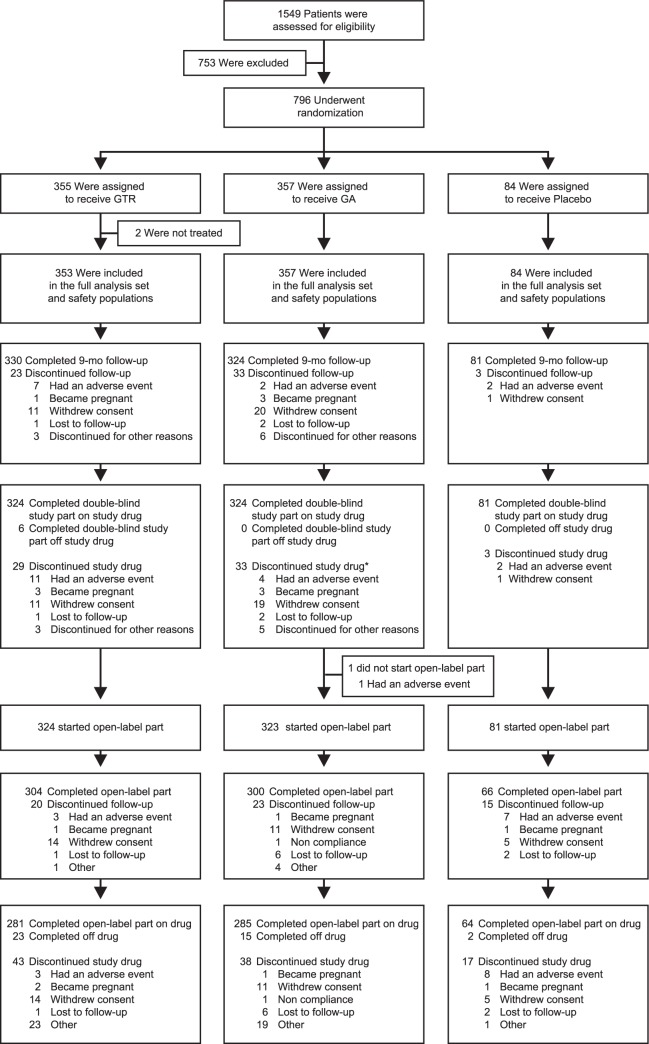
Methods: A total of 729 patients received GTR 20 mg/mL daily. Safety was assessed at months 12, 15, 18, 21, and 24 and Expanded Disability Status Scale and magnetic resonance imaging (MRI) scans at months 12, 18, and 24. The presence of glatiramer anti-drug antibodies (ADAs) was tested at baseline and months 1, 3, 6, 9, 12, 18, and 24.
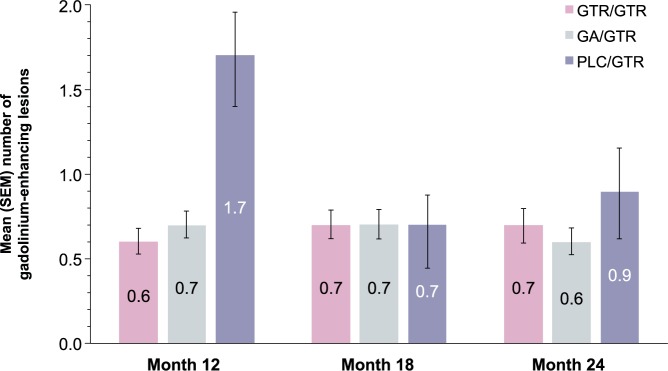
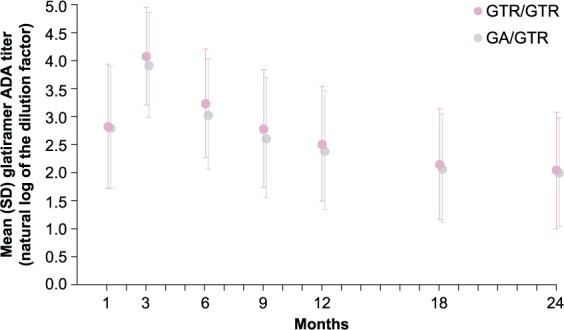
Results: The mean number of gadolinium-enhancing lesions in the GTR/GTR and GA/GTR groups was similar at months 12, 18, and 24. The change in other MRI parameters was also similar in the GTR/GTR and GA/GTR groups. The annualized relapse rate (ARR) did not differ between the GTR/GTR and GA/GTR groups, 0.21 and 0.24, respectively. The incidence, spectrum, and severity of reported adverse events did not differ between the GTR/GTR and GA/GTR groups. Glatiramer ADA titers were similar in the GTR/GTR and GA/GTR groups.
Conclusion: Efficacy and safety of GTR is maintained over 2 years. Additionally, switching from GA to GTR is safe and well tolerated.
Keywords: Multiple sclerosis; clinical trial; equivalence; generic; glatiramer acetate.
Conflict of interest statement
Figures
References
-
- Racke MK, Lovett Racke AE, Karandikar NJ. The mechanism of action of glatiramer acetate treatment in multiple sclerosis. Neurology 2010; 74: S25–S30. - PubMed
-
- Bornstein MB, Miller A, Slagle S, et al. A pilot trial of Cop 1 in exacerbating-remitting multiple sclerosis. N Engl J Med 1987; 317: 408–414. - PubMed
-
- Comi G, Filippi M, Wolinsky JS. European/Canadian multicenter, double-blind, randomized, placebo-controlled study of the effects of glatiramer acetate on magnetic resonance imaging—Measured disease activity and burden in patients with relapsing multiple sclerosis. European/Canadian Glatiramer Acetate Study Group. Ann Neurol 2001; 49: 290–297. - PubMed
-
- Johnson KP, Brooks BR, Cohen JA, et al. Copolymer 1 reduces relapse rate and improves disability in relapsing-remitting multiple sclerosis: Results of a phase III multicenter, double-blind placebo-controlled trial. The Copolymer 1 Multiple Sclerosis Study Group. Neurology 1995; 45: 1268–1276. - PubMed
-
- Comi G, Martinelli V, Rodegher M, et al. Effect of glatiramer acetate on conversion to clinically definite multiple sclerosis in patients with clinically isolated syndrome (PreCISe study): A randomised, double-blind, placebo-controlled trial. Lancet 2009; 374: 1503–1511. - PubMed
Publication types
MeSH terms
Substances
LinkOut - more resources
Full Text Sources
Other Literature Sources
Medical
Research Materials
