


Clinical variations in Parkinson's disease patients with or without REM sleep behaviour disorder: a meta-analysis
- PMID: 28091622
- PMCID: PMC5238497
- DOI: 10.1038/srep40779
Clinical variations in Parkinson's disease patients with or without REM sleep behaviour disorder: a meta-analysis
Abstract
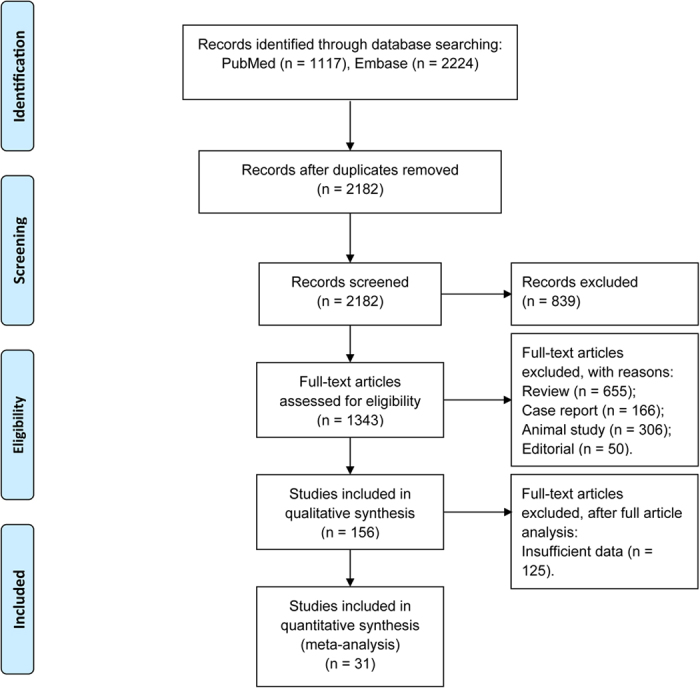
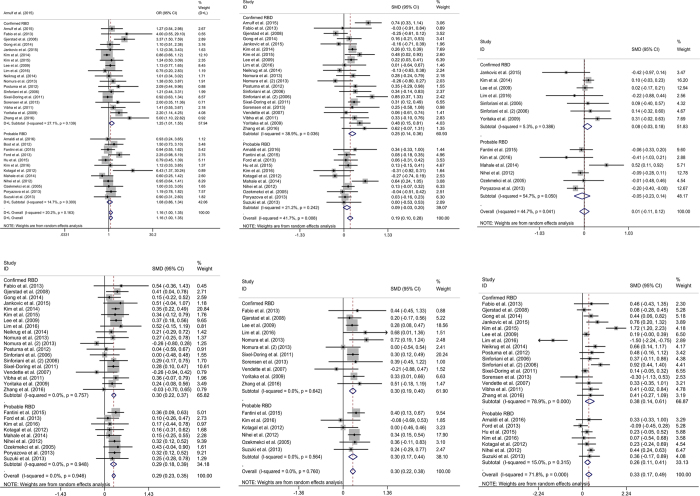
This study aimed to evaluate the clinical variations in patients with Parkinson's disease (PD) with (PDRBD) or without REM sleep behaviour disorder (RBD) (Non-RBD), and PDRBD patients were classified into Confirmed-RBD (definite diagnosis with polysomnography, PSG) and Probable-RBD (without PSG re-confirmation). The clinical difference between the groups of patients was measured as an odds ratio (OR) or standardized mean difference (SMD, Cohen d). A total of 31 articles with data from 5,785 participants were obtained for our analysis. Overall, the occurrence of Confirmed-RBD was more frequent in male patients (OR = 1.25; p = 0.038), elderly patients (SMD = 0.25; p = 0.000), and patients with longer disease duration (SMD = 0.30; p = 0.000), increased Hoehn-Yahr scale (SMD = 0.30; p = 0.000), and higher UPDRS-III score (SMD = 0.38; p = 0.002). On the other hand, the frequency of Probable-RBD was increased with disease duration (SMD = 0.29; p = 0.000), Hoehn-Yahr scale (SMD = 0.30; p = 0.000), and UPDRS-III score (SMD = 0.26; p = 0.001). Our study indicate that PDRBD patients may have different clinical features compared to patients with Non-RBD.
Figures
References
-
- Hu Y. et al. Parkinson disease with REM sleep behavior disorder: features, alpha-synuclein, and inflammation. Neurology. 84, 888–894 (2015). - PubMed
-
- Fantini M. L. et al. Increased risk of impulse control symptoms in Parkinson’s disease with REM sleep behaviour disorder. J Neurol Neurosurg Psychiatry. 86, 174–179 (2015). - PubMed
-
- Chiu H. F. et al. Sleep-related injury in the elderly–an epidemiological study in Hong Kong. Sleep. 23, 513–517 (2000). - PubMed
-
- Comella C. L., Nardine T. M., Diederich N. J. & Stebbins G. T. Sleep-related violence, injury, and REM sleep behavior disorder in Parkinson’s disease. Neurology. 51, 526–529 (1998). - PubMed
Publication types
MeSH terms
LinkOut - more resources
Full Text Sources
Other Literature Sources
Medical
