


Persistent pain after motor vehicle collision: comparative effectiveness of opioids vs nonsteroidal antiinflammatory drugs prescribed from the emergency department-a propensity matched analysis
- PMID: 28092325
- PMCID: PMC5242416
- DOI: 10.1097/j.pain.0000000000000756
Persistent pain after motor vehicle collision: comparative effectiveness of opioids vs nonsteroidal antiinflammatory drugs prescribed from the emergency department-a propensity matched analysis
Abstract
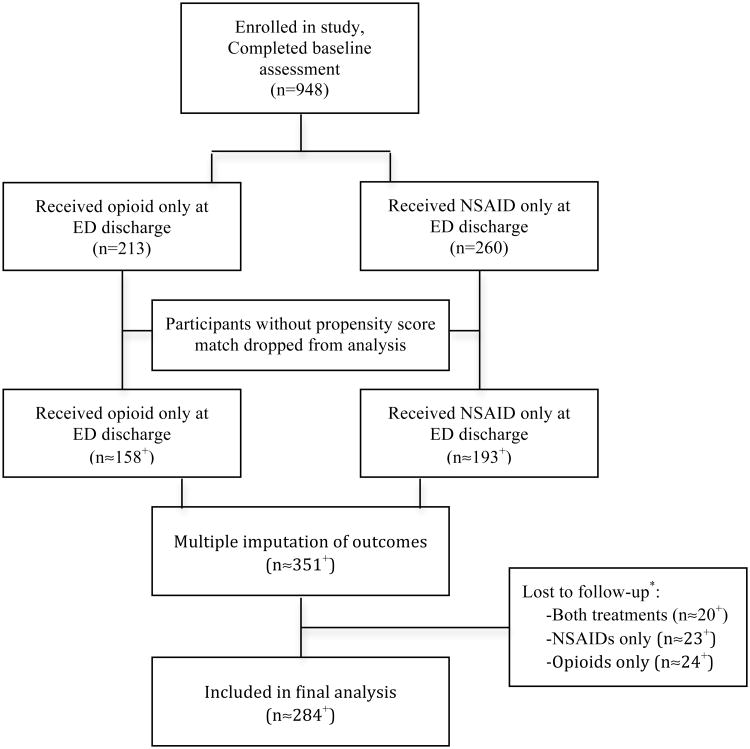
Each year millions of Americans present to the emergency department (ED) for care after a motor vehicle collision (MVC); the majority (>90%) are discharged to home after evaluation. Acute musculoskeletal pain is the norm in this population, and such patients are typically discharged to home with prescriptions for oral opioid analgesics or nonsteroidal antiinflammatory drugs (NSAIDs). The influence of acute pain management on subsequent pain outcomes in this common ED population is unknown. We evaluated the effect of opioid analgesics vs NSAIDs initiated from the ED on the presence of moderate to severe musculoskeletal pain and ongoing opioid use at 6 weeks in a large cohort of adult ED patients presenting to the ED after MVC (n = 948). The effect of opioids vs NSAIDs was evaluated using an innovative quasi-experimental design method using propensity scores to account for covariate imbalances between the 2 treatment groups. No difference in risk for moderate to severe musculoskeletal pain at 6 weeks was observed between those discharged with opioid analgesics vs NSAIDs (risk difference = 7.2% [95% confidence interval: -5.2% to 19.5%]). However, at follow-up participants prescribed opioids were more likely than those prescribed NSAIDs to report use of prescription opioids medications at week 6 (risk difference = 17.5% [95% confidence interval: 5.8%-29.3%]). These results suggest that analgesic choice at ED discharge does not influence the development of persistent moderate to severe musculoskeletal pain 6 weeks after an MVC, but may result in continued use of prescription opioids. Supported by NIAMS R01AR056328 and AHRQ 5K12HS022998.
Conflict of interest statement
The authors have no conflicts of interest to report.
Figures
References
-
- Ballina LE, Ulirsch JC, Soward AC, Rossi C, Rotolo S, Linnstaedt SD, Heafner T, Foley KA, Batts J, Collette R, Holbrook D, Zelman S, McLean SA. mu-Opioid Receptor Gene A118G Polymorphism Predicts Pain Recovery After Sexual Assault. The journal of pain : official journal of the American Pain Society. 2013;14(2):165–171. - PubMed
-
- Berger ML, Mamdani M, Atkins D, Johnson ML. Good research practices for comparative effectiveness research: defining, reporting and interpreting nonrandomized studies of treatment effects using secondary data sources: the ISPOR Good Research Practices for Retrospective Database Analysis Task Force Report--Part I. Value Health. 2009;12(8):1044–1052. - PubMed
-
- Cardon LR, Palmer LJ. Population stratification and spurious allelic association. Lancet. 2003;361(9357):598–604. - PubMed
-
- Carroll LJ, Holm LW, Hogg-Johnson S, Cote P, Cassidy JD, Haldeman S, Nordin M, Hurwitz EL, Carragee EJ, van der Velde G, Peloso PM, Guzman J. Course and prognostic factors for neck pain in whiplash-associated disorders (WAD): results of the Bone and Joint Decade 2000-2010 Task Force on Neck Pain and Its Associated Disorders. Spine (Phila Pa 1976) 2008;33(4 Suppl):S83–92. - PubMed
Publication types
MeSH terms
Substances
Grants and funding
LinkOut - more resources
Full Text Sources
Other Literature Sources
Medical
