. 2017 Feb;5(2):137-147.
doi: 10.1158/2326-6066.CIR-16-0210. Epub 2017 Jan 16.

Tumor-Infiltrating Merkel Cell Polyomavirus-Specific T Cells Are Diverse and Associated with Improved Patient Survival

Affiliations

Tumor-Infiltrating Merkel Cell Polyomavirus-Specific T Cells Are Diverse and Associated with Improved Patient Survival

Natalie J Miller et al. Cancer Immunol Res. 2017 Feb.

Abstract

Tumor-infiltrating CD8+ T cells are associated with improved survival of patients with Merkel cell carcinoma (MCC), an aggressive skin cancer causally linked to Merkel cell polyomavirus (MCPyV). However, CD8+ T-cell infiltration is robust in only 4% to 18% of MCC tumors. We characterized the T-cell receptor (TCR) repertoire restricted to one prominent epitope of MCPyV (KLLEIAPNC, "KLL") and assessed whether TCR diversity, tumor infiltration, or T-cell avidity correlated with clinical outcome. HLA-A*02:01/KLL tetramer+ CD8+ T cells from MCC patient peripheral blood mononuclear cells (PBMC) and tumor-infiltrating lymphocytes (TIL) were isolated via flow cytometry. TCRβ (TRB) sequencing was performed on tetramer+ cells from PBMCs or TILs (n = 14) and matched tumors (n = 12). Functional avidity of T-cell clones was determined by IFNγ production. We identified KLL tetramer+ T cells in 14% of PBMC and 21% of TIL from MCC patients. TRB repertoires were strikingly diverse (397 unique TRBs were identified from 12 patients) and mostly private (only one TCRb clonotype shared between two patients). An increased fraction of KLL-specific TIL (>1.9%) was associated with significantly increased MCC-specific survival P = 0.0009). T-cell cloning from four patients identified 42 distinct KLL-specific TCRa/b pairs. T-cell clones from patients with improved MCC-specific outcomes were more avid (P < 0.05) and recognized an HLA-appropriate MCC cell line. T cells specific for a single MCPyV epitope display marked TCR diversity within and between patients. Intratumoral infiltration by MCPyV-specific T cells was associated with significantly improved MCC-specific survival, suggesting that augmenting the number or avidity of virus-specific T cells may have therapeutic benefit. Cancer Immunol Res; 5(2); 137-47. ©2017 AACR.


Conflict of interest statement

Authors’ disclosures of potential conflicts of interest:

PN serves as a paid consultant for EMD Serono.

Figures
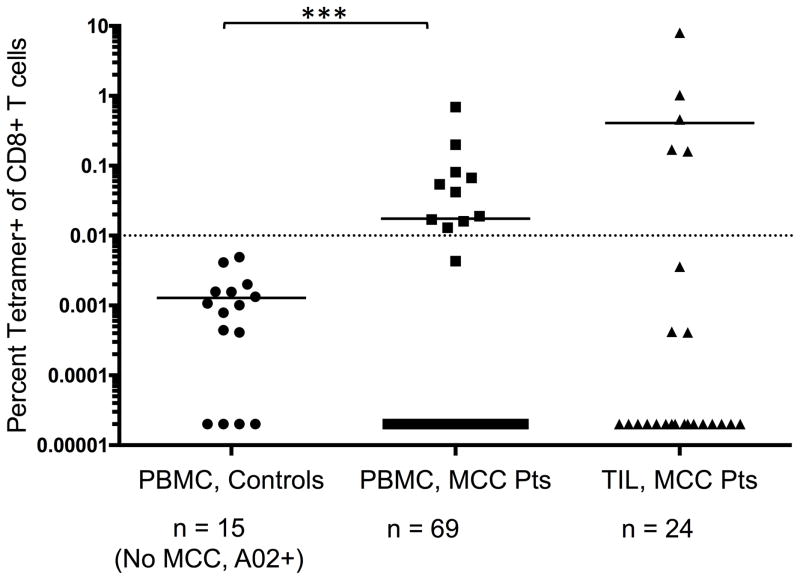
Figure 1
Figure 1. Frequencies of KLL tetramer+ CD8+ T cells in PBMC and TIL from MCC patients and controls
MCPyV-specific T-cell frequencies among HLA-A*02+ patients (n = 69 for PBMC, 24 for TIL) or PBMC from control subjects (n = 15). PBMC acquired when patients had evidence of disease was used in all analyses. Mean for each group is depicted, with dashed line at threshold for credible responses. The mean frequency of tetramer+ CD8+ cells was significantly different between MCC patient PBMC and control subjects (P = 0.0004 by Mann Whitney test) but not significantly different between MCC patient TIL and control PBMC (P = 0.11).
Figure 2
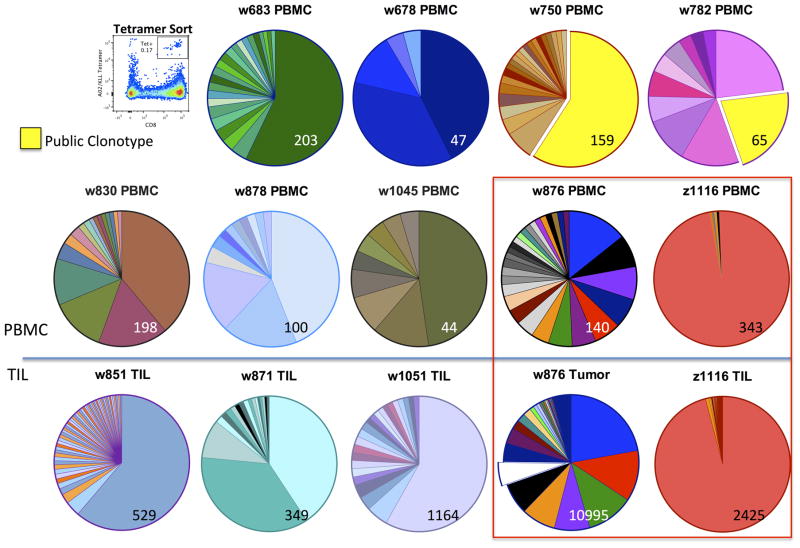
Figure 2. TRB CDR3 clonotype diversity among KLL tetramer+ CD8+ cells from PBMC and TIL of 12 patients
KLL tetramer+ CD8+ T cells were sorted by flow cytometry (a representative plot is shown) and the CDR3 region from TRB was sequenced. All productive TRB clonotypes with an estimated number of genomes ≥ 2 within each sample are indicated in proportion to their prevalence with a pie chart, with the total number of T cells sequenced indicated at bottom right in each pie. Patients are identified by unique “w” or “z” number. Among 397 total TRB clonotypes, only one shared clonotype was detected among two patients (highlighted in yellow). Paired tumor and PBMC samples were available for two patients (boxed).
Figure 3
Figure 3. Frequency and number of KLL-specific clonotypes in tumors from patients with KLL-specific T cells in PBMC or cultured TIL
A wedge (the length of which represents the total number of productive unique clonotypes in each tumor) is indicated for each tumor on a log scale. Each tumor is identified by patient “w” or “z” number and type of tumor. Tumors from 11 of 12 patients were analyzed; no tumor could be acquired for patient w750. Primary tumor from w782 was small and LN was analyzed to ensure adequate sampling. KLL-specific clonotypes (yellow) are depicted within each tumor with a width approximately proportional to their frequency within each tumor. More predominant clonotypes are located to the left for each tumor. The number of KLL-specific clonotypes out of the total number of unique clonotypes is tabulated at far right. Wedges for tumors from patients alive at time of censoring are in green, and wedges for tumors in grey are from patients who have died of MCC.
Figure 4
Figure 4. Increased frequency and number of KLL-specific clonotypes in tumors is associated with improved MCC-specific survival
A) MCC-specific survival was significantly increased for patients who had higher (n = 9) versus lower (n = 2) percentage of KLL-specific T cells in tumor (1.9%–18% versus 0%–0.14%, P = 0.0009 by log-rank test). (B) MCC-specific survival was increased for patients who had many unique KLL-specific clonotypes (5–108 clonotypes, n = 7 patients) in their tumors, compared to patients with few KLL-specific clonotypes (0–3, n = 4; P = 0.0051 by log-rank test). (C) Patients were grouped by whether they developed metastatic disease (n = 7) or remained disease-free after definitive treatment of first presentation of disease (n = 3). The percentage of KLL-specific T cells tended to be higher in patients without recurrence (range 4.3%–18%) compared to those who developed metastatic disease (range 0%–10.8%, P =0.11). (D) The number of KLL-specific clonotypes was significantly higher in patients without recurrence (median 38, range 9–108) compared to those who developed metastatic disease (median 2, range 0–17, P = 0.02).
Figure 5
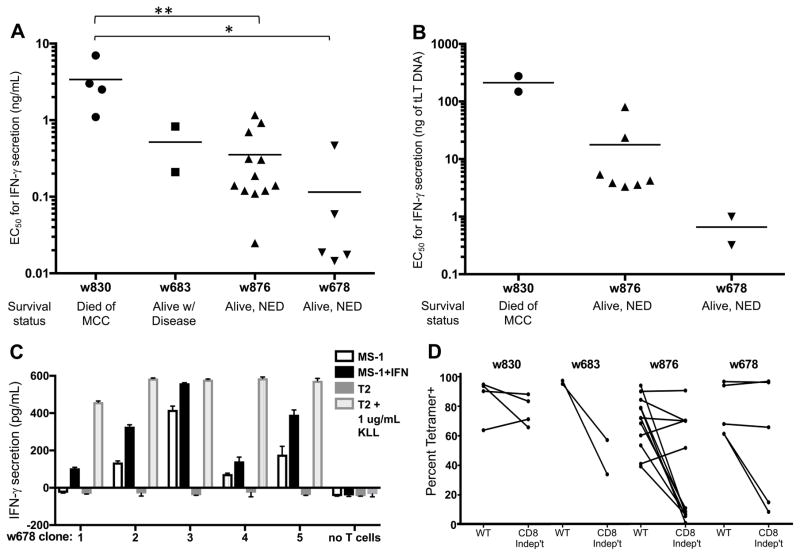
Figure 5. Functional avidity of 28 KLL-specific clonotypes from 4 patients
EC50 values for IFNγ secretion by KLL-specific clones in response to peptide concentration (A) or concentration of tLT-Ag DNA transfected into Cos7 cells (B) are plotted for each patient, with mean of all clones/patient depicted by the horizontal bar. For replicate experiments of clones with the same TCR, a single point representing the mean EC50 is plotted. Clonotypes from the same patient generally had similar functional avidities; more avid clonotypes are detected among patients with better MCC-specific survival. Statistical comparisons were made between patients; *, P < 0.05; **, P < 0.01, Mann Whitney test. (C) Clonotypes from one patient respond to the MCPyV+, HLA-A02+ MCC cell line MS-1 ± IFNβ treatment to upregulate HLA-I; responses of each clone to T2 cells ± KLL peptide are shown for comparison. Mean of duplicates + SEM are shown after subtracting background IFNγ secretion by T cells without targets; representative results from one of at least two separate experiments with each clone are shown. (D) Select clonotypes are able to bind a ‘CD8-independent’ KLL-tetramer.

References

    1. Feng H, Shuda M, Chang Y, Moore PS. Clonal Integration of a Polyomavirus in Human Merkel Cell Carcinoma. Science. 2008;319:1096–1100. - PMC - PubMed
    1. Heath M, Jaimes N, Lemos B, Mostaghimi A, Wang LC, Peñas PF, et al. Clinical characteristics of Merkel cell carcinoma at diagnosis in 195 patients: the AEIOU features. J Am Acad Dermatol. 2008;58:375–381. - PMC - PubMed
    1. Rodig SJ, Cheng J, Wardzala J, DoRosario A, Scanlon JJ, Laga AC, et al. Improved detection suggests all Merkel cell carcinomas harbor Merkel polyomavirus. J Clin Invest. 2012;122:4645–4653. - PMC - PubMed
    1. Allen PJ. Merkel Cell Carcinoma: Prognosis and Treatment of Patients From a Single Institution. J Clin Oncol. 2005;23:2300–2309. - PubMed
    1. Lemos BD, Storer BE, Iyer JG, Phillips JL, Bichakjian CK, Fang LC, et al. Pathologic nodal evaluation improves prognostic accuracy in Merkel cell carcinoma: analysis of 5823 cases as the basis of the first consensus staging system. J Am Acad Dermatol. 2010;63:751–761. - PMC - PubMed

Publication types

MeSH terms

Substances