


A double-edged sword: does highly active antiretroviral therapy contribute to syphilis incidence by impairing immunity to Treponema pallidum?
- PMID: 28093460
- PMCID: PMC5537507
- DOI: 10.1136/sextrans-2016-052870
A double-edged sword: does highly active antiretroviral therapy contribute to syphilis incidence by impairing immunity to Treponema pallidum?
Abstract
Background and hypothesis: Recently, the world has experienced a rapidly escalating outbreak of infectious syphilis primarily affecting men who have sex with men (MSM); many are taking highly active antiretroviral therapy (HAART) for HIV-1 infection. The prevailing hypothesis is that HAART availability and effectiveness have led to the perception among both individuals who are HIV-1 infected and those who are uninfected that HIV-1 transmission has become much less likely, and the effects of HIV-1 infection less deadly. This is expected to result in increased sexual risk-taking, especially unprotected anal intercourse, leading to more non-HIV-1 STDs, including gonorrhoea, chlamydia and syphilis. However, syphilis incidence has increased more rapidly than other STDs. We hypothesise that HAART downregulates the innate and acquired immune responses to Treponema pallidum and that this biological explanation plays an important role in the syphilis epidemic.
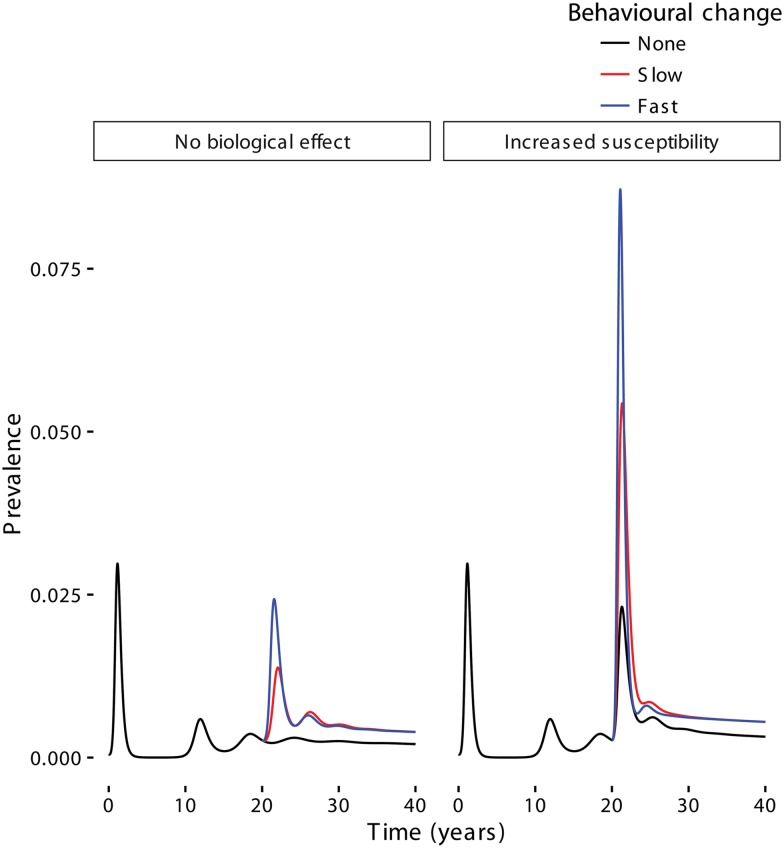
Methods: We performed a literature search and developed a mathematical model of HIV-1 and T. pallidum confection in a population with two risk groups with assortative mixing to explore the consequence on syphilis prevalence of HAART-induced changes in behaviour versus HAART-induced biological effects.
Conclusions and implications: Since rising syphilis incidence appears to have outpaced gonorrhoea and chlamydia, predominantly affecting HIV-1 positive MSM, behavioural factors alone may be insufficient to explain the unique, sharp increase in syphilis incidence. HAART agents have the potential to alter the innate and acquired immune responses in ways that may enhance susceptibility to T. pallidum. This raises the possibility that therapeutic and preventative HAART may inadvertently increase the incidence of syphilis, a situation that would have significant and global public health implications. We propose that additional studies investigating the interplay between HAART and enhanced T. pallidum susceptibility are needed. If our hypothesis is correct, HAART should be combined with enhanced patient management including frequent monitoring for pathogens such as T. pallidum.
Keywords: ANTERETROVIRAL THERAPY; HIV; INFECTION; MATHEMATICAL MODEL; SYPHILIS.
Published by the BMJ Publishing Group Limited. For permission to use (where not already granted under a licence) please go to http://www.bmj.com/company/products-services/rights-and-licensing/.
Conflict of interest statement
Competing interests: None.
Figures
Comment in
-
Response to: A double-edged sword: does highly active antiretroviral therapy contribute to syphilis incidence by impairing immunity to Treponema pallidum?Sex Transm Infect. 2017 Aug;93(5):313. doi: 10.1136/sextrans-2017-053212. Epub 2017 Apr 13. Sex Transm Infect. 2017. PMID: 28408646 Free PMC article. No abstract available.
References
-
- British Columbia Centre for Disease Control. STI in British Columbia: Annual Surveillance Reports 2000–2014. http://www.bccdc.ca/util/about/annreport/default.htm (accessed 3 Jan 2016).
-
- Centers for Disease Control and Prevention. Sexually Transmitted Disease Surveillance Reports 2000–2014 2015. http://www.cdc.gov (accessed 4 Jan 2016).
-
- Los Angeles County Department of Public Health Sexually Transmitted Disease Program. Early syphilis surveillance summary, May 31, 2010. 2010:1–45. http://publichealth.lacounty.gov/wwwfiles/ph/dcp/std/early_syphilis0501.pdf (accessed 3 Jan 2016).
-
- Malek R, Mitchell H, Furegato M, et al. Contribution of transmission in HIV-positive men who have sex with men to evolving epidemics of sexually transmitted infections in England: an analysis using multiple data sources, 2009–2013. Euro Surveill 2015;20 pii: 21093 10.2807/1560-7917.ES2015.20.15.21093 - DOI - PubMed
Publication types
MeSH terms
Grants and funding
LinkOut - more resources
Full Text Sources
Other Literature Sources
Medical
