


Blood Pressure Trajectories From Childhood to Young Adulthood Associated With Cardiovascular Risk: Results From the 23-Year Longitudinal Georgia Stress and Heart Study
- PMID: 28093467
- PMCID: PMC5300982
- DOI: 10.1161/HYPERTENSIONAHA.116.08312
Blood Pressure Trajectories From Childhood to Young Adulthood Associated With Cardiovascular Risk: Results From the 23-Year Longitudinal Georgia Stress and Heart Study
Abstract
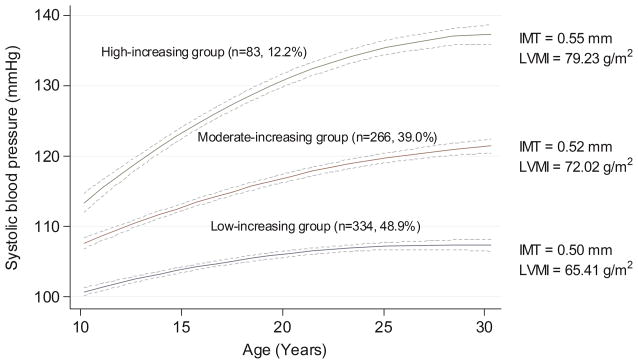
The purpose of this study is to identify subgroups of individuals with similar trajectories in blood pressure (BP) from childhood to young adulthood and to determine the relationship of BP trajectories with carotid intima-media thickness (IMT) and left ventricular mass index (LVMI). BP was measured ≤16 times during a 23-year period in 683 participants from childhood to young adulthood. IMT and LVMI were measured in 551 participants and 546 participants, respectively. Using latent class models, 3 trajectory groups in BP from childhood to young adulthood were identified, including high-increasing, moderate-increasing, and low-increasing groups. We found that trajectory of systolic BP was a significant predictor of both IMT and LVMI with increased rate of growth in systolic BP associated with higher levels of IMT and LVMI (Pfor trend <0.001). Similar to the BP trajectory groups from childhood to young adulthood, 3 trajectory groups in BP during childhood (≤18 years) were identified, and participants in the high-increasing group had thicker IMT (P<0.001) and increased LVMI (P=0.043) in comparison with those in the low-increasing group. Results were similar for mid-BP trajectories but not for diastolic BP trajectories. Our results suggested that different BP trajectories exist from childhood to young adulthood, and the trajectories were independently associated with IMT and LVMI. We, for the first time, reported the association between systolic BP trajectories derived from childhood with subclinical cardiovascular risk in young adulthood, indicating that monitoring trajectories of BP from childhood may help identify a high cardiovascular risk population in early life.
Keywords: adolescent; adult; atherosclerosis; heart ventricles; hypertension; longitudinal study.
© 2017 American Heart Association, Inc.
Conflict of interest statement
Disclosures None.
Figures

Comment in
-
One Step Further Toward a Targeted Screening Program.Hypertension. 2017 Mar;69(3):409-410. doi: 10.1161/HYPERTENSIONAHA.116.08390. Epub 2017 Jan 16. Hypertension. 2017. PMID: 28093468 No abstract available.
References
-
- Stamler J, Stamler R, Neaton JD. Blood pressure, systolic and diastolic, and cardiovascular risks. Us population data. Arch Intern Med. 1993;153:598–615. - PubMed
-
- Kannel WB. Blood pressure as a cardiovascular risk factor: Prevention and treatment. JAMA. 1996;275:1571–1576. - PubMed
-
- Mozaffarian D, Benjamin EJ, Go AS, et al. Heart disease and stroke statistics--2015 update: A report from the american heart association. Circulation. 2015;131:e29–322. - PubMed
-
- Berenson GS. Childhood risk factors predict adult risk associated with subclinical cardiovascular disease. The bogalusa heart study. Am J Cardiol. 2002;90:3L–7L. - PubMed
Publication types
MeSH terms
Grants and funding
LinkOut - more resources
Full Text Sources
Other Literature Sources
Medical
