Leishmaniasis in Thailand: A Review of Causative Agents and Situations
- PMID: 28093539
- PMCID: PMC5361524
- DOI: 10.4269/ajtmh.16-0604
Leishmaniasis in Thailand: A Review of Causative Agents and Situations
Abstract
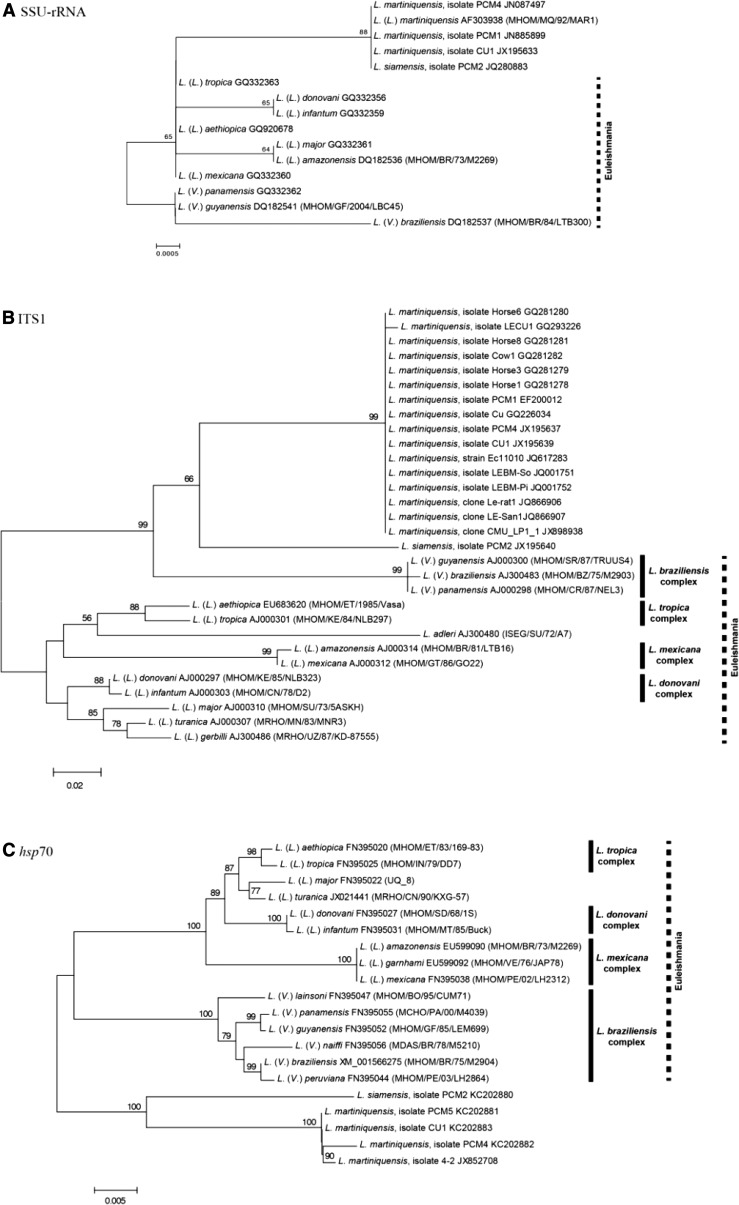
Before 1999, leishmaniasis was considered an imported disease in Thailand. Since then, autochthonous leishmaniasis was reported in both immmunocompetent and immmunocompromised patients especially in human immunodeficiency virus (HIV)/acquired immunodeficiency syndrome (AIDS). A new species was identified and named as Leishmania siamensis consisting of two lineages, that is, lineages TR and PG. Analysis of isoenzymes has clarified the more commonly detected L. siamensis lineage PG as Leishmania martiniquensis (MON-229), a species originally reported from the Martinique Island, whereas the L. siamensis lineage TR has been identified as the true novel species, L. siamensis (MON-324). Both cutaneous leishmaniasis (CL) and visceral leishmaniasis (VL) have been found among Thai patients. Disseminated CL and VL could be presented in some reported patients who had HIV/AIDS coinfection. So far, only sporadic cases have been reported; thus, the true prevalence of leishmaniasis should be determined in Thailand among the high-risk populations such as people with HIV/AIDS. A recent survey among animals identified L. martiniquensis DNA in black rats (Rattus rattus) suggesting a potential animal reservoir. In addition, L. martiniquensis DNA was identified in Sergentomyia gemmea and Sergentomyia barraudi, the predominant sandfly species in the affected areas. However, further studies are needed to prove that these sandflies could serve as the vector of leishmaniasis in Thailand.
Figures
References
-
- Lainson R, Ward RD, Shaw JJ. Leishmania in phlebotomid sandflies: VI. Importance of hindgut development in distinguishing between parasites of the Leishmania mexicana and L. braziliensis complexes. Proc R Soc Lond B Biol Sci. 1977;199:309–320. - PubMed
-
- Bañuls AL, Bastien P, Pomares C, Arevalo J, Fisa R, Hide M. Clinical pleiomorphism in human leishmaniases, with special mention of asymptomatic infection. Clin Microbiol Infect. 2011;17:1451–1461. - PubMed
Publication types
MeSH terms
Substances
LinkOut - more resources
Full Text Sources
Other Literature Sources