. 2017 Jan 17;18(1):93.
doi: 10.1186/s12864-016-3382-y.

The pangenome of (Antarctic) Pseudoalteromonas bacteria: evolutionary and functional insights

Affiliations

The pangenome of (Antarctic) Pseudoalteromonas bacteria: evolutionary and functional insights

Emanuele Bosi et al. BMC Genomics. .

Abstract

Background: Pseudoalteromonas is a genus of ubiquitous marine bacteria used as model organisms to study the biological mechanisms involved in the adaptation to cold conditions. A remarkable feature shared by these bacteria is their ability to produce secondary metabolites with a strong antimicrobial and antitumor activity. Despite their biotechnological relevance, representatives of this genus are still lacking (with few exceptions) an extensive genomic characterization, including features involved in the evolution of secondary metabolites production. Indeed, biotechnological applications would greatly benefit from such analysis.

Results: Here, we analyzed the genomes of 38 strains belonging to different Pseudoalteromonas species and isolated from diverse ecological niches, including extreme ones (i.e. Antarctica). These sequences were used to reconstruct the largest Pseudoalteromonas pangenome computed so far, including also the two main groups of Pseudoalteromonas strains (pigmented and not pigmented strains). The downstream analyses were conducted to describe the genomic diversity, both at genus and group levels. This allowed highlighting a remarkable genomic heterogeneity, even for closely related strains. We drafted all the main evolutionary steps that led to the current structure and gene content of Pseudoalteromonas representatives. These, most likely, included an extensive genome reduction and a strong contribution of Horizontal Gene Transfer (HGT), which affected biotechnologically relevant gene sets and occurred in a strain-specific fashion. Furthermore, this study also identified the genomic determinants related to some of the most interesting features of the Pseudoalteromonas representatives, such as the production of secondary metabolites, the adaptation to cold temperatures and the resistance to abiotic compounds.

Conclusions: This study poses the bases for a comprehensive understanding of the evolutionary trajectories followed in time by this peculiar bacterial genus and for a focused exploitation of their biotechnological potential.

Keywords: Antarctic bacteria; Antibiotics; Comparative genomics; Horizontal gene transfer; Marine bacteria; Microbial evolution; Pangenome; Pseudoalteromonas.


Figures

Fig. 1
Fig. 1
ML phylogenetic tree of the Pseudoalteromonas genus computed using a genome-scale set of genes. The light blue shaded area marks the strains assigned to the P. haloplanktis-like group; the strain names and nodes are colored according to the literature records (when available) about the pigmentation: strains with a red name are reported to be pigmented, where those with a blue name are non-pigmented. Support values for nodes, are reported when different from 100
Fig. 2
Fig. 2
Pangenomes analysis. The section a of this figure reports the number of genes in each pangenome category for: the pangenome of the Pseudoalteromonas genus, the pigmented and the P.h. –group. The section b reports the rarefaction curves for the core genome and the pangenome, for each dataset. For the pigmented and P.h. –group, the dashed line represents the projection of the curve fit up to 38 genomes. The panel c reports the new genes discovery rate for each dataset on a log-log scale. The dashed line represents the correspondent curve for a closed pangenome
Fig. 3
Fig. 3
Distributions of the COG categories in the different pangenomes. For each of these, three colored lines indicate the distributions in each category
Fig. 4
Fig. 4
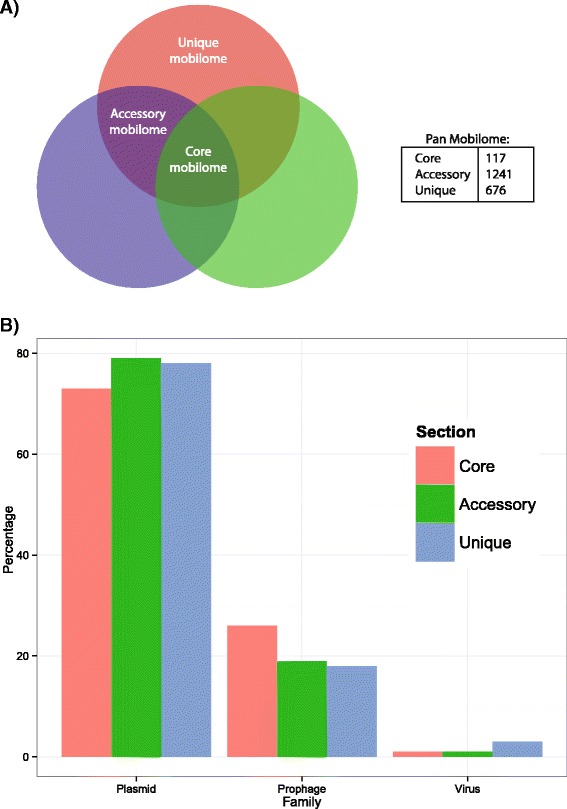
The Pseudoalteromonas panmobilome. In this figure are reported a the composition of the panmobilome and b the distribution of the ACLAME families in the panmobilome sections
Fig. 5
Fig. 5
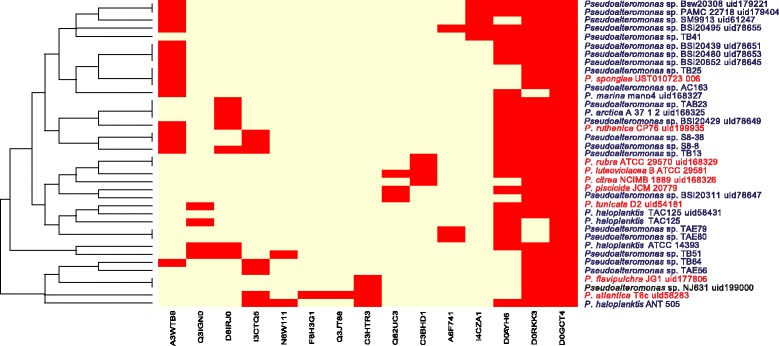
Heatmap representation of the panmobilome. Each cell indicates whether a gene associated with a MGE (columns) is present (blue) or not (white) in a strain (rows). Each column is color labeled according to the three MGE ACLAME families (plasmid, virus, prophage). The dendrogram on the left has been produced from the hierarchical clustering of the rows
Fig. 6
Fig. 6
Gene gains/losses reconstruction of the Pseudoalteromonas genus. For each node of the cladogram, the number of gene gains (blue) and losses (red) are reported, along with the estimated ancestral genome size
Fig. 7
Fig. 7
Heatmap of CAPs presence/absence. The strain names are colored according to the pigmentation
Fig. 8
Fig. 8
Biosynthetic operons involved in the biosynthesis of secondary metabolites in 38 Pseudoalteromonas genomes identified through antiSMASH analysis. The bar plot reports the number of the biosynthetic operon assigned to each Pseudoalteromonas strain. The phylogenetic tree is reported next to the bar plot. The strain names are colored according to the pigmentation

References

    1. Yooseph S, Nealson KH, Rusch DB, McCrow JP, Dupont CL, Kim M, Johnson J, Montgomery R, Ferriera S, Beeson K, et al. Genomic and functional adaptation in surface ocean planktonic prokaryotes. Nature. 2010;468(7320):60–6. doi: 10.1038/nature09530. - DOI - PubMed
    1. Ivanova EP, Flavier S, Christen R. Phylogenetic relationships among marine Alteromonas-like proteobacteria: emended description of the family Alteromonadaceae and proposal of Pseudoalteromonadaceae fam. nov., Colwelliaceae fam. nov., Shewanellaceae fam. nov., Moritellaceae fam. nov., Ferrimonadaceae fam. nov., Idiomarinaceae fam. nov. and Psychromonadaceae fam. nov. Int J Syst Evol Microbiol. 2004;54(Pt 5):1773–88. doi: 10.1099/ijs.0.02997-0. - DOI - PubMed
    1. Brian-Jaisson F, Ortalo-Magne A, Guentas-Dombrowsky L, Armougom F, Blache Y, Molmeret M. Identification of bacterial strains isolated from the Mediterranean Sea exhibiting different abilities of biofilm formation. Microb Ecol. 2014;68(1):94–110. doi: 10.1007/s00248-013-0342-9. - DOI - PubMed
    1. Kim EH, Cho KH, Lee YM, Yim JH, Lee HK, Cho JC, Hong SG. Diversity of cold-active protease-producing bacteria from arctic terrestrial and marine environments revealed by enrichment culture. J Microbiol. 2010;48(4):426–32. doi: 10.1007/s12275-010-0015-z. - DOI - PubMed
    1. Lo Giudice A, Caruso C, Mangano S, Bruni V, De Domenico M, Michaud L. Marine bacterioplankton diversity and community composition in an antarctic coastal environment. Microb Ecol. 2012;63(1):210–23. doi: 10.1007/s00248-011-9904-x. - DOI - PubMed

Publication types

MeSH terms

Substances