. 2017 Jan 17;18(1):89.
doi: 10.1186/s12864-017-3484-1.

Diet, gonadal sex, and sex chromosome complement influence white adipose tissue miRNA expression

Affiliations

Diet, gonadal sex, and sex chromosome complement influence white adipose tissue miRNA expression

Jenny C Link et al. BMC Genomics. .

Abstract

Background: MicroRNAs (miRNAs) are small non-coding RNA molecules that regulate gene expression by targeting specific mRNA species for degradation or interfering with translation. Specific miRNAs are key regulators of adipogenesis, and are expressed at different levels in adipose tissue from lean and obese mice. The degree of lipid accumulation and distribution of white adipose tissue differs between males and females, and it is unknown whether sex differences in adipose tissue-specific miRNA expression may contribute to this dimorphism. Typically, sex differences are attributed to hormones secreted from ovaries or testes. However, the sex chromosome complement (XX versus XY) is also a determinant of sex differences and may regulate miRNA expression in adipocytes.

Results: To identify sex differences in adipose tissue miRNA expression and to understand the underlying mechanisms, we performed high-throughput miRNA sequencing in gonadal fat depots of the Four Core Genotypes mouse model. This model, which consists of XX female, XX male, XY female, and XY male mice, allowed us to assess independent effects of gonadal type (male vs. female) and sex chromosome complement (XX vs. XY) on miRNA expression profiles. We have also assessed the effects of a high fat diet on sex differences in adipose tissue miRNA profiles. We identified a male-female effect on the overall miRNA expression profile in mice fed a chow diet, with a bias toward higher expression in male compared to female gonadal adipose tissue. This sex bias disappeared after gonadectomy, suggesting that circulating levels of gonadal secretions modulate the miRNA expression profile. After 16 weeks of high fat diet, the miRNA expression distribution was shifted toward higher expression in XY vs. XX adipose tissue. Principal component analysis revealed that high fat diet has a substantial effect on miRNA profile variance, while gonadal secretions and sex chromosome complement each have milder effects.

Conclusions: Our results demonstrate that the overall miRNA expression profile in adipose tissue is influenced by gonadal hormones and the sex chromosome complement, and that expression profiles change in response to gonadectomy and high fat diet. Differential miRNA expression profiles may contribute to sex differences in adipose tissue gene expression, adipose tissue development, and diet-induced obesity.

Keywords: Adipose tissue; Sex chromosome; Sex differences; microRNA.


Figures
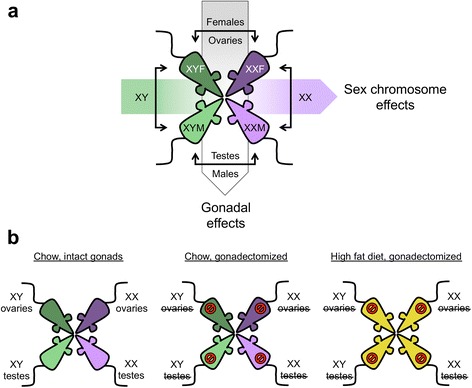
Fig. 1
Fig. 1
Study design to identify sex and dietary effects on miRNA expression. a miRNAs were sequenced in adipose tissue from the Four Core Genotypes mouse model (comprising XX female, XX male, XY female and XY male mice). A comparison of miRNA levels in female XX and XY adipose tissue with those in male XX and XY tissue allows detection of effects due to gonadal type. A comparison of miRNA levels in female and male XX adipose tissue with those on female and male XY tissue allows detection of effects due to sex chromosome type. b To determine the effects of acute gonadal hormones of diet, miRNA sequencing was performed in Four Core Genotypes cohorts that were fed a chow diet in the gonadally intact state, fed a chow diet and gonadectomized as adults to remove the acute effects of gonadal secretions, and in mice that were gonadectomized as adults and fed a high fat diet for 16 weeks
Fig. 2
Fig. 2
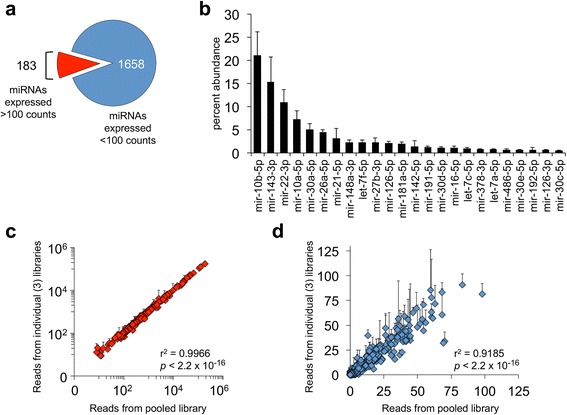
Highly expressed miRNAs in gonadal fat. a Out of 1841 mapped miRNAs, 183 were expressed at over 100 counts per million reads in at least one of the twelve libraries. These miRNAs are termed “highly expressed” miRNAs. b Percent abundance of miRNAs in gonadal fat of FCG mice. Values represent mean ± SD of the twelve sequencing libraries. c, d Three individual miRNA sequencing libraries representing biological replicates of XX females fed a high fat diet are correlated with the pooled sequencing library composed of those same mice. Highly expressed gonadal fat miRNAs (c) are more correlated between the individual and pooled libraries than miRNAs that are expressed at a lower level (d). Values represent mean ± SD. r2 and p-values were calculated using Pearson product–moment correlation
Fig. 3
Fig. 3
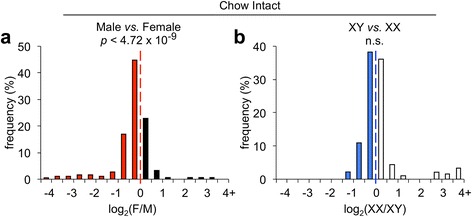
Distribution of miRNAs in chow-fed gonadally intact mice. Distribution of female-to-male ratios (a) and XX-to-XY ratios (b) in highly expressed miRNAs. Ratios were calculated for each miRNA, log2-transformed, and binned in 0.5 increments. Values less than −4 were grouped into the first bin, and values greater than 4 were grouped into the last bin. Red bars refer to male (M)-biased miRNAs, black bars refer to female (F)-biased miRNAs, blue bars refer to XY-biased miRNAs, and white bars refer to XX-biased miRNAs. p-values were calculated using the exact binomial test
Fig. 4
Fig. 4
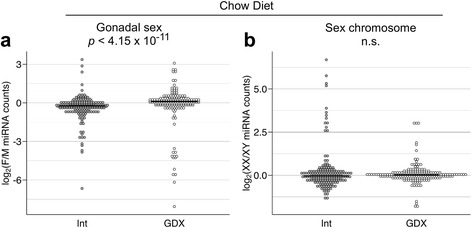
Gonadectomy alters distribution of miRNAs in chow-fed mice. Distribution of female-to-male ratios (a) and XX-to-XY ratios (b) in highly expressed miRNAs. Ratios were calculated for each miRNA and log2-transformed in gonadally intact (Int) and gonadectomized (GDX) FCG mice fed a chow diet. Data for gonadally intact (Int) mice are identical to Fig. 3a–b, but binned in 0.1 increments and compared to data distribution for GDX mice. Each dot represents one of the 183 highly expressed miRNAs. Black bars represent median values. Distributions were significantly different for female-to-male ratios, but not for XX-to-XY ratios. p-values were calculated using the Wilcoxon rank sum test. F, female; M, male
Fig. 5
Fig. 5
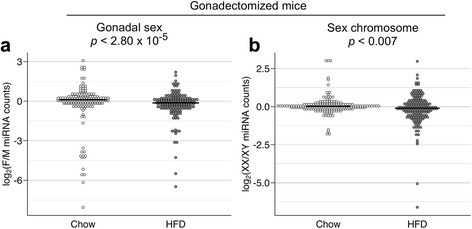
High fat diet alters miRNA expression levels in a sex-dependent and sex chromosome complement-dependent manner. Distribution of female-to-male ratios (a) and XX-to-XY ratios (b) in highly expressed miRNAs. Ratios were calculated for each miRNA and log2-transformed in gonadectomized (GDX) FCG mice fed a high fat diet (HFD). Data for chow-fed gonadectomized mice are identical to Fig. 4a–b. Distributions were significantly different for female-to-male ratios and for XX-to-XY ratios. p-values were calculated using the Wilcoxon rank sum test. F, female; M, male
Fig. 6
Fig. 6
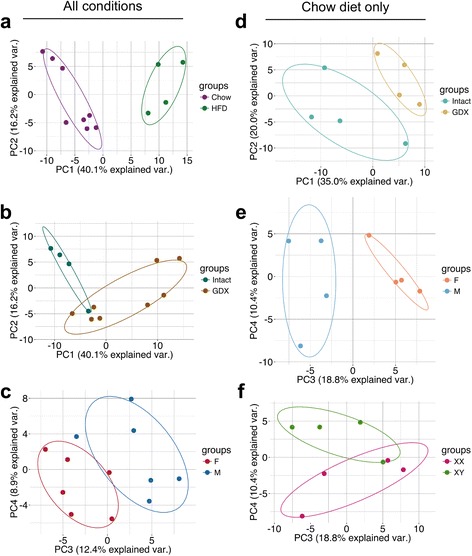
Principal component analysis (PCA) reveals factors influencing miRNA correlation covariance. PCA of all twelve sequencing libraries (ac) or chow-fed samples only (df). Each dot represents a sequencing library and consists of normalized read counts for each of the 183 highly expressed miRNAs. Dots are colored and encircled according to diet (a), gonadal state (b, d), gonadal sex (c, e), or sex chromosome complement (f). HFD, high fat diet; Int, gonadally intact; GDX, gonadectomized; F, female; M, male

References

    1. Llave C, Xie Z, Kasschau KD, Carrington JC. Cleavage of scarecrow-like mRNA targets directed by a class of Arabidopsis miRNA. Science. 2002;297:2053–6. doi: 10.1126/science.1076311. - DOI - PubMed
    1. Chen X. A microRNA as a translational repressor of APETALA2 in Arabidopsis flower development. Science. 2004;303:2022–5. doi: 10.1126/science.1088060. - DOI - PMC - PubMed
    1. Lee Y, Jeon K, Lee J-T, Kim S, Kim VN. MicroRNA maturation: stepwise processing and subcellular localization. EMBO J. 2002;21:4663–70. doi: 10.1093/emboj/cdf476. - DOI - PMC - PubMed
    1. Lagos-Quintana M, Rauhut R, Meyer J, Borkhardt A, Tuschl T. New microRNAs from mouse and human. RNA. 2003;9:175–9. doi: 10.1261/rna.2146903. - DOI - PMC - PubMed
    1. Kozomara A, Griffiths-Jones S. miRBase: annotating high confidence microRNAs using deep sequencing data. Nucleic Acids Res. 2014;42:D68–73. doi: 10.1093/nar/gkt1181. - DOI - PMC - PubMed

Publication types