. 2017 Jan 17;5(1):2.
doi: 10.1186/s40168-016-0220-z.

Deciphering composition and function of the root microbiome of a legume plant

Affiliations

Deciphering composition and function of the root microbiome of a legume plant

Kyle Hartman et al. Microbiome. .

Abstract

Background: Diverse assemblages of microbes colonize plant roots and collectively function as a microbiome. Earlier work has characterized the root microbiomes of numerous plant species, but little information is available for legumes despite their key role in numerous ecosystems including agricultural systems. Legumes form a root nodule symbiosis with nitrogen-fixing Rhizobia bacteria and thereby account for large, natural nitrogen inputs into soils. Here, we describe the root bacteria microbiome of the legume Trifolium pratense combining culture-dependent and independent methods. For a functional understanding of individual microbiome members and their impact on plant growth, we began to inoculate root microbiome members alone or in combination to Trifolium roots.

Results: At a whole-root scale, Rhizobia bacteria accounted for ~70% of the root microbiome. Other enriched members included bacteria from the genera Pantoea, Sphingomonas, Novosphingobium, and Pelomonas. We built a reference stock of 200 bacteria isolates, and we found that they corresponded to ~20% of the abundant root microbiome members. We developed a microcosm system to conduct simplified microbiota inoculation experiments with plants. We observed that while an abundant root microbiome member reduced plant growth when inoculated alone, this negative effect was alleviated if this Flavobacterium was co-inoculated with other root microbiome members.

Conclusions: The Trifolium root microbiome was dominated by nutrient-providing Rhizobia bacteria and enriched for bacteria from genera that may provide disease protection. First microbiota inoculation experiments indicated that individual community members can have plant growth compromising activities without being apparently pathogenic, and a more diverse root community can alleviate plant growth compromising activities of its individual members. A trait-based characterization of the reference stock bacteria will permit future microbiota manipulation experiments to decipher overall microbiome functioning and elucidate the biological mechanisms and interactions driving the observed effects. The presented reductionist experimental approach offers countless opportunities for future systematic and functional examinations of the plant root microbiome.

Keywords: 16S rRNA sequencing; Clover; Microbiome; Microcosm; Root.


Figures
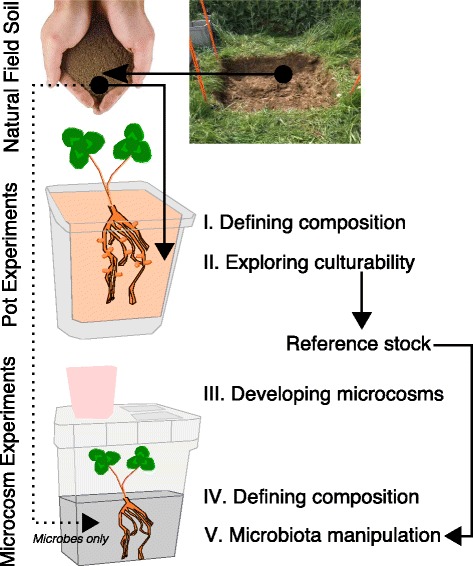
Fig. 1
Fig. 1
Characterization of the root microbiome. We collected a natural field soil and used it in a series of Trifolium growth experiments. (I) We investigated the composition of the root bacteria microbiome using 16S rRNA sequencing of root samples. (II) We utilized the same root material for an isolation effort to explore the culturable fraction of root bacteria microbiome and assembled a reference stock of bacteria isolates. (III) We subsequently developed a microcosm system to explore plant-microbiota interactions and (IV) investigated the composition of the Trifolium root microbiome in the system by inoculating microbiota extracted from the field soil. (V) We conducted microbiota manipulation experiments in which we inoculated culturable, abundant members of the root microbiome and scored their effects on plant growth
Fig. 2
Fig. 2
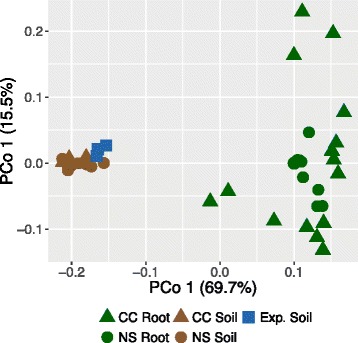
Sample type, growth conditions, and experiment explain much of the variation in soil and root bacteria communities. Unconstrained principal coordinates analysis (PCoA) of weighted UniFrac distances of root and soil samples from climate chamber (CC Root, CC Soil) and natural site growth experiments (NS Root, NS Soil), as well as the unplanted experimental field soil (Exp. Soil). See Additional file 1: Figure S4 for points colored by the replicate experiment
Fig. 3
Fig. 3
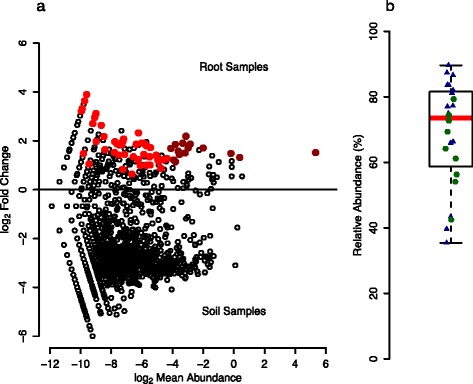
Abundant and root-specific OTUs of the Trifolium root microbiome. a The plot reports the mean relative abundance and the log2 fold change between root and soil samples of all OTUs present in the rarefied community (open black circles). Filled red circles indicate the 61 OTUs significantly enriched (P < 0.05, FDR corrected) in root samples. Dark red circles indicate the 15 OTUs present in the RootOTUs (see text). b Box plot (overplotted with individual data points) showing the median relative abundance of OTU1 (Rhizobium leguminosarum) in sequenced climate chamber (blue triangles) and natural site (green circles) root samples
Fig. 4
Fig. 4
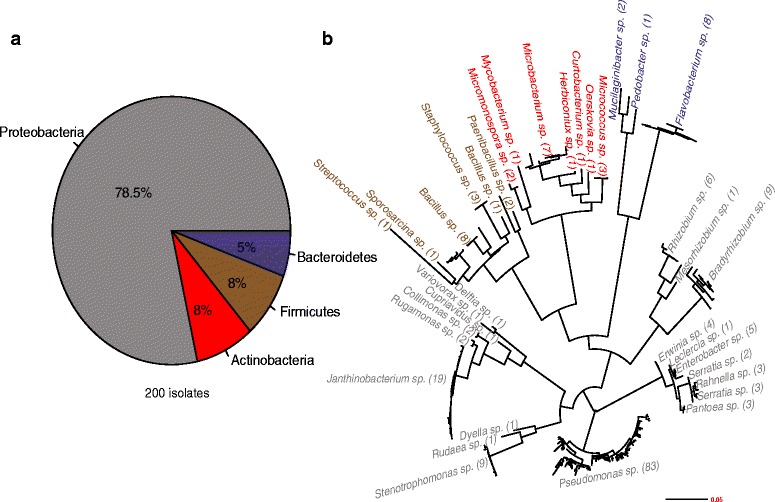
Taxonomic diversity of the Trifolium bacteria reference stock. a Taxonomic composition of the isolate collection at the Phylum level. b The phylogenetic diversity of the isolates at the genus level and the number of isolates assigned to each genus is indicated in parentheses. Isolates are labeled at the genus level and color-coded by phylum in a
Fig. 5
Fig. 5
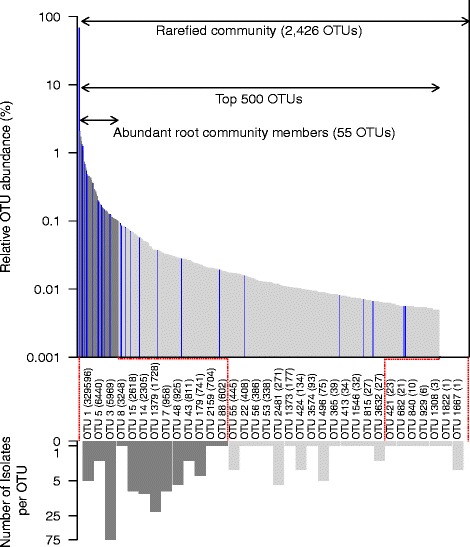
Mapping of reference stock bacteria to root microbiome OTUs. The upper bar graph represents the relative abundance of the 2426 OTUs in the root-associated bacteria community of Trifolium, with the 500 most abundant OTUs shown in gray bars. The dark gray bars indicate the 55 most abundant root OTUs (mean RA >0.1%). The blue bars indicate OTUs for which at least one isolate is present in the reference stock. The lower, inverted bar graph indicates the number of isolates in the reference stock mapping to an OTU in the community profile. Bars are shaded the same as in the upper graph to indicate the relative abundance of each OTU. Bars are labeled with the representative OTU name and its total number of sequences in the community profile in parentheses
Fig. 6
Fig. 6
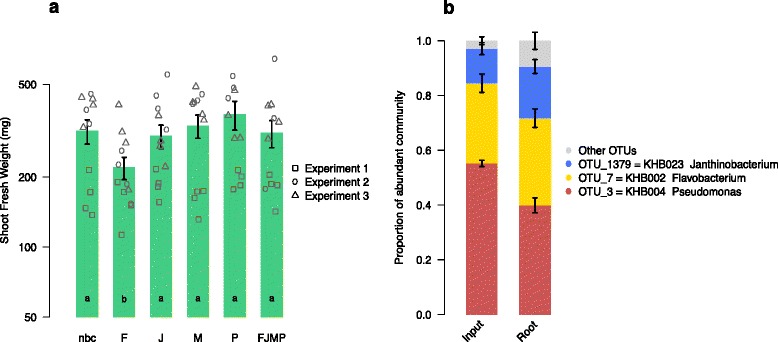
Functional analysis of a simplified Trifolium root microbiota in microcosms. a Trifolium growth in microcosms in the absence of inoculated bacteria (nbc no-bacteria control), with specific strains (F Flavobacterium KHB002, J Janthinobacterium KHB023, M Microbacterium strain KHB073, P Pseudomonas KHB004) or the simplified community (FJMP). The graph reports the mean shoot fresh weight (n = 12; ± s.e.m.) and the individual data points from the three independent experiments with four replicates each. The letters indicate statistical significance at P < 0.05 (Tukey’s HSD; analysis over the three experiments). Note, the Microbacterium (M, panel a) was not captured with the community quantification method. b Community composition of the simplified community (FJMP) at inoculation (input) and after 25 days on the roots. Sequences of other OTUs are indicated in gray

References

    1. Curtis TP, Sloan WT, Scannell JW. Estimating prokaryotic diversity and its limits. Proc Natl Acad Sci U S A. 2002;99:10494–9. doi: 10.1073/pnas.142680199. - DOI - PMC - PubMed
    1. Hacquard S, Garrido-Oter R, González A, Spaepen S, Ackermann G, Lebeis S, et al. Microbiota and host nutrition across plant and animal kingdoms. Cell Host Microbe. 2015;17:603–16. doi: 10.1016/j.chom.2015.04.009. - DOI - PubMed
    1. Bulgarelli D, Rott M, Schlaeppi K, Ver Loren van Themaat E, Ahmadinejad N, Assenza F, et al. Revealing structure and assembly cues for Arabidopsis root-inhabiting bacterial microbiota. Nature. 2012;488:91–5. doi: 10.1038/nature11336. - DOI - PubMed
    1. Lundberg DS, Lebeis SL, Paredes SH, Yourstone S, Gehring J, Malfatti S, et al. Defining the core Arabidopsis thaliana root microbiome. Nature. 2012;488:86–90. doi: 10.1038/nature11237. - DOI - PMC - PubMed
    1. Bulgarelli D, Garrido-Oter R, Münch PC, Weiman A, Dröge J, Pan Y, et al. Structure and function of the bacterial root microbiota in wild and domesticated barley. Cell Host Microbe. 2015;17:392–403. doi: 10.1016/j.chom.2015.01.011. - DOI - PMC - PubMed

Publication types

LinkOut - more resources