


Treatment-seeking behaviour and barriers to service access for sexually transmitted diseases among men who have sex with men in China: a multicentre cross-sectional survey
- PMID: 28095879
- PMCID: PMC5242014
- DOI: 10.1186/s40249-016-0219-5
Treatment-seeking behaviour and barriers to service access for sexually transmitted diseases among men who have sex with men in China: a multicentre cross-sectional survey
Abstract
Background: Delayed or inappropriate treatment for sexually transmitted diseases (STDs) increases the risk of HIV acquisition and may cause other harmful outcomes. However, studies on STD treatment-seeking behaviour and correlated factors in men who have sex with men (MSM) are scarce. This information is crucial for the promotion of STD treatment-seeking behaviour and reduction of HIV transmission among Chinese MSM.
Methods: During 2012-2013, a multicentre cross-sectional study was conducted in 7 Chinese cities. Participants completed an interview-questionnaire and gave venous blood samples, which were then tested for antibodies to HIV, syphilis, and herpes simplex virus-2 (HSV-2). MSM who tested positive for syphilis/HSV-2 or had obvious STD-related symptoms within the last 12 months were defined as suspected STD-infected MSM.
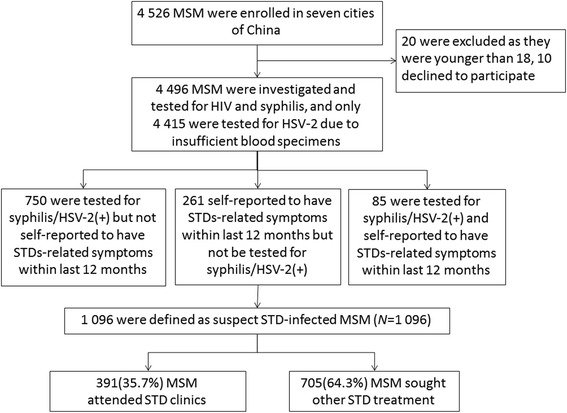
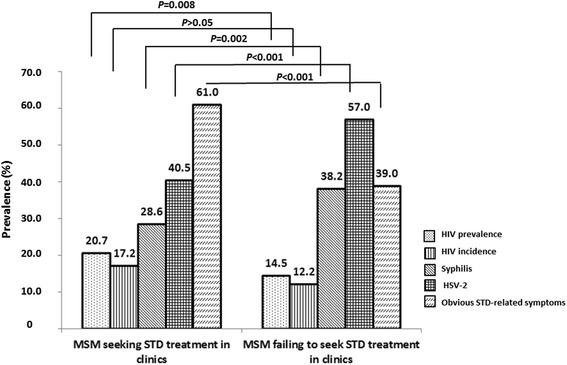
Results: Of the 4 496 eligible MSM who completed this survey, 24.4% (1 096/4 496) were categorized as suspected STD-infected MSM. 35.7% (391/1 096) of these MSM with suspected STD infections sought STD treatment in clinics within the last 12 months. Among MSM who did not attend STD clinics for treatment, the prevalence of syphilis and HSV-2 was significantly higher; the HIV prevalence and incidence within this subpopulation reached as high as 14.5% and 12.2/100 person-years, respectively. Multivariate logistic regression analysis indicated that having 7-12 years of education (vs. ≤6 years; aOR, 2.5; 95%CI, 1.0-6.1), ≥13 years of education (vs. ≤6 years: aOR, 2.8; 95%CI, 1.2-7.0), monthly income >500 USD (vs. ≤500 USD: aOR, 1.5; 95%CI, 1.1-2.1), obvious STD-related symptoms within last 12 months (aOR, 5.3; 95%CI, 3.7-7.5), being HIV infected (aOR, 1.7; 95%CI, 1.1-2.6), currently syphilis infected (aOR, 0.6; 95%CI, 0.4-0.9) and HSV-2 infected (aOR, 0.6; 95%CI, 0.5-0.9) were independent correlates with seeking STD treatment in clinics among Chinese MSM.
Conclusions: The high prevalence of STD infection coupled with a low proportion of individuals who exhibit appropriate treatment-seeking behaviour create a high risk of a growing HIV epidemic among Chinese MSM. Models that prioritize better screening for and education about STDs should be urgently implemented, especially among low-income MSM.
Keywords: China; HIV; Men who have sex with men (MSM); Sexually transmitted diseases (STDs); Treatment-seeking behaviour.
Figures
References
-
- Okonofua FE, Coplan P, Collins S, Oronsaye F, Ogunsakin D, Ogonor JT, Kaufman JA, Heggenhougen K. Impact of an intervention to improve treatment-seeking behavior and prevent sexually transmitted diseases among Nigerian youths. Int J Infect Dis. 2003;7:61–73. doi: 10.1016/S1201-9712(03)90044-0. - DOI - PubMed
-
- Grosskurth H, Todd J, Mwijarubi E, Mayaud P, Nicoll A, Newell J, Mabey D, Hayes R, Mosha F, Senkoro K. Impact of improved treatment of sexually transmitted diseases on HIV infection in rural Tanzania: randomised controlled trial. Lancet. 1995;346:530–536. doi: 10.1016/S0140-6736(95)91380-7. - DOI - PubMed
-
- World Health Organization. Men who have sex with men. Available at: http://www.who.int/hiv/topics/msm/about/en/. Verified on: 9 September 2016.
Publication types
MeSH terms
LinkOut - more resources
Full Text Sources
Other Literature Sources
Medical
Research Materials
