. 2017 Jan 17;5(1):4.
doi: 10.1186/s40168-016-0213-y.

Evolution of gut microbiota composition from birth to 24 weeks in the INFANTMET Cohort

Affiliations

Evolution of gut microbiota composition from birth to 24 weeks in the INFANTMET Cohort

Cian J Hill et al. Microbiome. .

Erratum in

Abstract

Background: The gut is the most extensively studied niche of the human microbiome. The aim of this study was to characterise the initial gut microbiota development of a cohort of breastfed infants (n = 192) from 1 to 24 weeks of age.

Methods: V4-V5 region 16S rRNA amplicon Illumina sequencing and, in parallel, bacteriological culture. The metabolomic profile of infant urine at 4 weeks of age was also examined by LC-MS.

Results: Full-term (FT), spontaneous vaginally delivered (SVD) infants' microbiota remained stable at both phylum and genus levels during the 24-week period examined. FT Caesarean section (CS) infants displayed an increased faecal abundance of Firmicutes (p < 0.01) and lower abundance of Actinobacteria (p < 0.001) after the first week of life compared to FT-SVD infants. FT-CS infants gradually progressed to harbouring a microbiota closely resembling FT-SVD (which remained stable) by week 8 of life, which was maintained at week 24. The gut microbiota of preterm (PT) infants displayed a significantly greater abundance of Proteobacteria compared to FT infants (p < 0.001) at week 1. Metabolomic analysis of urine at week 4 indicated PT-CS infants have a functionally different metabolite profile than FT (both CS and SVD) infants. Co-inertia analysis showed co-variation between the urine metabolome and the faecal microbiota of the infants. Tryptophan and tyrosine metabolic pathways, as well as fatty acid and bile acid metabolism, were found to be affected by delivery mode and gestational age.

Conclusions: These findings confirm that mode of delivery and gestational age both have significant effects on early neonatal microbiota composition. There is also a significant difference between the metabolite profile of FT and PT infants. Prolonged breastfeeding was shown to have a significant effect on the microbiota composition of FT-CS infants at 24 weeks of age, but interestingly not on that of FT-SVD infants. Twins had more similar microbiota to one another than between two random infants, reflecting the influence of similarities in both host genetics and the environment on the microbiota..


Figures
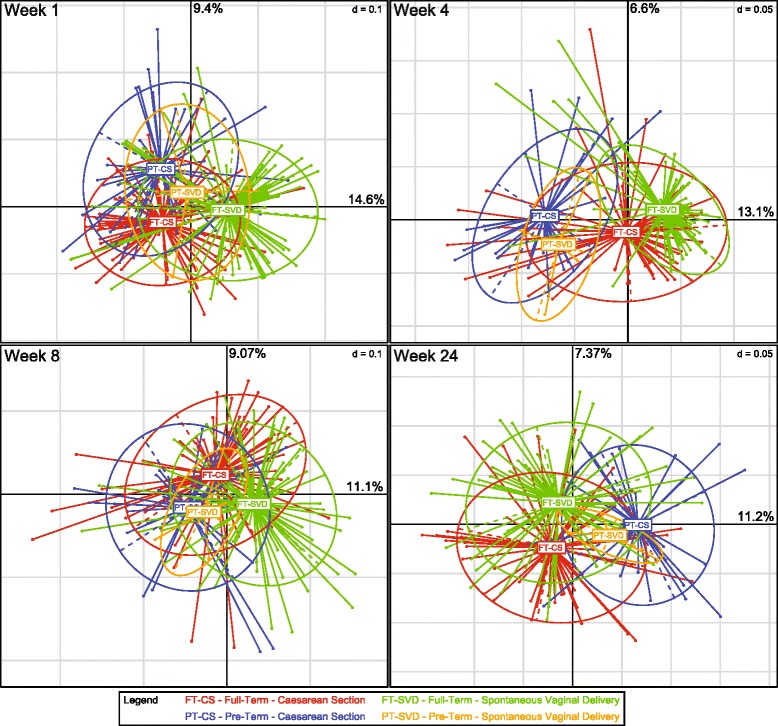
Fig. 1
Fig. 1
Birth mode and gestation age both significantly affect the composition of the infant gut microbiota to 24 weeks of age. Principal coordinates analysis (PCoAs) on Spearman distance matrices of samples at each of four time points (weeks 1, 4, 8 and 24) revealed significant differences between the groups. Significance was calculated using permutational multivariate analysis of variance (PerMANOVA, Additional file 1: Table S3). *p < 0.05; **p < 0.01; ***p < 0.001
Fig. 2
Fig. 2
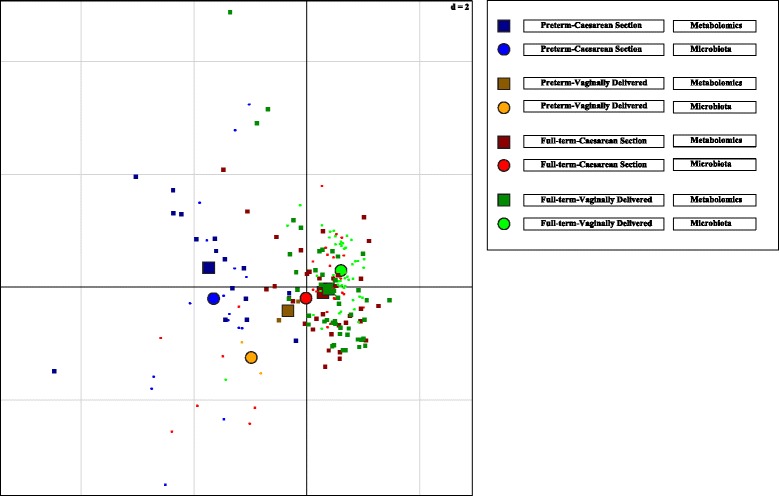
Co-inertia analysis of urine-derived metabolomic and 16S rRNA gut microbiota data from stool. Microbiota data was scalar normalised and logged. Microbiota is represented by circles and the metabolomic samples are represented by squares. Four groups are visualised; preterm-Caesarean section (blue), preterm-spontaneous vaginal delivery (orange), full-term Caesarean section (red) and full-term spontaneous vaginal delivery (green). Small objects represent the individual samples and large objects represent the barycentre of the group. Analysis shows that the co-variance between the microbiota and metabolomics dataset splits the preterm infants from the full-terms. Metabolites associated with this split are highlighted in Additional file 3: Figure S1 and Additional file 1: Table S4
Fig. 3
Fig. 3
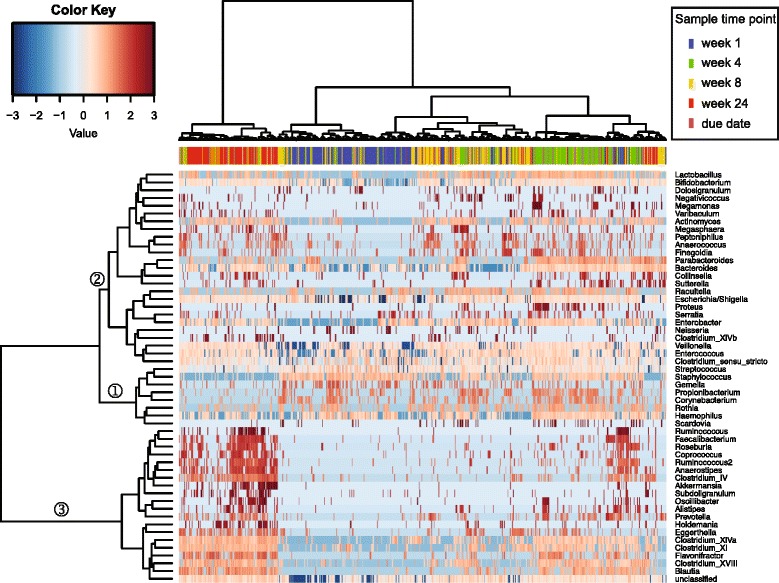
Infants separate temporally and into three distinct clusters based on differentially abundant taxa. The three clusters may indicate the beginning of an enterotype-based microbiota profile as early as 24 weeks of age. Only those genera (side) that are present in at least 10% of samples (top) are shown. Samples are highlighted by the time point at which they were obtained
Fig. 4
Fig. 4
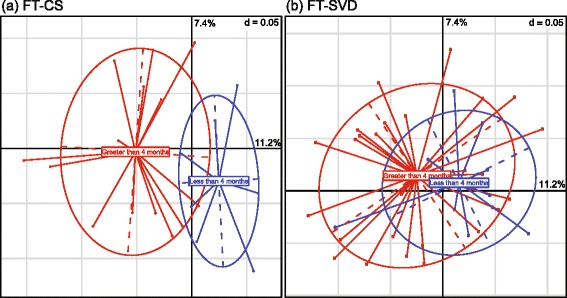
Breastfeeding duration influences the gut microbiota of C-section infants but not naturally delivered infants at 24 weeks of age. a Caesarean section, full-term infants. b Naturally delivered full-term infants. In blue are infants that were breastfed for less than 4 months (i.e. between 1 and 2 months, or between 2 and 4 months). In red are infants that were breastfed for longer than 4 months. The vast majority of infants in the cohort were breastfed for 1 month
Fig. 5
Fig. 5
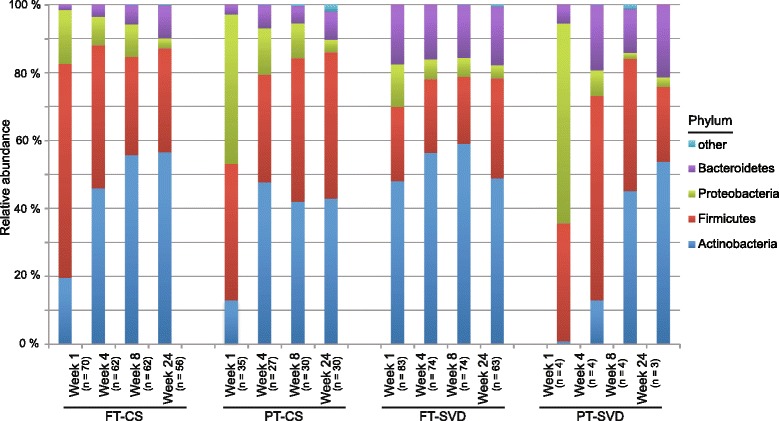
Naturally delivered infant microbiota remains stable at phylum level from 1 to 24 weeks of age, while C-section delivered infants progress to a similar microbiota profile over time. There is no shift in the FT-SVD infant composition from 1 to 24 weeks of age. FT-CS progresses by increasing the relative abundance of Actinobacteria (p < 0.001) and Bacteroidetes (p < 0.001) and decreasing the relative abundance of Firmicutes (p < 0.05) over the same period. PT-CS infants initially have a higher abundance of Proteobacteria compared to the FT groups (p < 0.001). Between week 1 and week 4 the Proteobacteria and Firmicutes abundance decreased (p < 0.001 and p < 0.01, respectively). No significant differences were recorded after week 4. The PT-SVD group had low subject numbers (n = 4), hindering significant associations, resulting in no significant changes being observed. Showing phyla found at >1% average in total population. Phyla found at <1% were grouped as ‘other’
Fig. 6
Fig. 6
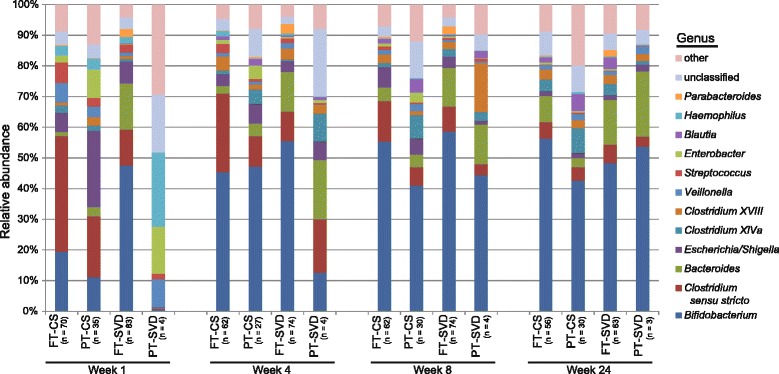
Comparison of the microbiota composition of infants born by different birth modes and gestation duration at the same age across four time points from 1 week to 24 weeks of age. The most pronounced differences are evident at week 1 of age, with the microbiota composition becoming increasingly uniform over time to 24 weeks. Showing genera found at >1% average in total population. Genera found at <1% were grouped as ‘other’
Fig. 7
Fig. 7
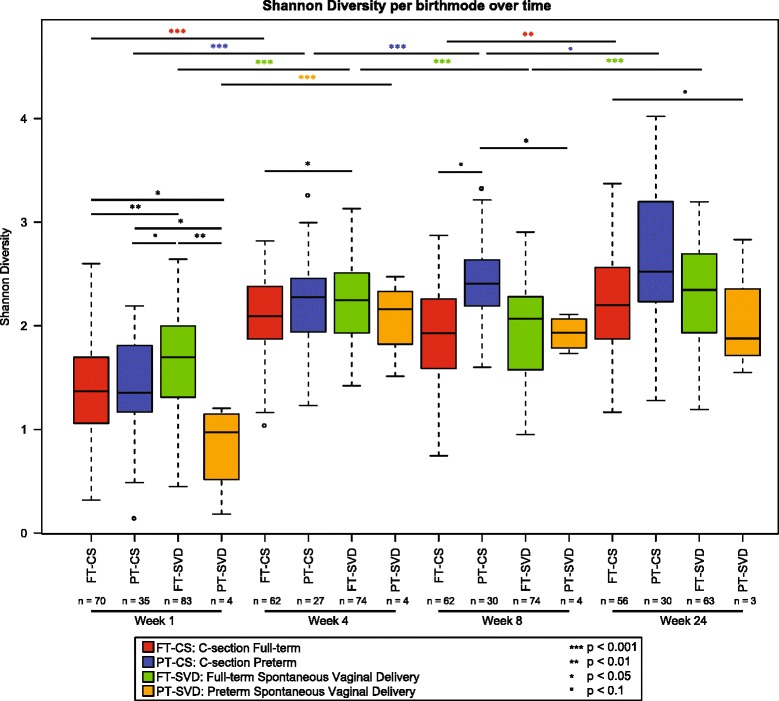
Shannon diversity of different groups of infant gut microbiota increases with age, demonstrated by separating subjects by both age and by birth mode. Significant differences between birth modes at a given time point were tested with a linear mixed effects model which adjusts for potential batch effect (sequencing run), and the age of the infants at the given time point. Comparing different time points for a given birth mode was performed with linear mixed effects models that adjust for the batch and the subjects
Fig. 8
Fig. 8
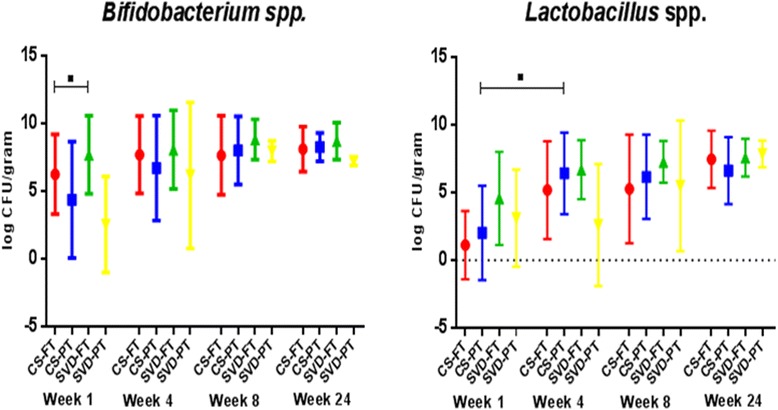
Count data showing the absolute levels of Bifidobacterium and Lactobacillus at all time points from 1 to 24 weeks of age for all four infant groups. Culture techniques were used to generate count data to verify the accuracy of the culture-independent sequencing data. Over 7000 strains of Bifidobacterium and Lactobacillus stocks were isolated and stocked in a biobank

References

    1. Maynard CL, Elson CO, Hatton RD, Weaver CT. Reciprocal interactions of the intestinal microbiota and immune system. Nature. 2012;489:231–41. doi: 10.1038/nature11551. - DOI - PMC - PubMed
    1. Yatsunenko T, Rey FE, Manary MJ, et al. Human gut microbiome viewed across age and geography. Nature. 2012;486:222–7. - PMC - PubMed
    1. Aagaard K, Ma J, Antony KM, Ganu R, Petrosino J, Versalovic J. The placenta harbors a unique microbiome. Sci Transl Med. 2014;6:237ra65. doi: 10.1126/scitranslmed.3008599. - DOI - PMC - PubMed
    1. Cilieborg MS, Boye M, Sangild PT. Bacterial colonization and gut development in preterm neonates. Early Hum Dev. 2012. doi: 10.1016/j.earlhumdev.2011.12.027. - PubMed
    1. Dominguez-Bello CEK, Contreras M, Magris M, Hidalgo G, Fierer N, Knight R. Delivery mode shapes the acquisition and structure of the initial microbiota across multiple body habitats in newborns. Proc Natl Acad Sci U S A. 2010;107:11971–5. doi: 10.1073/pnas.1002601107. - DOI - PMC - PubMed

Publication types