


Formation of Fructose-Mediated Advanced Glycation End Products and Their Roles in Metabolic and Inflammatory Diseases
- PMID: 28096127
- PMCID: PMC5227984
- DOI: 10.3945/an.116.013912
Formation of Fructose-Mediated Advanced Glycation End Products and Their Roles in Metabolic and Inflammatory Diseases
Abstract
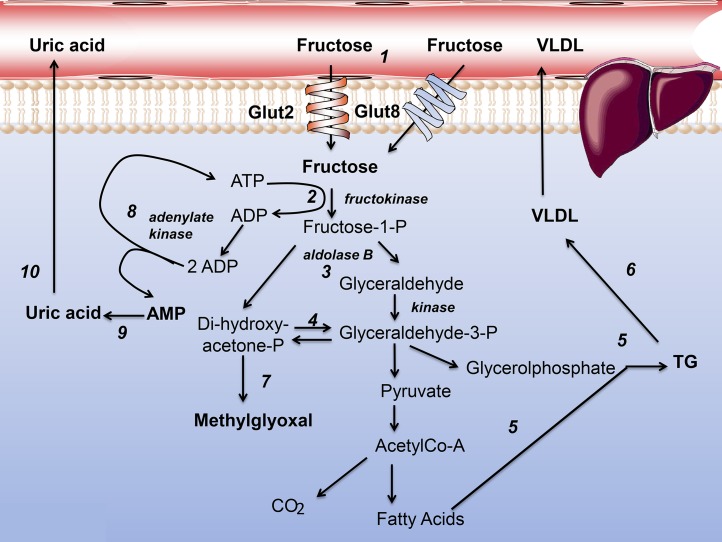
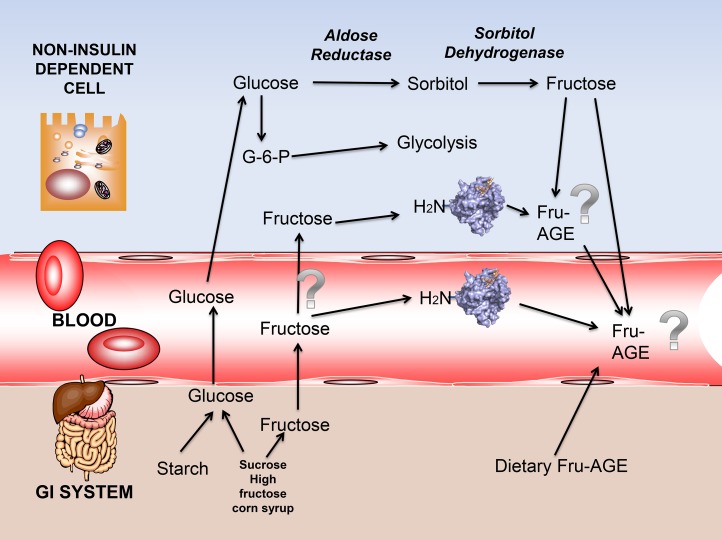
Fructose is associated with the biochemical alterations that promote the development of metabolic syndrome (MetS), nonalcoholic fatty liver disease, and type 2 diabetes. Its consumption has increased in parallel with MetS. It is metabolized by the liver, where it stimulates de novo lipogenesis. The triglycerides synthesized lead to hepatic insulin resistance and dyslipidemia. Fructose-derived advanced glycation end products (AGEs) may be involved via the Maillard reaction. Fructose has not been a main focus of glycation research because of the difficulty in measuring its adducts, and, more importantly, because although it is 10 times more reactive than glucose, its plasma concentration is only 1% of that of glucose. In this focused review, I summarize exogenous and endogenous fructose metabolism, fructose glycation, and in vitro, animal, and human data. Fructose is elevated in several tissues of diabetic patients where the polyol pathway is active, reaching the same order of magnitude as glucose. It is plausible that the high reactivity of fructose, directly or via its metabolites, may contribute to the formation of intracellular AGEs and to vascular complications. The evidence, however, is still unconvincing. Two areas that have been overlooked so far and should be actively explored include the following: 1) enteral formation of fructose AGEs, generating an inflammatory response to the receptor for AGEs (which may explain the strong association between fructose consumption and asthma, chronic bronchitis, and arthritis); and 2) inactivation of hepatic AMP-activated protein kinase by a fructose-mediated increase in methylglyoxal flux (perpetuating lipogenesis, fatty liver, and insulin resistance). If proven correct, these mechanisms would put the fructose-mediated Maillard reaction in the limelight again as a contributing factor in chronic inflammatory diseases and MetS.
Keywords: AMPK; Maillard reaction; RAGE; advanced glycation; arthritis; asthma; diabetes; fructose; inflammation; metabolic syndrome.
© 2017 American Society for Nutrition.
Conflict of interest statement
2 Author disclosures: A Gugliucci, no conflicts of interest.
Figures


References
-
- Gugliucci A, Lustig RH, Caccavello R, Erkin-Cakmak A, Noworolski SM, Tai VW, Wen MJ, Mulligan K, Schwarz JM. Short-term isocaloric fructose restriction lowers apoC-III levels and yields less atherogenic lipoprotein profiles in children with obesity and metabolic syndrome. Atherosclerosis 2016;253:171–7. - PubMed
-
- Brownlee M. The pathobiology of diabetic complications: a unifying mechanism. Diabetes 2005;54:1615–25. - PubMed
-
- Nishikawa T, Edelstein D, Brownlee M. The missing link: a single unifying mechanism for diabetic complications. Kidney Int Suppl 2000;77:S26–30. - PubMed
Publication types
MeSH terms
Substances
LinkOut - more resources
Full Text Sources
Other Literature Sources
Medical
