Comparative Study
. 2017 Jan 31;114(5):1135-1140.
doi: 10.1073/pnas.1616248114. Epub 2017 Jan 17.

Multi-institute analysis of carbapenem resistance reveals remarkable diversity, unexplained mechanisms, and limited clonal outbreaks

Affiliations
Comparative Study

Multi-institute analysis of carbapenem resistance reveals remarkable diversity, unexplained mechanisms, and limited clonal outbreaks

Gustavo C Cerqueira et al. Proc Natl Acad Sci U S A. .

Abstract

Carbapenem-resistant Enterobacteriaceae (CRE) are among the most severe threats to the antibiotic era. Multiple different species can exhibit resistance due to many different mechanisms, and many different mobile elements are capable of transferring resistance between lineages. We prospectively sampled CRE from hospitalized patients from three Boston-area hospitals, together with a collection of CRE from a single California hospital, to define the frequency and characteristics of outbreaks and determine whether there is evidence for transfer of strains within and between hospitals and the frequency with which resistance is transferred between lineages or species. We found eight species exhibiting resistance, with the majority of our sample being the sequence type 258 (ST258) lineage of Klebsiella pneumoniae There was very little evidence of extensive hospital outbreaks, but a great deal of variation in resistance mechanisms and the genomic backgrounds carrying these mechanisms. Local transmission was evident in clear phylogeographic structure between the samples from the two coasts. The most common resistance mechanisms were KPC (K. pneumoniae carbapenemases) beta-lactamases encoded by blaKPC2, blaKPC3, and blaKPC4, which were transferred between strains and species by seven distinct subgroups of the Tn4401 element. We also found evidence for previously unrecognized resistance mechanisms that produced resistance when transformed into a susceptible genomic background. The extensive variation, together with evidence of transmission beyond limited clonal outbreaks, points to multiple unsampled transmission chains throughout the continuum of care, including asymptomatic carriage and transmission of CRE. This finding suggests that to control this threat, we need an aggressive approach to surveillance and isolation.

Keywords: Enterobacteriaceae; carbapenem resistance; comparative genomics; molecular evolution; whole-genome sequencing.


Conflict of interest statement

The authors declare no conflict of interest.

Figures
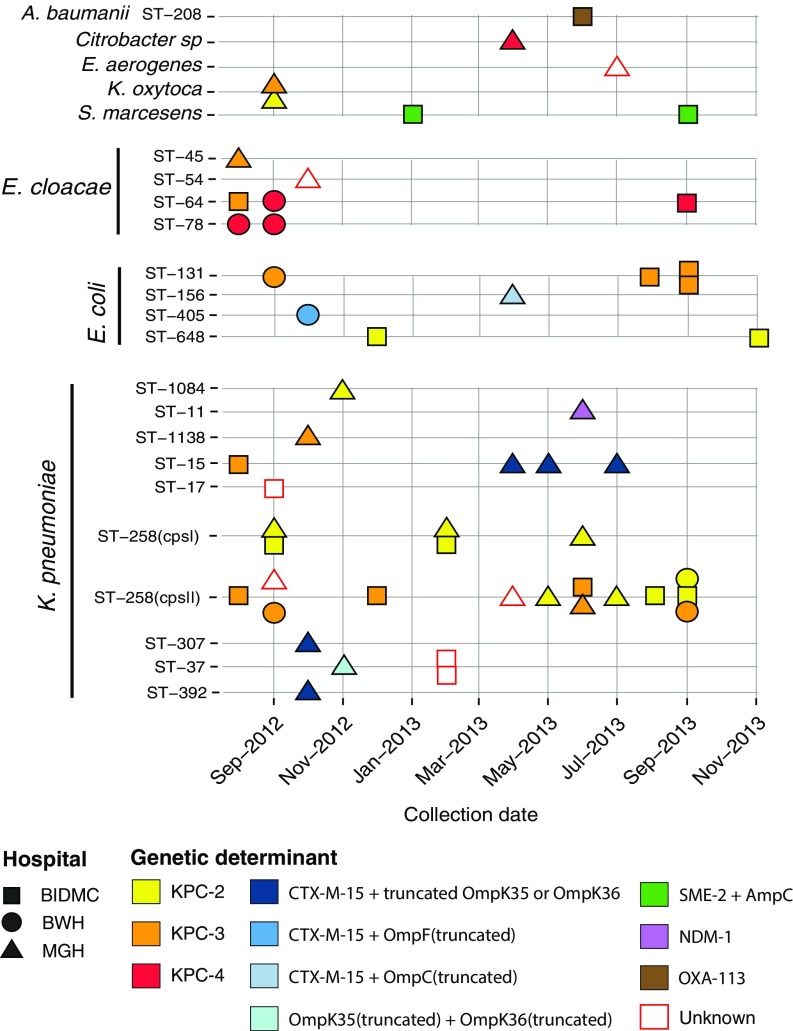
Fig. 1.
Fig. 1.
Carbapenem-nonsusceptible Enterobacteriaceae from three Boston-area hospitals. Isolates are shown as squares (BIDMC), circles (BWH), and triangles (MGH). Isolates are stratified based on species and MLST (vertical axis) and with respect to time of collection (horizontal axis). Color indicates the predicted genetic determinant for meropenem nonsusceptibility. Isolates for which no genetic determinant was predicted are outline in red. Each rectangle on December 2012 represents two specimens collected from the same patient.
Fig. 2.
Fig. 2.
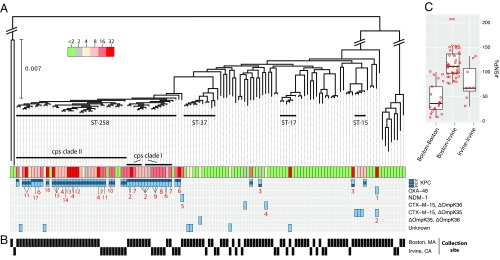
K. pneumoniae diversity. (A) Phylogeny of K. pneumoniae core genomes across all collections. Diagonal bars crossing major branches represent scale breaks. Horizontal thick black bars show clusters associated with a single MLST and containing resistant strains. The MIC of meropenem in micrograms per milliliter for each isolate is shown together with the predicted genetic determinant of resistance from the list of alternative genotypes located on the right. Numbers in red indicate predicted location of resistance determinants, including the predicted incompatibility group and name of closest replicon at GenBank and accession, if detected: 1, IncL/M(pOXA-48); 2, IncR; 3, IncN [pBK31551]; 4, chromosome; 5, IncFII(pKPX1) [accession no. KF727591.2]; 6, IncFIB(pQil); 7, IncFIB(K); 8, IncN; 9, IncN [accession no. FJ223607.1]; 10, IncFIA(HI1); 11, ColRNAI; 12, IncR [accession no. CP006657.1]; 13, two genomic locations: chromosome; IncI2 [pBK15692]; 14, IncI2 [pBK15692]; 15, IncFIA(HI1) [pBK30683]; 16, [pKpS90]; and 17, IncFIB(K) [pBK32179]. (B) Black rectangles indicate the city in which the isolate was collected. (C) Box plot of the distribution of SNPs (after removing recombination) separating closest pairs of ST258 from the same or different cities. Whiskers correspond to 1.5× the interquartile range (distance between the first and the third quartile). Red circles indicate the number of SNPs between each pair evaluated.
Fig. 3.
Fig. 3.
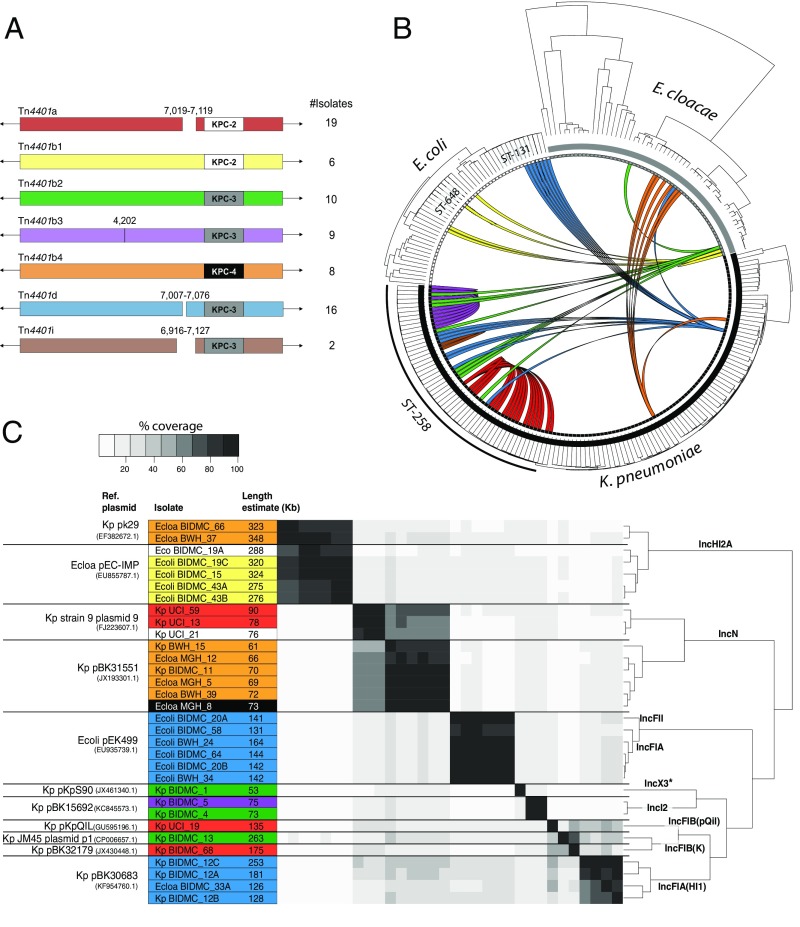
CRE Tn4401 isoforms. (A) The coordinates of indels (gaps in the rectangle) and substitutions (vertical line) are based on alignment against Tn4401b, the longest subtype identified. Only identical transposons within a single scaffold and found in more than one isolate were considered. The number of isolates with each form is listed to the right of the figure. The blaKPC associated with each transposon is indicated. (B) The phylogeny of each species is depicted in the outer radius. Colored arcs indicate isolates with identical Tn4401 sequences and are consistent with colors used in A. (C) Similarity among plasmids harboring the blaKPC gene. The name for the best matching reference plasmid at NCBI, the species associated with it (Kp for K. pneumoniae, Ecoli for E. coli, and Ecloa for E. cloacae), and GenBank accession number is given for each group in the first column. Species and isolate names are given alongside the estimated length of their predicted plasmid. Color indicates Tn4401 isoform encoded by plasmid according to A, and white cells are unique and unnamed isoforms. Black cells are truncated transposons. Pairwise percentage coverage between plasmids is shown in gray scale. Dendrogram depicts hierarchical clustering of plasmids based on their pairwise identity and coverage, and labels along branches indicate the plasmid incompatibility group assigned to each group. Nonchromosomal scaffolds that did not have sufficient identity to a previously reported plasmid are not included. *IncX3 incompatibility group was inferred from best-match plasmid: pKpS90 (accession no. JX461340.1).

References

    1. Centers for Disease Control and Prevention 2013. Antibiotic Resistance Threats in the United States, 2013 (Centers for Disease Control and Prevention, Atlanta). Available at: www.cdc.gov/drugresistance/threat-report-2013. Accessed July 25, 2014.
    1. Schwaber MJM, et al. Predictors of carbapenem-resistant Klebsiella pneumoniae acquisition among hospitalized adults and effect of acquisition on mortality. Antimicrob Agents Chemother. 2008;52(3):1028–1033. - PMC - PubMed
    1. Hidron AI, et al. National Healthcare Safety Network Team; Participating National Healthcare Safety Network Facilities NHSN annual update: antimicrobial-resistant pathogens associated with healthcare-associated infections: annual summary of data reported to the National Healthcare Safety Network at the Centers for Disease Control and Prevention, 2006-2007. Infect Control Hosp Epidemiol. 2008;29(11):996–1011. - PubMed
    1. Nordmann P, Dortet L, Poirel L. Carbapenem resistance in Enterobacteriaceae: here is the storm! Trends Mol Med. 2012;18(5):263–272. - PubMed
    1. Conlan S, et al. Single-molecule sequencing to track plasmid diversity of hospital-associated carbapenemase-producing Enterobacteriaceae. Sci Transl Med. 2014;6(254):254ra126. - PMC - PubMed

Publication types

MeSH terms