. 2017 Mar;232(3):525-534.
doi: 10.1530/JOE-16-0452. Epub 2017 Jan 17.

Regulation of aldosterone secretion by mineralocorticoid receptor-mediated signaling

Affiliations

Regulation of aldosterone secretion by mineralocorticoid receptor-mediated signaling

Cherish Chong et al. J Endocrinol. 2017 Mar.

Abstract

We posit the existence of a paracrine/autocrine negative feedback loop, mediated by the mineralocorticoid receptor (MR), regulating aldosterone secretion. To assess this hypothesis, we asked whether altering MR activity in zona glomerulosa (ZG) cells affects aldosterone production. To this end, we studied ex vivo ZG cells isolated from male Wistar rats fed chow containing either high (1.6% Na+ (HS)) or low (0.03% Na+ (LS)) amount of sodium. Western blot analyses demonstrated that MR was present in both the ZG and zona fasciculata/zona reticularis (ZF/ZR/ZR). In ZG cells isolated from rats on LS chow, MR activation by fludrocortisone produced a 20% and 60% reduction in aldosterone secretion basally and in response to angiotensin II (ANGII) stimulation, respectively. Corticosterone secretion was increased in these cells suggesting that aldosterone synthase activity was being reduced by fludrocortisone. In contrast, canrenoic acid, an MR antagonist, enhanced aldosterone production by up to 30% both basally and in response to ANGII. Similar responses were observed in ZG cells from rats fed HS. Modulating glucocorticoid receptor (GR) activity did not alter aldosterone production by ZG cells; however, altering GR activity did modify corticosterone production from ZF/ZR/ZR cells both basally and in response to adrenocorticotropic hormone (ACTH). Additionally, activating the MR in ZF/ZR/ZR cells strikingly reduced corticosterone secretion. In summary, these data support the hypothesis that negative ultra-short feedback loops regulate adrenal steroidogenesis. In the ZG, aldosterone secretion is regulated by the MR, but not the GR, an effect that appears to be secondary to a change in aldosterone synthase activity.

Keywords: adrenal cortex; aldosterone; corticosterone; zona fasciculata; zona glomerulosa.


Figures

Figure 1
Figure 1
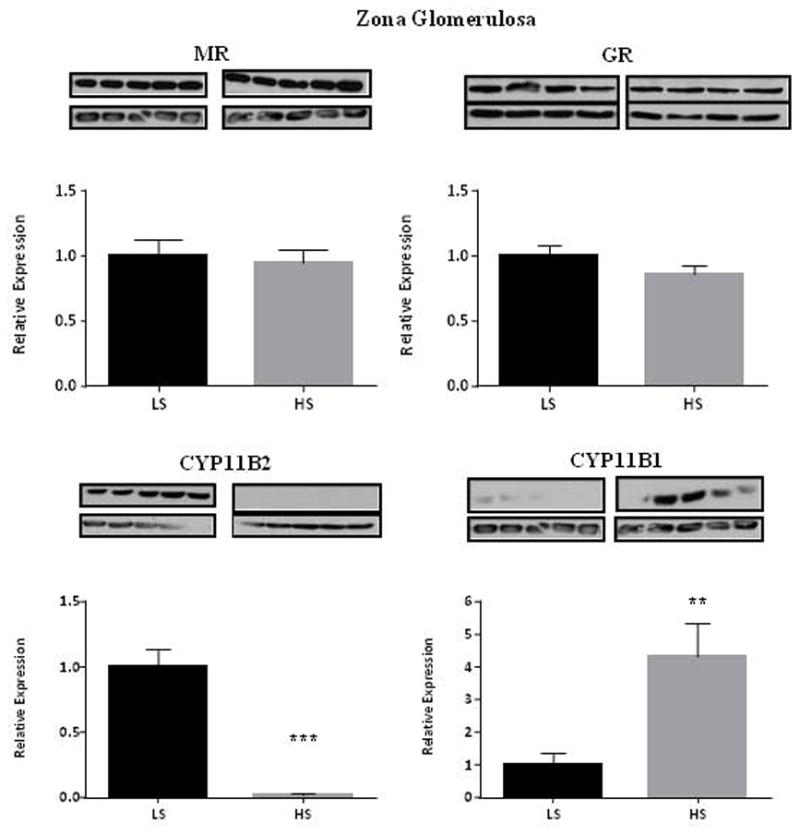
Western blot analyses showing expression of MR, GR, CYP11B2 and CYP11B1 in zona glomerulosa cells obtained from rats maintained on Low Salt (LS) or High Salt (HS) diets. HS diet reduced CYP11B2 levels but increased CYP11B1 expression. Representative western blots are shown above each graph. n=9 per group (Controls are the lower panels). **P<0.01; ***P<0.001.
Figure 2
Figure 2
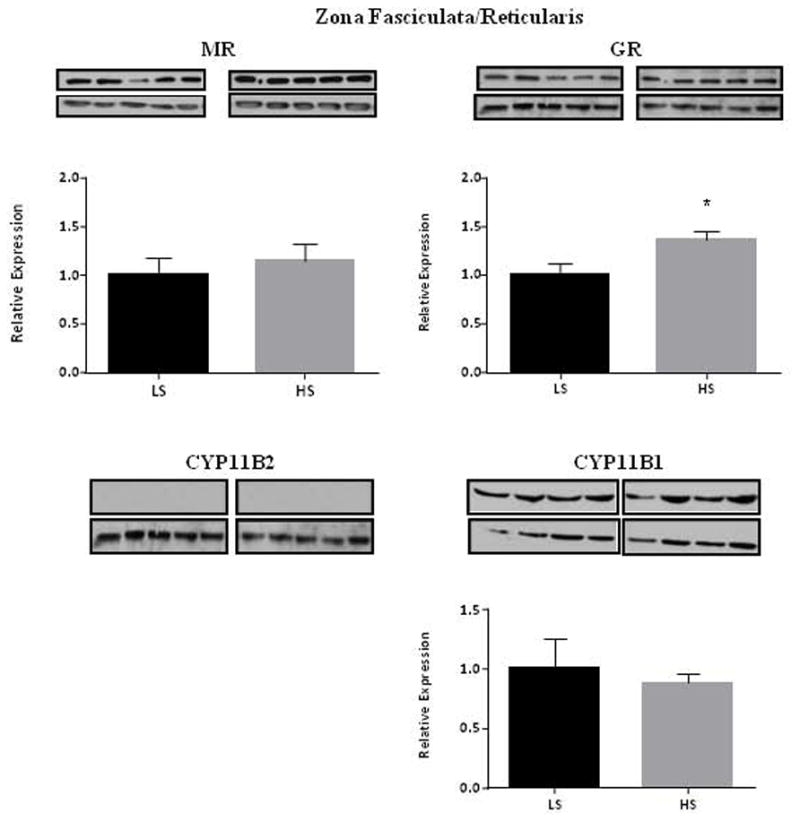
Western blot analyses showing expression of MR, GR, CYP11B2 and CYP11B1 in zona fasciculata/reticularis cells obtained from rats maintained on Low Salt (LS) or High Salt (HS) diets. CYP11B1 levels are not significantly affected by dietary salt. CYP11B2 was non-detectable in these cells. Representative Western blots are shown above each graph (Controls are the lower panels). n=9 per group. *P<0.05.
Figure 3
Figure 3
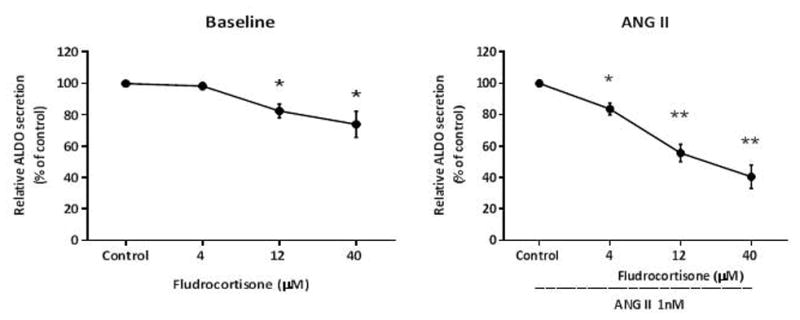
Effect of activation of MR by fludrocortisone (FLUDRO) on basal (left panel) and stimulated (right panel) aldosterone release by zona glomerulosa cells from low salt treated rats. Results are means ± SEM (n=8) and are expressed as percentage of secretion with controls set at 100%. * P < 0.05, ** P < 0.001.
Figure 4
Figure 4
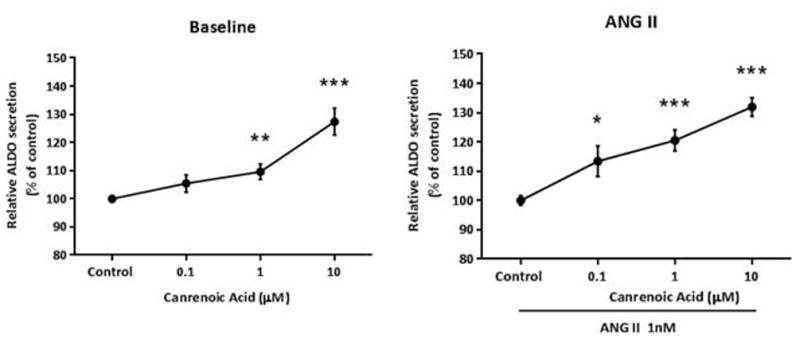
Effect of MR inhibition on baseline and ANGII stimulated aldosterone secretion by isolated zona glomerulosa cells from rats fed a low salt diet. Results are means ± SEM (n=22) and are expressed as percentage of secretion with controls set at 100%. * P < 0.05, ** P < 0.01, *** P < 0.0001.
Figure 5
Figure 5
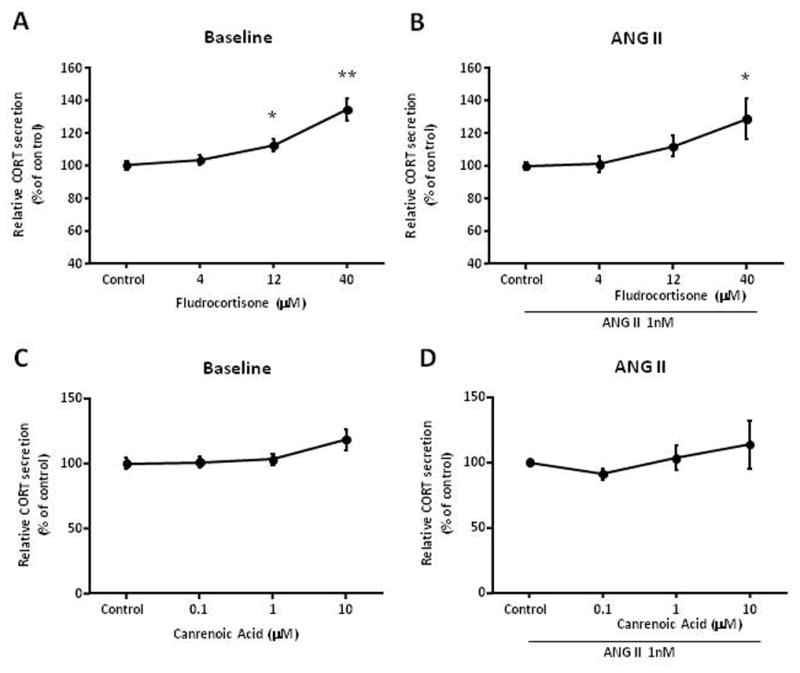
Corticosterone (CORT) secretion in isolated zona glomerulosa cells from rats on a low salt diet with FLUDRO (A, B with n=8) and canrenoic acid (C, D with n=22) treatment. Results are means ± SEM and are expressed as percentage of secretion with controls set at 100%. * P < 0.05, ** P < 0.005.
Figure 6
Figure 6
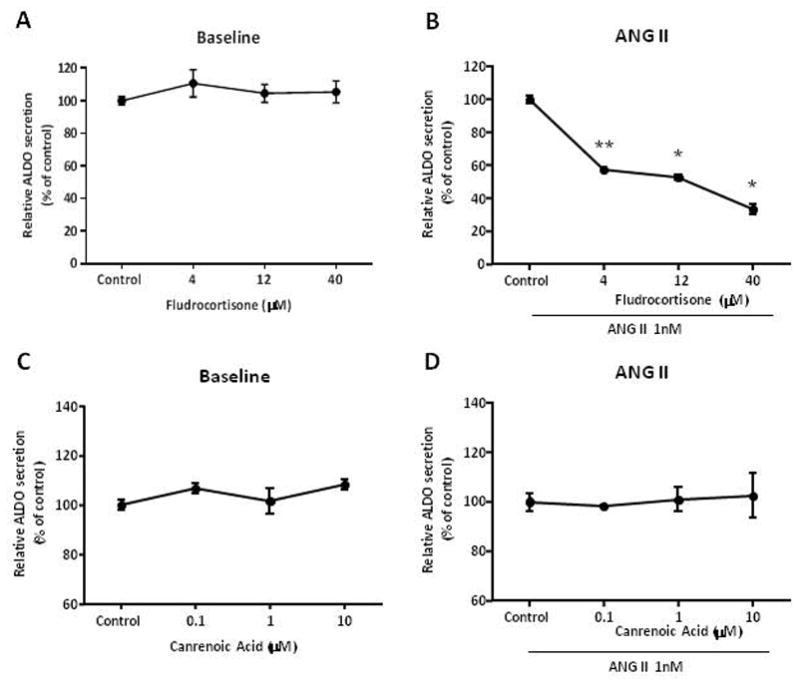
Modulation of MR function in zona glomerulosa cells from rats on a high salt diet. Effect of FLUDRO (A, B with n=4) and CAN (C, D with n=6) on aldosterone secretion. Results are means ± SEM and are expressed as percentage of secretion with controls set at 100%. * P < 0.005 , ** P < 0.001.
Figure 7
Figure 7
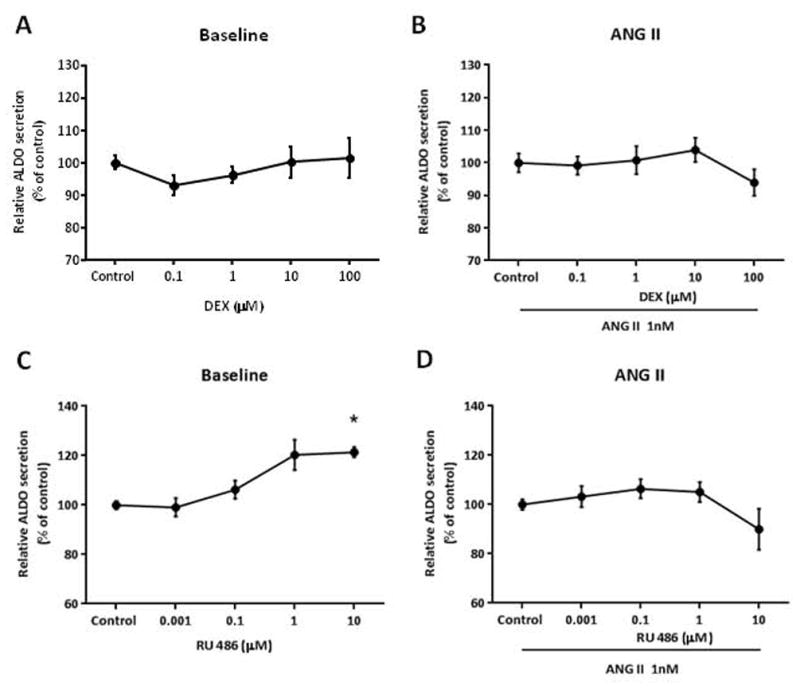
Effect of modifying GR activity on aldosterone secretion in zona glomerulosa cells from low salt fed rats. Cells were incubated with DEX. a GR agonist (A, B) and RU486, a GR antagonist (C, D). Results are means ± SEM with n=6 and are expressed as percentage of secretion with controls set at 100%. * P < 0.005.
Figure 8
Figure 8
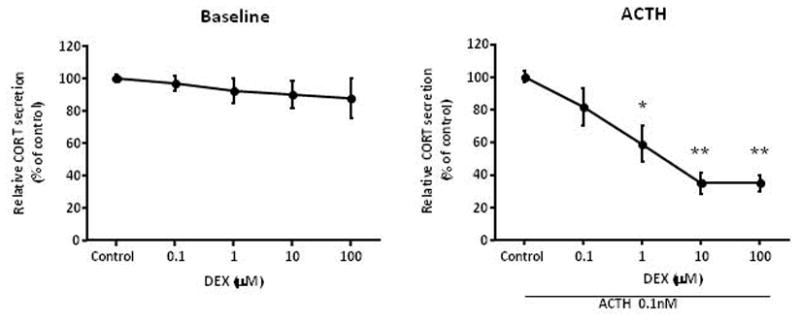
Inhibition of stimulated corticosterone secretion by DEX in zona fasciculata/reticularis cells from low salt fed rats. Results are means ± SEM (n=8) and are expressed as percentage of secretion with controls set at 100%. * P < 0.05, ** P < 0.0005.
Figure 9
Figure 9
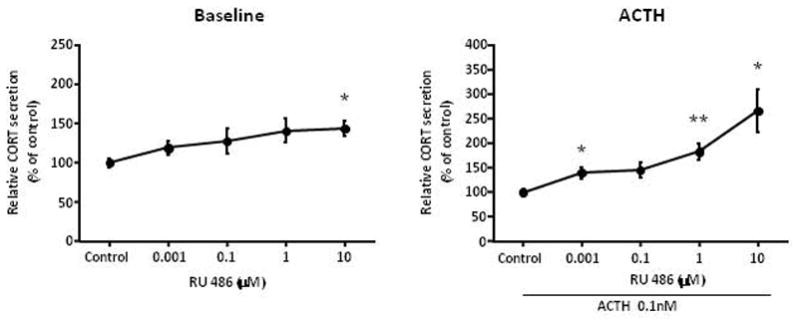
RU486 treatment stimulates corticosterone production in ACTH-stimulated zona fasciculata/reticularis cells from rats fed a low salt diet. Results show means ± SEM (n=8) and are expressed as percentage of secretion with controls set at 100%. * P < 0.05,** P < 0.005.
Figure 10
Figure 10
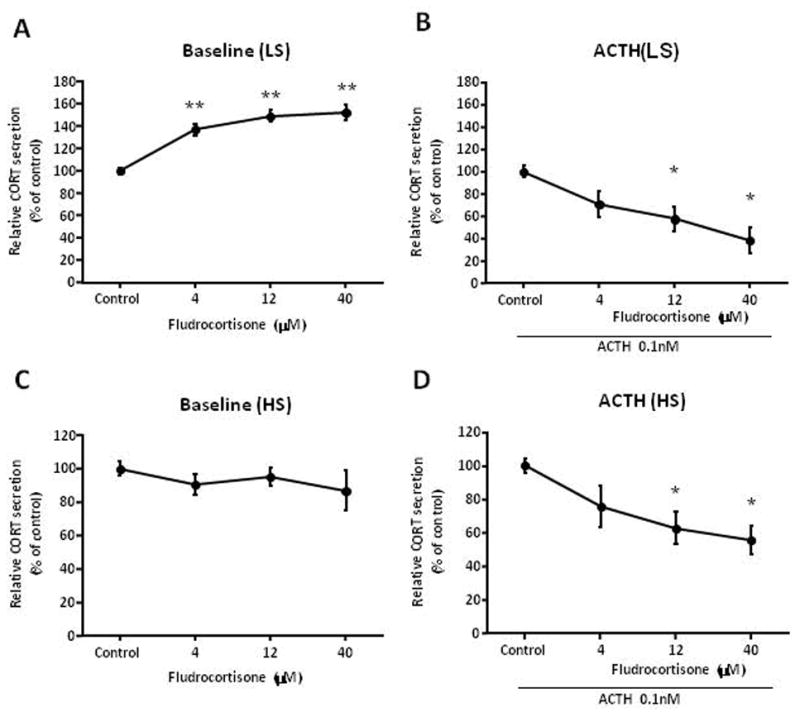
Effect of MR activation on corticosterone from low salt (LS, top panels) and high salt (HS, bottom panels) zona fasciculata/reticularis cells. Results are means ± SEM (n=6) and are expressed as percentage of secretion with controls set at 100%. * P < 0.05, ** P < 0.005.
Figure 11
Figure 11
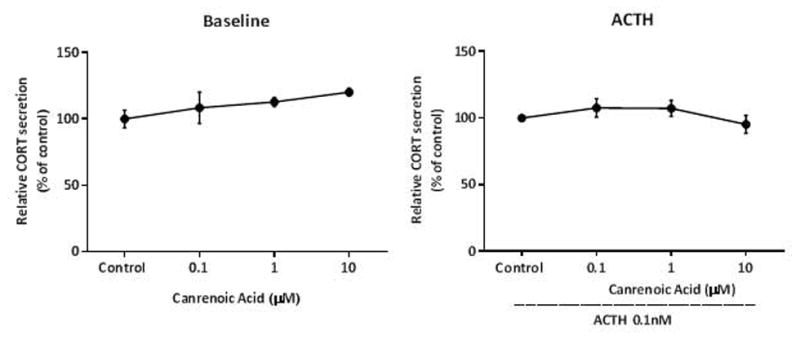
MR blockade with canrenoate did not alter corticosterone secretion in basal and ACTH-stimulated zona fasciculata/reticularis cells on low salt. Results are means ± SEM (n=6) and are expressed as percentage of secretion with controls set at 100%.

References

    1. Agarwal MK, Coupry F, Philippe M. Physiological activity and receptor binding of 9 alpha fluorohydrocortisone. Biochem Biophys Res Commun. 1977;78(2):747–753. - PubMed
    1. Aguilera G, Catt KJ. Loci of action of regulators of aldosterone biosynthesis in isolated glomerulosa cells. Endocrinology. 1979;104(4):1046–1052. - PubMed
    1. Arvat E, Maccagno B, Giordano R, Pellegrino M, Broglio F, Gianotti L, Maccario M, Camanni F, Ghigo E. Mineralocorticoid receptor blockade by canrenoate increases both spontaneous and stimulated adrenal function in humans. J Clin Endocrinol Metab. 2001;86(7):3176–3181. - PubMed
    1. Asser L, Hescot S, Viengchareun S, Delemer B, Trabado S, Lombes M. Autocrine positive regulatory feedback of glucocorticoid secretion: glucocorticoid receptor directly impacts H295R human adrenocortical cell function. Mol Cell Endocrinol. 2014;395(1–2):1–9. - PubMed
    1. Baird A, Kan KW, Solomon S. Androstenedione-mediated inhibition of 11 beta-hydroxylation in monolayer cell cultures of fetal calf adrenals. J Steroid Biochem. 1983;18(5):581–584. - PubMed