


More severe disease and slower recovery in younger patients with anti-3-hydroxy-3-methylglutaryl-coenzyme A reductase-associated autoimmune myopathy
- PMID: 28096458
- PMCID: PMC5850825
- DOI: 10.1093/rheumatology/kew470
More severe disease and slower recovery in younger patients with anti-3-hydroxy-3-methylglutaryl-coenzyme A reductase-associated autoimmune myopathy
Abstract
Objective: To study disease severity and response to therapy in a large cohort of patients with anti-hydroxy-3-methylglutaryl-coenzyme A reductase (HMGCR)-associated myositis.
Methods: Muscle strength, creatine kinase levels and treatments were assessed in anti-HMGCR-positive patients at each clinical visit. Univariate and multivariate analyses were used to analyse the influence of clinical characteristics on strength and the change in strength over time. Whole exome sequencing was performed in a subset of patients.
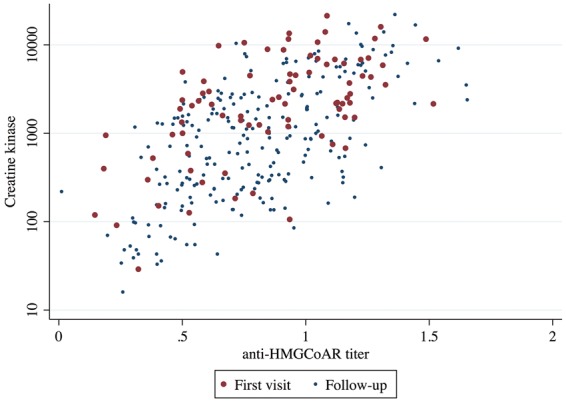
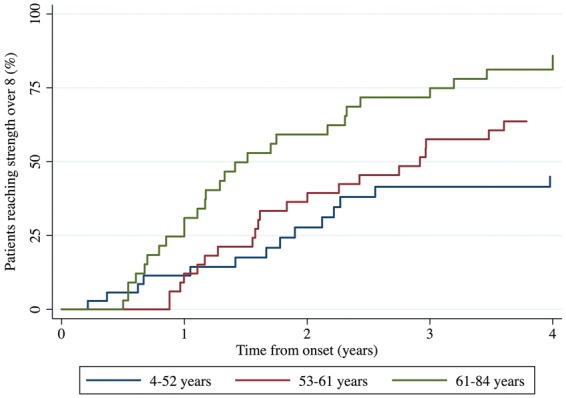
Results: . Among 50 patients followed for ⩾2 years, only 22 (44%) reached full strength with immunosuppressive therapy; even among those with full strength, 55% continued to have CK levels in excess of 500 IU/l and only three could be tapered off immunosuppressive therapy. Both univariate and multivariate analysis showed that patients who were older at disease onset were stronger at all time points (P < 0.001) and improved faster (P < 0.008) than younger patients; a history of statin exposure was not independently associated with the improvement rate. Younger patients were more likely to have refractory disease (P = 0.02) than older patients. Among eight refractory patients with DNA available for testing, whole exome sequencing did not reveal pathogenic mutations in known dystrophy genes. The risk of cancer was not increased in anti-HMGCR myositis patients compared with the general population.
Conclusions: Anti-HMGCR myositis is usually a chronic disease requiring long-term immunosuppression. Although younger patients had more severe disease and a worse prognosis than older patients, they did not have evidence of a known co-existing muscular dystrophy to explain their persistent, and sometimes progressive, muscle weakness.
Keywords: autoantibodies; myopathy; polymyositis.
© Published by Oxford University Press British Society for Rheumatology 2017. This work is written by US Government employees and is in the public domain in the United States.
Figures
References
-
- Mammen AL. Statin-associated autoimmune myopathy. N Engl J Med 2016;374:664–9. - PubMed
Publication types
MeSH terms
Substances
Grants and funding
LinkOut - more resources
Full Text Sources
Other Literature Sources
Medical
Research Materials
