. 2017 Jan 17;8(1):e01121-16.
doi: 10.1128/mBio.01121-16.

The Gut Microbiome of the Vector Lutzomyia longipalpis Is Essential for Survival of Leishmania infantum

Affiliations

The Gut Microbiome of the Vector Lutzomyia longipalpis Is Essential for Survival of Leishmania infantum

Patrick H Kelly et al. mBio. .

Abstract

The vector-borne disease leishmaniasis, caused by Leishmania species protozoa, is transmitted to humans by phlebotomine sand flies. Development of Leishmania to infective metacyclic promastigotes in the insect gut, a process termed metacyclogenesis, is an essential prerequisite for transmission. Based on the hypothesis that vector gut microbiota influence the development of virulent parasites, we sequenced midgut microbiomes in the sand fly Lutzomyia longipalpis with or without Leishmania infantum infection. Sucrose-fed sand flies contained a highly diverse, stable midgut microbiome. Blood feeding caused a decrease in microbial richness that eventually recovered. However, bacterial richness progressively decreased in L. infantum-infected sand flies. Acetobacteraceae spp. became dominant and numbers of Pseudomonadaceae spp. diminished coordinately as the parasite underwent metacyclogenesis and parasite numbers increased. Importantly, antibiotic-mediated perturbation of the midgut microbiome rendered sand flies unable to support parasite growth and metacyclogenesis. Together, these data suggest that the sand fly midgut microbiome is a critical factor for Leishmania growth and differentiation to its infective state prior to disease transmission.

Importance: Leishmania infantum, a parasitic protozoan causing fatal visceral leishmaniasis, is transmitted to humans through the bite of the sand fly Lutzomyia longipalpis Development of the parasite to its virulent metacyclic state occurs in the sand fly gut. In this study, the microbiota within the Lu. longipalpis midgut was delineated by 16S ribosomal DNA (rDNA) sequencing, revealing a highly diverse community composition that lost diversity as parasites developed to their metacyclic state and increased in abundance in infected flies. Perturbing sand fly gut microbiota with an antibiotic cocktail, which alone had no effect on either the parasite or the fly, arrested both the development of virulent parasites and parasite expansion. These findings indicate the importance of bacterial commensals within the insect vector for the development of virulent pathogens, and raise the possibility that impairing the microbial composition within the vector might represent a novel approach to control of vector-borne diseases.


Figures

FIG 1
FIG 1
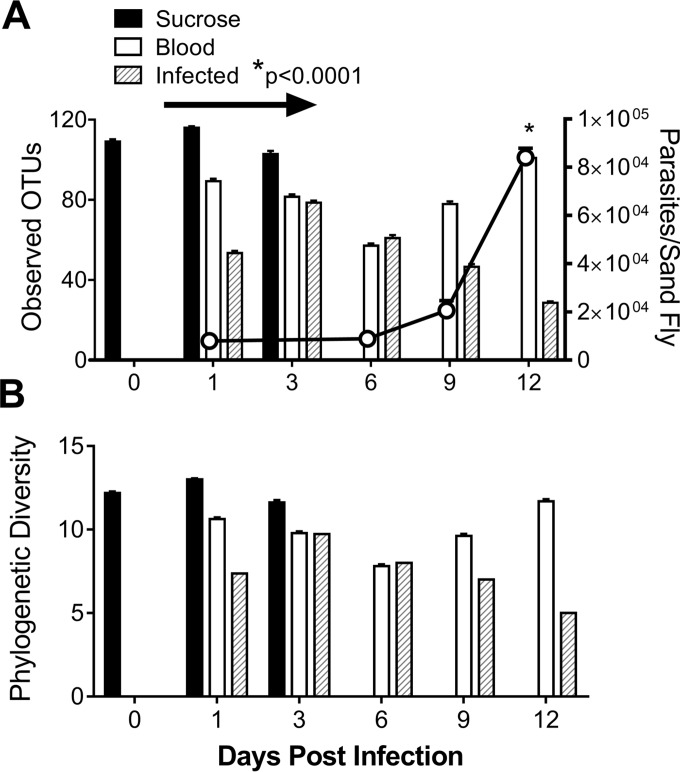
L. infantum parasite burden is inversely correlated with bacterial richness in infected sand fly midguts, measured in numbers of OTUs at the species (A) or phylum (B) level. (A) The total number of OTUs obtained by bacterial 16S rDNA sequencing of DNA derived from the gut of sand flies fed on different meals (bars, left y axis) was determined in triplicate pools of 20 sand fly midguts under each condition, in three separate biological replicate experiments. The parasite burden represents the mean of results of 3 separate experiments in which parasites in 10 infected flies from each condition were counted microscopically. Panel A (line graph, right y axis) shows the means ± standard errors (SE) of the results from 3 replicate experiments. *, 2-way ANOVA with Tukey posttest was performed between treatments over time. The arrow indicates the duration of detectable blood in sand flies fed on blood. (B) UniFrac diversity metric over time in each treatment group. Sucrose-fed flies were obtained for the day 0 to day 3 time points. Data for days 0 to 9 are from three independent experiments; data for day 12 are from two independent experiments. Each experiment included triplicate pools of 20 dissected sand fly midguts.
FIG 2
FIG 2
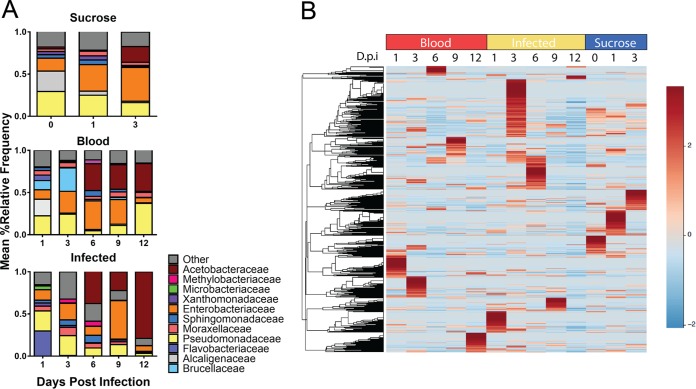
Temporal variation in the relative abundances of midgut OTUs. (A) Bar graphs represent the relative abundances of family-level OTUs in sand flies under each condition. OTUs representing >5% of the overall relative abundance under at least one condition are shown; OTUs that remained at less than 5% of the overall abundance under all conditions are pooled as “other.” (B) A heat map of species-level OTUs over time in all treatment groups, clustered by Euclidean distances, is shown. Data for days 0 to 9 are representative of three independent experiments; data for day 12 are from two independent experiments. Sequence data were obtained from the same 3 experiments described for Fig. 1.
FIG 3
FIG 3
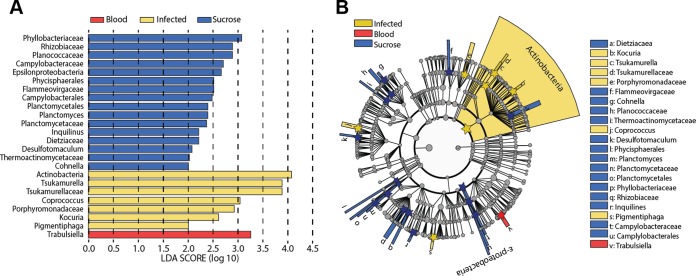
The “uniqueness” and divergence of the microbiome under each sand fly condition determined by linear discriminant analysis. (A) Multiple regression results for Fisher’s linear discriminant analysis (LDA) of microbiomes from each of the sand fly diets, utilizing discriminatory OTUs to define phylogenetic levels. LDA is used to determine the effect size and identify components of the bacterial kingdom microbiomes determining the “uniqueness” of each sand fly group. Colors indicate the fly condition of the phylogenetic component contributing to group uniqueness at an LDA score of >2.0. (B) Cladogram visualization of the LDA results from the experiment represented in panel A. Levels of the cladogram represent, from the inner to outer rings, phylum, class, order, family, and genus. Color codes indicate the condition, and letters indicate the taxa that contribute to the uniqueness of the corresponding sand fly group at an LDA of >2.0. Sequence data were obtained from the same 3 experiments described for Fig. 1.
FIG 4
FIG 4
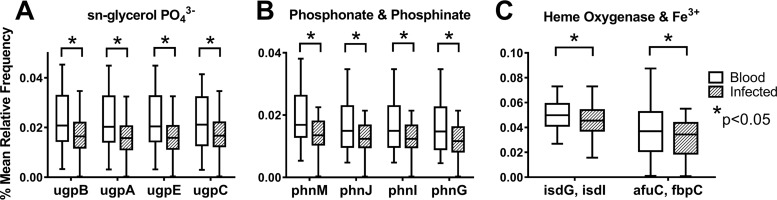
KEGG orthologs of the iron and phosphate ATP-binding cassette (ABC). Transport pathways differ between blood-fed and L. infantum-infected sand flies. (A to C) Box and whisker plots illustrate the predicted metagenomic content of ABC transport orthologs defined in KEGG. The functional metagenomes were calculated from OTUs with PICRUSt, and the ortholog content in the microbiomes of midguts from uninfected versus L. infantum-infected blood-fed sand fly midguts was determined by PICRUSt. Significant orthologs were selected by one-way ANOVA and the Tukey-Kramer posttest. All statistically significant pathways were determined using one-way ANOVA and the Tukey-Kramer posttest (*, P < 0.05). Data for uninfected and L. infantum-infected blood-fed sand flies include all samples from 1 to 12 dpi. Sequence data were obtained from the same 3 experiments described for Fig. 1.
FIG 5
FIG 5
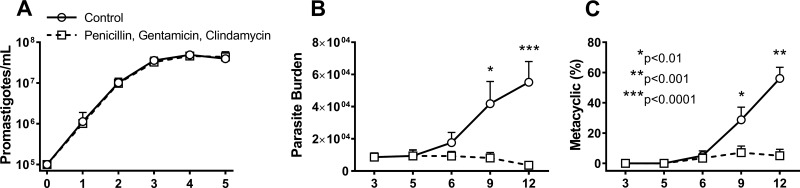
Antibiotic treatment of infected sand flies halts parasite survival and replication and development of metacyclic forms. (A) In vitro Leishmania infantum growth curve in the absence or presence of antibiotics. Data are representative of results from three independent replicates. (B and C) In vivo Leishmania infantum growth curve (B) and metacyclic parasite counts (C) in the absence and presence of antibiotics during sand fly infection over time. Data are representative of results of four independent biological replicates. Antibiotics included a cocktail of penicillin, gentamicin, and clindamycin. The arrow indicates the day of antibiotic treatment. Statistical analyses included Student’s t test (*, P < 0.01; **, P < 0.001; ***, P < 0.0001) and two-way ANOVA (***, P < 0.0001)

References

    1. World Health Organization 2016. Leismaniasis. http://www.who.int/topics/leishmaniasis/en/.
    1. Diniz SA, Silva FL, Carvalho Neta AC, Bueno R, Guerra RM, Abreu-Silva AL, Santos RL. 2008. Animal reservoirs for visceral leishmaniasis in densely populated urban areas. J Infect Dev Ctries 2:24–33. - PubMed
    1. Ready PD. 2013. Biology of phlebotomine sand flies as vectors of disease agents. Annu Rev Entomol 58:227–250. doi: 10.1146/annurev-ento-120811-153557. - DOI - PubMed
    1. Kamhawi S, Belkaid Y, Modi G, Rowton E, Sacks D. 2000. Protection against cutaneous leishmaniasis resulting from bites of uninfected sand flies. Science 290:1351–1354. doi: 10.1126/science.290.5495.1351. - DOI - PubMed
    1. Botelho AC, Mayrink W, Oliveira RC. 2009. Alterations in phenotypic profiles of peripheral blood cells from patients with human American cutaneous leishmaniasis following treatment with an antimonial drug and a vaccine. Acta Trop 112:143–148. doi: 10.1016/j.actatropica.2009.07.012. - DOI - PubMed

Publication types

LinkOut - more resources