The Relationship between Childhood Trauma and Suicidal Ideation: Role of Maltreatment and Potential Mediators
- PMID: 28096873
- PMCID: PMC5240465
- DOI: 10.4306/pi.2017.14.1.37
The Relationship between Childhood Trauma and Suicidal Ideation: Role of Maltreatment and Potential Mediators
Abstract
Objective: Childhood trauma is recognized as an important risk factor in suicidal ideation, however it is not fully understood how the different types of childhood maltreatment influence suicidal ideation nor what variables mediate the relationship between childhood trauma and suicidal ideation. This study examined the path from childhood trauma to suicidal ideation, including potential mediators.
Methods: A sample of 211 healthy adults completed the Childhood Trauma Questionnaire (CTQ), Beck scale for Suicidal Ideation (BSI), Functional Social Support Questionnaire (FSSQ) and Hospital Anxiety and Depression Scale (HADS). Path analysis was used to investigate the relationship among study variables.
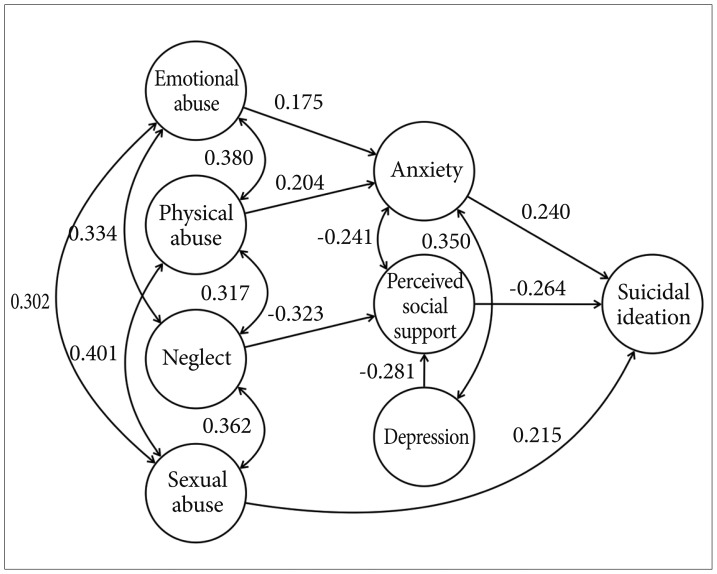
Results: Of the several types of childhood maltreatment we considered, only childhood sexual abuse directly predicted suicidal ideation (β=0.215, p=0.001). Childhood physical abuse (β=0.049, 95% confidence interval: 0.011-0.109) and childhood emotional abuse (β=0.042, 95% confidence interval: 0.001-0.107) indirectly predicted suicidal ideation through their association with anxiety. Childhood neglect indirectly predicted suicidal ideation through association with perceived social support (β=0.085, 95% confidence interval: 0.041-0.154).
Conclusion: Our results confirmed that childhood sexual abuse is a strong predictor of suicidal ideation. Perceived social support mediated the relationship between suicidal ideation and neglect. Anxiety fully mediated the relationship between suicidal ideation and both physical abuse and emotional abuse. Interventions to reduce suicidal ideation among survivors of childhood trauma should focus on anxiety symptoms and attempt to increase their social support.
Keywords: Anxiety; Childhood traumatic experience; Perceived social support; Sexual abuse; Suicidal ideation.
Figures
References
-
- King RA, Schwab-Stone M, Flisher AJ, Greenwald S, Kramer RA, Goodman SH, et al. Psychosocial and risk behavior correlates of youth suicide attempts and suicidal ideation. J Am Acad Child Adolesc Psychiatry. 2001;40:837–846. - PubMed
-
- Lester D. Why People Kill Themselves: A 1990s Summary of Research Findings on Suicidal Behavior. Springfield, IL, England: Charles C Thomas, Publisher; 1992.
-
- Gould MS, King R, Greenwald S, Fisher P, Schwab-Stone M, Kramer R, et al. Psychopathology associated with suicidal ideation and attempts among children and adolescents. J Am Acad Child Adolesc Psychiatry. 1998;37:915–923. - PubMed
LinkOut - more resources
Full Text Sources
Other Literature Sources